.jpeg)
Pegloticase (Krystexxa) Complete Medication Guide
1.Standard Dosage Regimen
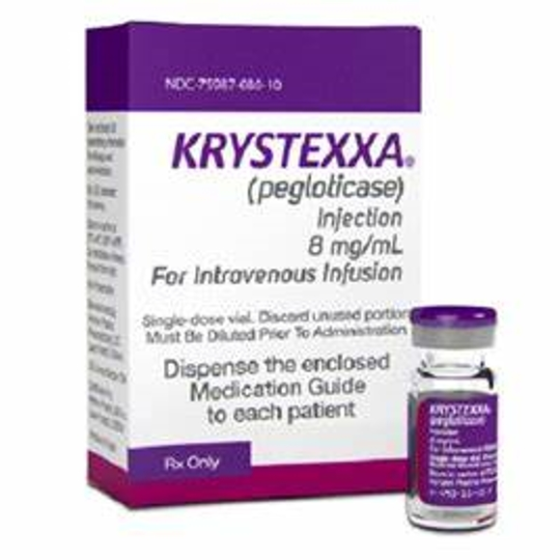
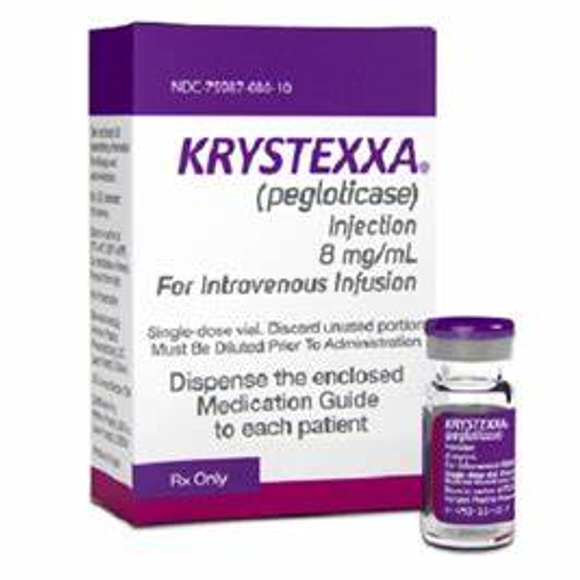
Pegloticase is indicated for the treatment of refractory chronic gout in patients who have failed conventional urate-lowering therapy,have serum uric acid levels persistently above 6mg/dL,and present with tophi or frequent gout flares.The standard recommended dose is 8mg/kg administered by intravenous infusion every 2 weeks,with each infusion lasting no less than 2 hours.A standard treatment course consists of 12 infusions over 6 months.Regarding pricing,the cost of the original brand medication(8mg/mL per vial)varies by region worldwide,and no generic versions are currently available.
2.Pre-Infusion Preparation
To significantly reduce the risk of infusion reactions,all patients must receive pre-medication 30 minutes before each infusion.The standard pre-medication regimen includes:
Acetaminophen 650mg orally
Antihistamine:Diphenhydramine 25-50mg orally or intravenously
Corticosteroid:Methylprednisolone 40mg intravenously or Dexamethasone 10mg intravenously
For patients with a history of severe infusion reactions,pre-treatment with oral prednisone 20mg once daily for 3 days,starting the day before infusion,may be considered for enhanced prophylaxis.
3.Infusion Procedure
Establish intravenous access,preferably using a large-bore catheter(20G or larger).A 0.2μm in-line filter must be used during the entire infusion.
Calculate the required dose accurately:Patient weight(kg)×8mg.Withdraw the corresponding volume of pegloticase concentrate(8mg per 1mL)and dilute it to 250mL with 0.9%sodium chloride injection.Gently invert the infusion bag to mix;do not shake vigorously as this may damage the drug structure.
Administer using a stepwise infusion rate:
Initial rate:20mL/h(approximately 0.3mL/min)for the first 30 minutes;
If no adverse reactions occur,increase the rate to 40mL/h for the next 30 minutes;
Finally,increase the rate to 80mL/h until the infusion is complete.Total infusion time is approximately 2-3 hours.
During the infusion,healthcare providers should monitor the patient's vital signs,including blood pressure,heart rate,respiratory rate,and oxygen saturation,every 15 minutes.
After the infusion is completed,the patient must be observed in the hospital for at least 1 hour to confirm no delayed reactions occur before discharge.
4.Graded Management of Infusion Reactions
Infusion reactions are the most common adverse events associated with pegloticase treatment and should be managed according to their severity:
Mild reactions(chills,rash,headache):Immediately reduce the infusion rate by half and administer diphenhydramine 25mg intravenously.Once symptoms have completely resolved,the infusion may be continued at the adjusted rate.
Moderate reactions(mild hypotension,dyspnea):Immediately stop the infusion and administer dexamethasone 10mg and diphenhydramine 50mg intravenously.Once symptoms have completely resolved,restart the infusion at an initial rate of 20mL/h.
Severe reactions(severe hypotension,laryngeal edema,altered mental status):Immediately discontinue the infusion,rapidly administer epinephrine 0.3-0.5mg intramuscularly and methylprednisolone 100mg intravenously,and provide oxygen support.Transfer to the intensive care unit if necessary.Patients who experience severe infusion reactions should permanently discontinue pegloticase.
5.Efficacy Assessment and Discontinuation Principles
Serum uric acid levels should be measured before each infusion during treatment.If two consecutive measurements are above 6mg/dL(typically occurring between weeks 6 and 10 of treatment),this indicates the development of anti-drug antibodies,and treatment should be discontinued immediately as further therapy will be ineffective.
After completing the 12-infusion standard course,if the patient's serum uric acid remains consistently below 6mg/dL and tophi have significantly reduced,the patient may switch to combination oral urate-lowering therapy for maintenance.If uric acid levels remain above target,continued maintenance therapy with infusions every 2 weeks may be considered.
6.Special Populations
Renal impairment:No dose adjustment is required for patients with mild to severe renal impairment.However,fluid status should be closely monitored during treatment.
Elderly patients(65 years and older):No initial dose adjustment is generally required.However,elderly patients have a slightly higher risk of infusion reactions compared to younger patients and require closer monitoring during treatment.
G6PD deficiency:Pegloticase is contraindicated in patients with G6PD deficiency.The rapid breakdown of uric acid by pegloticase produces hydrogen peroxide,which may induce severe hemolytic reactions in these patients.
7.Patient Education and Follow-Up
Patients should keep a detailed record of any adverse reactions after each infusion to inform their healthcare provider at the next visit.Prophylactic medication to prevent acute gout flares is required during treatment,with options including colchicine 0.6mg once daily or naproxen 250mg twice daily.Prophylaxis should be continued for 3-6 months.
During follow-up,patients should undergo complete blood count,liver function tests,and serum uric acid measurements every 3 months to timely assess treatment efficacy and safety.
[ 免责声明 ] 本页面内容来自公开渠道(如FDA官网、Drugs官网、原研药厂官网等),仅供持有医疗专业资质的人员用于医学药学研究参考,不构成任何治疗建议或药品推荐。所涉药品可能未在中国大陆获批上市,不适用于中国境内销售和使用。如需治疗,请咨询正规医疗机构。本站不提供药品销售或代购服务。