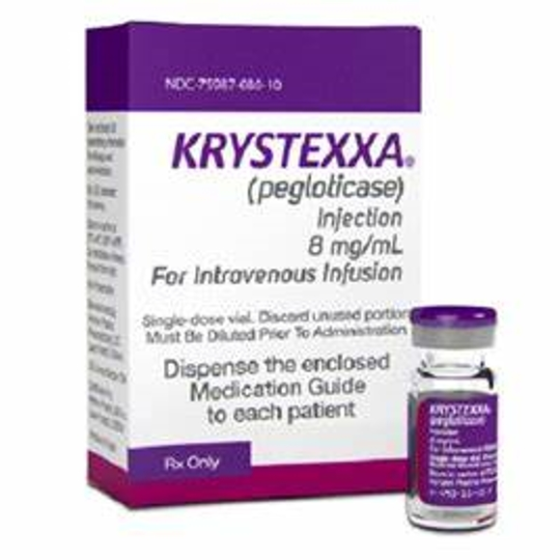
.jpeg)
Management Strategies and Long-Term Outcomes Following 6 Months of Pegloticase (Krystexxa) Therapy
1.Efficacy Assessment After Initial Course
The standard initial treatment regimen for Pegloticase(Krystexxa)spans 6 months,involving 12 bi-weekly infusions.Phase III clinical trial data indicates that approximately 40%of patients who complete this course achieve the primary endpoint of maintaining serum uric acid levels below 6 mg/dL.For these responders,tophi volume shrinks by an average of over 80%,and the frequency of gout flares decreases by 90%.
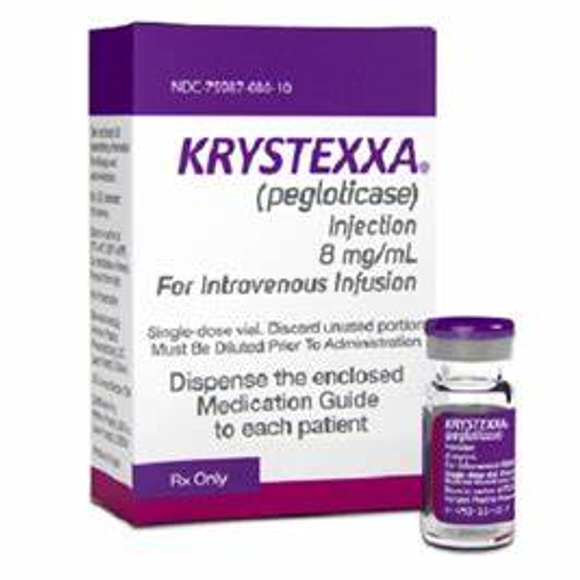
2.Post-Treatment Maintenance Strategies
Serum uric acid levels typically rebound to baseline within 4 to 8 weeks after discontinuation.Therefore,for patients requiring continued control after 6 months,clinicians generally adopt one of two strategies:
The first is to continue maintenance infusions every two weeks for up to 12 months or longer.Real-world evidence shows an 85%responder retention rate at 12 months.
The second strategy involves transitioning to oral urate-lowering therapy(ULT)two weeks after the last Pegloticase dose.A combination regimen of Febuxostat(40–80 mg daily)and Allopurinol(300 mg daily)allows approximately 60%of patients to maintain serum uric acid below 6 mg/dL for at least six months.
3.Long-Term Management and Antibody Monitoring
Patients continuing therapy require regular monitoring of serum uric acid and anti-drug antibodies(ADAs).Notably,about 50%of patients develop ADAs within one year,which can lead to loss of response.A rise in serum uric acid above 6 mg/dL often signals ADA-mediated inactivation,necessitating discontinuation of Pegloticase.
4.Safety and Adverse Event Follow-Up
Beyond the 6-month mark,infusion reactions remain the most common adverse event,occurring in about 20%of cases,though these are mostly Grade 1 or 2.No new safety signals have been identified with extended use beyond 12 months.While rapid urate lowering frequently triggers flares early in treatment(requiring prophylaxis like colchicine),flare frequency significantly diminishes after 6 months.
5.Cost Considerations and Access
Treatment costs are substantial;based on US market pricing,a single vial is priced around$20,000 USD,bringing the total cost for a 6-month course to approximately$200,000–$240,000 USD.Consequently,continued therapy is only feasible for patients with significant financial resources.For others,switching to oral maintenance therapy is the recommended alternative.
6.Conclusion
In summary,maintaining efficacy after 6 months of Pegloticase hinges on the absence of ADAs.Regular monitoring of serum uric acid and ADA levels is paramount.For patients unable to afford prolonged biologic therapy,transitioning to combination oral ULT remains a rational and effective management path.
[ 免责声明 ] 本页面内容来自公开渠道(如FDA官网、Drugs官网、原研药厂官网等),仅供持有医疗专业资质的人员用于医学药学研究参考,不构成任何治疗建议或药品推荐。所涉药品可能未在中国大陆获批上市,不适用于中国境内销售和使用。如需治疗,请咨询正规医疗机构。本站不提供药品销售或代购服务。