.jpeg)
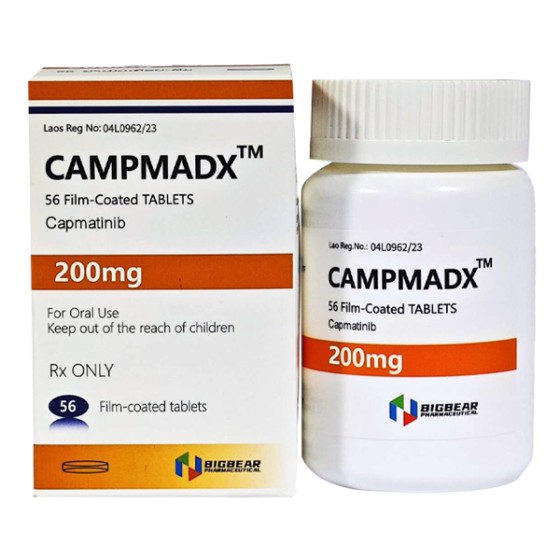
Capmatinib for MET Exon 14 Non-Small Cell Lung Cancer
Capmatinib is an oral kinase inhibitor that primarily targets the MET(mesenchymal-epithelial transition)receptor tyrosine kinase.Targeted therapy first identifies a driver alteration in the tumor and then blocks the corresponding signaling pathway to reduce proliferation,survival,migration,and metastasis while limiting unnecessary damage to normal cells.For appropriately selected tumors,this makes treatment more precise than non-selective approaches.
In NSCLC,MET exon 14 skipping removes a regulatory region that normally helps degrade the MET receptor,leading to sustained MET activation and oncogenic signaling.Although this alteration accounts for a minority of NSCLC cases,it is clinically important because it defines a treatable driver subset.Confirmation usually requires validated tissue or liquid-based genomic testing before therapy.
The FDA label approves capmatinib for adults with metastatic NSCLC whose tumors have a mutation leading to MET exon 14 skipping detected by an FDA-approved test.Broader treatment planning should still consider EGFR/ALK status,stage,brain metastases,prior therapy,performance status,and toxicity risk.NCCN 2026 NSCLC guidance lists capmatinib and tepotinib as preferred first-line MET-TKI options for advanced or metastatic MET exon 14 NSCLC;crizotinib is useful only in certain circumstances,and switching between similar ME T-TKIs at progression is not recommended.
For dosing and safety,the standard regimen is capmatinib 400 mg orally twice daily,with or without food,as whole tablets.In GEOMETRY mono-1,treatment-naïve patients with MET exon 14 metastatic NSCLC had an objective response rate of about 68%,and previously treated patients about 44%;median duration of response was approximately 16.6 months in the naïve group and 9.7 months in the pretreated group.Common adverse events include edema,nausea,musculoskeletal pain,fatigue,vomiting,dyspnea,cough,and decreased appetite.Laboratory issues may involve transaminases,amylase,lipase,creatinine,and albumin.Key safety priorities are interstitial lung disease/pneumonitis,hepatotoxicity,pancreatic toxicity,hypersensitivity,photosensitivity,and embryo-fetal toxicity.New or worsening dyspnea,cough,or fever requires prompt evaluation for ILD;suspected ILD generally leads to permanent discontinuation if no alternative cause is found.Avoid strong or moderate CYP3A inducers;use strong CYP3A inhibitors cautiously with closer toxicity monitoring.Initiation,interruption,or dose reduction should always follow confirmed genomic results and specialist assessment.
[ 免责声明 ] 本页面内容来自公开渠道(如FDA官网、Drugs官网、原研药厂官网等),仅供持有医疗专业资质的人员用于医学药学研究参考,不构成任何治疗建议或药品推荐。所涉药品可能未在中国大陆获批上市,不适用于中国境内销售和使用。如需治疗,请咨询正规医疗机构。本站不提供药品销售或代购服务。