.jpeg)
Encorafenib (Braftovi): Comprehensive Guide to BRAF V600 Inhibitor Indications, Dose Regimens by Tumor Type, and Administration Requirements
1.Drug Positioning and BRAF V600 Targeting Mechanism
Encorafenib(brand name:Braftovi)is a highly selective,orally administered inhibitor of mutant BRAF serine/threonine kinase,specifically targeting BRAF V600E and V600K variants.Oncogenic mutations at the V600 position of BRAF cause constitutive activation of the MAPK/ERK signaling cascade,driving uncontrolled tumor cell proliferation.Encorafenib competitively occupies the ATP-binding site of mutant BRAF protein,effectively blocking downstream MEK-ERK signal transduction,suppressing tumor growth,and inducing apoptosis.In clinical practice,encorafenib is never administered as monotherapy;it is combined with the MEK inhibitor binimetinib or the anti-EGFR monoclonal antibody cetuximab to achieve vertical pathway blockade or counteract feedback-loop reactivation,thereby enhancing antitumor efficacy while reducing cutaneous toxicities associated with single-agent RAF inhibition.
2.Approved Indications and Mandatory Genetic Testing
Per the prescribing information,encorafenib carries three approved indications.First:in combination with binimetinib for adult patients with unresectable or metastatic melanoma harboring BRAF V600E or V600K mutations.Second:in combination with cetuximab for adult patients with BRAF V600E-mutant metastatic colorectal cancer who have received prior systemic therapy.Third:in combination with binimetinib for adult patients with BRAF V600E-mutant metastatic non-small cell lung cancer(NSCLC).
An absolute prerequisite for all indications is confirmation of the relevant BRAF V600E or V600K mutation in tumor tissue using a validated,regulatory-approved diagnostic assay prior to initiating therapy.Encorafenib is contraindicated in BRAF wild-type patients or those with unknown mutation status,as inappropriate use may paradoxically activate RAF signaling and accelerate tumor progression.
3.Adverse Effect Profile and Serious Risk Warnings
The most common adverse reactions associated with encorafenib include fatigue(approximately 50%),nausea(approximately 40%),rash(approximately 30%),diarrhea(approximately 30%),arthralgia(approximately 20%),and hyperkeratosis(approximately 20%).Among Grade 3 or higher events,fatigue,hypertension,and rash are the most frequently observed.
Three categories of serious risks require particular vigilance.First,cutaneous squamous cell carcinoma and other new primary skin malignancies:comprehensive dermatologic examinations should be performed at baseline,every two months during treatment,and for up to six months after discontinuation.Second,hepatotoxicity:liver function tests should be monitored regularly;significant transaminase elevations warrant dose interruption and clinical evaluation.Third,QTc prolongation:patients with pre-existing cardiac conditions or those receiving concurrent QTc-prolonging medications require enhanced electrocardiographic monitoring.When combined with binimetinib,the incidence of musculoskeletal pain and diarrhea may increase further.If symptoms of interstitial lung disease or pneumonitis develop(new or worsening dyspnea,cough,fever),both encorafenib and binimetinib must be permanently discontinued.
4.Melanoma and NSCLC:Combination with Binimetinib—Dosing Schedule
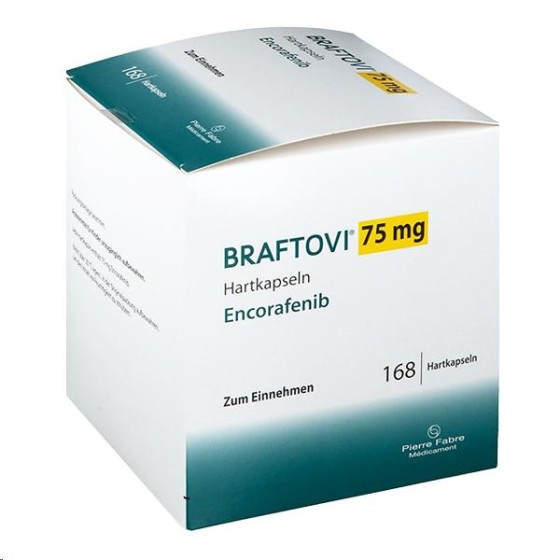
For unresectable or metastatic melanoma and BRAF V600E-mutant metastatic NSCLC,encorafenib is administered in combination with binimetinib.The recommended dose of encorafenib is 450 mg orally once daily(six 75 mg capsules per dose);binimetinib is given at 45 mg orally twice daily(morning and evening).The once-daily dosing design for encorafenib significantly reduces pill burden and supports long-term treatment adherence.
Dose reduction pathway for encorafenib in the event of adverse reactions:first reduction to 300 mg once daily(four capsules),second reduction to 225 mg once daily(three capsules).Binimetinib is correspondingly reduced to 30 mg twice daily.If toxicity remains intolerable after two reductions,permanent discontinuation is required.
5.Metastatic Colorectal Cancer:Combination with Cetuximab—Dosing Schedule
For BRAF V600E-mutant metastatic colorectal cancer,encorafenib is combined with cetuximab.The recommended dose of encorafenib is 300 mg orally once daily(four 75 mg capsules per dose).Cetuximab is administered intravenously per standard protocol:an initial loading dose of 400 mg/m²,followed by weekly maintenance infusions of 250 mg/m².
Notably,the encorafenib dose in the colorectal cancer indication(300 mg)is intentionally lower than in melanoma and NSCLC(450 mg),reflecting a deliberate balance between efficacy and tolerability in this patient population.If dose modification is needed,encorafenib may be reduced to 225 mg once daily(first reduction)or 150 mg once daily(second reduction);further intolerance warrants permanent discontinuation.
6.Administration Timing and Dietary Considerations
Encorafenib pharmacokinetics are not significantly affected by food;patients may take the medication on an empty stomach or with meals.The key recommendation is to take the dose at a consistent time each day(for example,with breakfast)to maintain steady-state plasma concentrations and minimize peak-trough fluctuations that could compromise efficacy or increase toxicity.If a patient chooses to take encorafenib with food,consistent meal patterns should be maintained to reduce inter-day variability in drug exposure.
Capsules must be swallowed whole with an adequate volume of water;crushing,chewing,or opening the capsule shell is prohibited.In the event of a missed dose,the patient should take it as soon as remembered that same day;however,if fewer than 12 hours remain before the next scheduled dose,the missed dose should be skipped and the regular schedule resumed.Doubling up on doses is not permitted.
7.Drug Interaction Management
Encorafenib is predominantly metabolized by hepatic CYP3A4.Co-administration with strong CYP3A4 inhibitors(such as itraconazole,ketoconazole,clarithromycin,or ritonavir)may significantly elevate encorafenib plasma concentrations,increasing toxicity risk;dose reduction of encorafenib or substitution of the interacting agent should be considered.Co-administration with strong CYP3A4 inducers(such as rifampin,phenytoin,carbamazepine,or St.John's Wort)may substantially reduce encorafenib exposure and compromise efficacy;concurrent use should be avoided.Grapefruit and grapefruit juice must be strictly avoided during treatment.Additionally,when encorafenib is used alongside known QTc-prolonging agents(certain antiarrhythmics,fluoroquinolone antibiotics),the frequency of ECG monitoring should be increased.
8.Special Population Guidance
Elderly patients(aged 65 and above):No starting dose adjustment is required;however,given the elevated baseline risk of skin malignancies and cardiovascular events in this population,enhanced dermatologic surveillance and ECG monitoring are recommended.Hepatic impairment:No dose adjustment is necessary for mild to moderate hepatic impairment;data are insufficient for severe hepatic impairment,and use is not recommended.Renal impairment:Available data do not indicate a need for dose adjustment.Pregnancy and lactation:Encorafenib is embryotoxic and contraindicated during pregnancy and breastfeeding;women of reproductive potential must use highly effective contraception during treatment and for at least two weeks after the final dose.Pediatric patients:Safety and efficacy have not been established;no dosing recommendation is available.
[ 免责声明 ] 本页面内容来自公开渠道(如FDA官网、Drugs官网、原研药厂官网等),仅供持有医疗专业资质的人员用于医学药学研究参考,不构成任何治疗建议或药品推荐。所涉药品可能未在中国大陆获批上市,不适用于中国境内销售和使用。如需治疗,请咨询正规医疗机构。本站不提供药品销售或代购服务。