.jpeg)
Adagrasib (Krazati) for KRAS G12C: NSCLC Dosing, Titration, and CRC Regulatory Update
1.Position and Patient Selection
Adagrasib(Krazati)is a small-molecule oral irreversible KRAS G12C inhibitor.It locks mutant KRAS G12C in the GDP-bound state and blocks downstream RAF–MEK–ERK proliferative signaling.Use only after validated testing confirms KRAS G12C;it is not indicated for G12D,G12V,G13D,other KRAS alterations,or KRAS wild-type tumors.
Non-small cell lung cancer has the most established evidence.Colorectal,pancreatic,biliary,and other solid tumors are considered only in selected pretreated populations or trials.Long half-life and central nervous system penetration make brain-metastatic NSCLC suitable for specialist evaluation,not self-initiation.
2.Approvals and Regulatory Update
NSCLC:FDA accelerated approval in 2022 for adults with locally advanced or metastatic KRAS G12C NSCLC and prior systemic therapy;confirmatory NSCLC data further support the pretreated setting.
Colorectal cancer:accelerated approval previously covered adagrasib plus cetuximab after fluoropyrimidine,oxaliplatin,and irinotecan-based chemotherapy.The confirmatory KRYSTAL-10 trial versus chemotherapy did not meet PFS or OS co-primary endpoints:median PFS 7.5 vs 8.1 months and OS 21.6 vs 21.7 months,although ORR was 47%vs 16%.Because surrogate response did not convert into survival superiority,current colorectal use—monotherapy or with cetuximab,and in which line—should follow the newest prescribing information,local regulatory status,and oncology judgment;it should not be treated as a routine standard without confirmation.
Other tumors:trial or multidisciplinary case discussion only.
3.Standard Dosing and Administration
Dose:adagrasib 600mg orally twice daily for NSCLC monotherapy and for CRC combination with cetuximab per protocol.
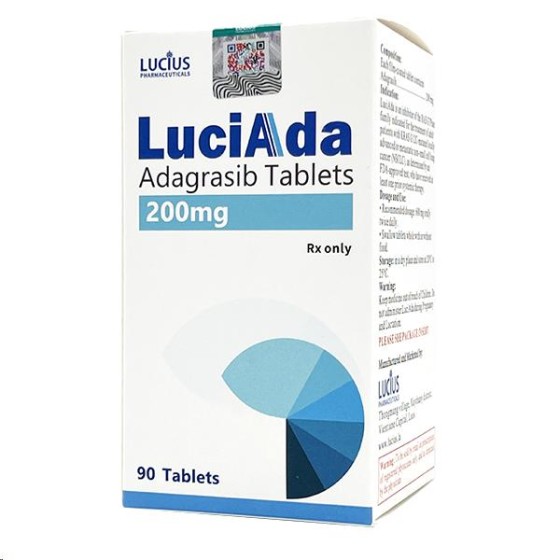
Administration:swallow tablets whole with water;do not chew,crush,or split.With or without food,at fixed times.Common strength 200mg;600mg equals three tablets.
Duration:continue until progression or unacceptable toxicity.Assess response by RECIST plus symptoms,repeat molecular testing when appropriate,and brain imaging if CNS disease is present.
Missed dose:if more than 4 hours remain before the next dose,take the missed dose;if 4 hours or less,skip and resume the schedule.Do not double.
Vomiting:do not replace the dose;give the next scheduled dose.
Special populations:mild-moderate hepatic or renal impairment rarely requires routine change solely for function,but severe abnormality,jaundice,or markedly reduced eGFR needs individualization.Avoid in pregnancy and lactation;use effective contraception in people with reproductive potential.
4.Adverse Events and Dose Modification
Common any-grade events include diarrhea,nausea,vomiting,fatigue,decreased appetite,musculoskeletal pain,edema,dizziness,transaminase elevation,dyspnea,cough,and QTc prolongation.Laboratory issues include lymphopenia,ALT/AST rise,lipase/amylase rise,anemia/thrombocytopenia,and electrolyte disturbances.
Toxicity-based taper:
First reduction:600mg twice daily→400mg twice daily.
Second reduction:400mg twice daily→600mg once daily.
If 600mg once daily is still intolerable,or with severe hepatotoxicity,persistent≥grade 2 drug-induced ILD,marked QTc prolongation with arrhythmia,or severe pancreatic/renal injury,discontinue.
Key safety rules:
GI:diarrhea/nausea/vomiting—hydration,antidiarrheals,antiemetics;hold and taper for grade 3–4 or dehydration.
Hepatotoxicity:baseline and monthly LFTs for the first 3 months,then clinically;ALT/AST with concurrent bilirubin rise suggests drug-induced liver injury—stop and evaluate.
QTc:baseline and on-treatment ECG,potassium,magnesium;avoid known QT-prolonging drugs when possible;congenital long QT,uncontrolled heart failure,significant bradyarrhythmia,or marked QTc prolongation require withholding/permanent stop per severity.
ILD/pneumonitis:new or worsening cough,dyspnea,chest pain,hypoxia—hold adagrasib,image,exclude infection;confirm drug-induced ILD with no alternative cause and discontinue permanently.
Interactions:adagrasib affects CYP3A and transporters;strong CYP3A inhibitors raise exposure,strong inducers lower it;review narrow-therapeutic-index CYP3A substrates,some P-gp drugs,azoles,antiepileptics,certain antibiotics,and herbal products.
5.Key Trial Data
KRYSTAL-1 NSCLC monotherapy:about 112–116 pretreated KRAS G12C advanced NSCLC patients,600mg twice daily;ORR about 42.9%–43%,median DoR about 8.5 months,median PFS about 6.5 months;intracranial ORR about 33%in baseline brain-metastasis subgroup.
KRYSTAL-12 NSCLC confirmatory:versus chemotherapy met PFS primary endpoint,HR about 0.58,supporting pretreated NSCLC positioning.
KRYSTAL-1 CRC plus cetuximab:accelerated-approval phase ORR about 34%,median PFS about 6.9 months,median OS about 15.9 months,DoR about 5.8 months.
KRYSTAL-10 CRC confirmatory:461 pretreated KRAS G12C metastatic colorectal cancer patients,adagrasib plus cetuximab vs chemotherapy;PFS 7.5 vs 8.1 months(HR 0.89,p≈0.32),OS 21.6 vs 21.7 months(HR 0.83,p≈0.09),ORR 47%vs 16%,CR 7%vs<1%,grade≥3 treatment-related AEs 46%vs 55%.Objective shrinkage favored the combination,but PFS/OS superiority was not shown,making this the core basis for colorectal indication re-evaluation.
6.Concise FAQ
Q1 Without KRAS G12C?Do not use;the drug targets G12C specifically,and other KRAS alterations or wild-type disease are unlikely to benefit.
Q2 Diarrhea/nausea?Grade 1–2:hydration,antidiarrheal/antiemetic,monitor.Persistent,severe,or dehydrating:hold adagrasib and taper by toxicity grade.
Q3 Transaminase elevation?Mild ALT/AST rise:repeat and monitor.With bilirubin rise,INR abnormality,or symptomatic hepatitis:stop and obtain hepatology/oncology review.
Q4 Brain metastases?Can be considered.CNS penetration exists,but decide with brain imaging,neurologic status,systemic control,and prior radiation.
Q5 Colorectal now?Do not use as automatic standard.After KRYSTAL-10 missed survival endpoints,follow the newest label and local regulation;heavily pretreated patients may be discussed for trials or MDT case review with cetuximab,not self-prescribed.
[ 免责声明 ] 本页面内容来自公开渠道(如FDA官网、Drugs官网、原研药厂官网等),仅供持有医疗专业资质的人员用于医学药学研究参考,不构成任何治疗建议或药品推荐。所涉药品可能未在中国大陆获批上市,不适用于中国境内销售和使用。如需治疗,请咨询正规医疗机构。本站不提供药品销售或代购服务。