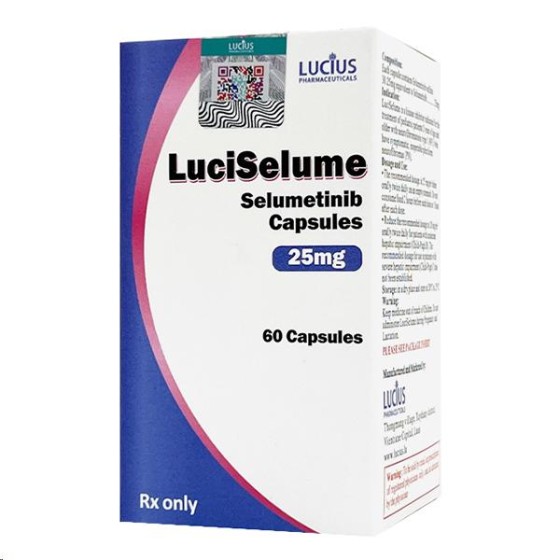
.jpeg)
Selumetinib: The First MEK1/2 Inhibitor Approved for Inoperable Plexiform Neurofibromas in NF1
Neurofibromatosis Type 1(NF1)is an autosomal dominant genetic disorder caused by pathogenic variants in the NF1 gene,affecting approximately 1 in 3,000 individuals worldwide.Plexiform neurofibromas(PN)represent one of the most clinically challenging manifestations of NF1,occurring in approximately 30%to 50%of patients during their lifetime.These tumors grow diffusely along nerves and their branches,frequently intertwining with critical neurovascular structures and surrounding tissues,rendering complete surgical resection highly risky or entirely infeasible.For decades,patients with symptomatic,inoperable PN had no effective pharmacological treatment options.The approval of selumetinib(brand name Koselugo)marked a transformative milestone in addressing this unmet medical need.
Mechanism of Action:Precision Targeting of the RAS/MAPK Pathway.The NF1 gene encodes neurofibromin,a GTPase-activating protein that negatively regulates RAS signaling by accelerating the hydrolysis of RAS-GTP to RAS-GDP.Loss-of-function mutations in NF1 result in constitutive RAS activation,leading to hyperactivation of the downstream RAF-MEK-ERK signaling cascade that drives abnormal cellular proliferation and survival.Selumetinib is an oral,highly selective,non-ATP-competitive inhibitor of MEK1 and MEK2.By blocking MEK1/2 kinase activity,selumetinib effectively reduces downstream ERK phosphorylation and suppresses the aberrant signaling caused by NF1 deficiency.Unlike conventional chemotherapy that indiscriminately targets rapidly dividing cells,selumetinib represents a precision-targeted approach that addresses the molecular root cause of tumor growth.
Approved Indication and Eligible Population.Selumetinib is approved for the treatment of symptomatic,inoperable plexiform neurofibromas in NF1 patients aged 1 year and older,encompassing both pediatric and adult populations.Importantly,not all PN patients are candidates for selumetinib therapy.Eligibility requires clinical and imaging confirmation that the PN cannot be safely and completely resected—typically due to deep anatomical location,intimate involvement with critical neurovascular structures,or diffusely infiltrative growth pattern—combined with clinically meaningful symptoms such as pain,motor or sensory impairment,significant disfigurement,or compression of the airway or gastrointestinal tract.The decision to initiate therapy should be made by a multidisciplinary team experienced in NF1 management.
KOMET Trial:The First Global Randomized Phase 3 Study.Prior to approval,selumetinib's efficacy was primarily supported by the phase 2 SPRINT trial.The KOMET study,a global,randomized,multicenter,double-blind,placebo-controlled phase 3 trial,provided high-level evidence further validating selumetinib's therapeutic benefit.The trial enrolled NF1 patients with PN that could not be safely and completely resected due to location,invasiveness,or proximity to vital structures,randomized to receive selumetinib or placebo.
Results demonstrated that the overall response rate(ORR)in the selumetinib arm was significantly higher than in the placebo arm.Among responders in the selumetinib group,the majority achieved durable responses lasting a clinically meaningful duration,confirming that the observed tumor shrinkage represented substantive and sustained efficacy rather than transient imaging fluctuations.These findings were consistent with the durable response patterns observed in the earlier SPRINT study,further solidifying selumetinib's position in the management of inoperable PN.
Efficacy Assessment Beyond Tumor Volume.For NF1-associated plexiform neurofibromas,evaluating treatment benefit solely through imaging-based tumor shrinkage provides an incomplete picture.PN imposes multidimensional clinical burdens:persistent or intermittent pain,restricted limb mobility,sensory deficits,facial or body surface disfigurement,and compromised respiratory or swallowing function.Selumetinib's therapeutic goals extend beyond reducing tumor volume to encompass alleviating tumor-burden-related symptoms,improving functional status,and enhancing overall quality of life.In clinical practice,some patients may experience only modest tumor shrinkage yet achieve meaningful pain reduction,improved mobility,or relief from compressive symptoms—all representing clinically valuable outcomes.Therefore,efficacy assessment should integrate tumor volumetric changes,symptom improvement,functional recovery,and patient-reported outcomes.
Safety Profile and Monitoring Requirements.Selumetinib's overall safety profile remains consistent with the established safety characteristics observed in pediatric and adult NF1 populations.Adverse events requiring attention span multiple organ systems:dermatological effects including rash,acneiform dermatitis,and skin dryness;gastrointestinal effects such as nausea,vomiting,diarrhea,and abdominal pain;musculoskeletal effects including elevated creatine kinase(CK)and myalgia;cardiac effects including decreased left ventricular ejection fraction(LVEF);and ocular effects including retinopathy.
In accordance with the prescribing information and clinical management guidelines,the following monitoring is recommended during selumetinib therapy:baseline and periodic echocardiography to assess left ventricular function;regular ophthalmological examinations to exclude retinal toxicity;and routine laboratory assessments including complete blood counts,hepatic and renal function panels,and CK levels.Individual tolerance varies considerably among patients.Should significant adverse events occur,the treating physician may implement dose interruption,dose reduction,or permanent discontinuation based on severity grading.Patients and caregivers should never independently modify the dosing regimen—all adjustments must be guided by a qualified healthcare professional.
Practical Administration Considerations.Selumetinib should be taken on an empty stomach(at least 1 hour before or 2 hours after a meal),swallowed whole as intact capsules without opening,chewing,or dissolving.The recommended dosing schedule is twice daily,approximately 12 hours apart,at consistent times each day.If a dose is missed,it should be taken as soon as remembered unless the next scheduled dose is within 6 hours—in which case the missed dose should be skipped.A double dose should never be taken to compensate.Concomitant use of strong CYP3A4 inhibitors or inducers should be avoided due to potential effects on selumetinib plasma concentrations.Patients of reproductive potential should use effective contraception during treatment and for the specified period after discontinuation.
Setting Realistic Treatment Expectations.It is important to acknowledge that selumetinib does not eliminate all PN lesions in every patient.In clinical studies,a proportion of patients demonstrated limited response or only achieved disease stabilization rather than significant tumor shrinkage.Additionally,the biological behavior of PN is complex,and some lesions may regrow following treatment discontinuation.Treatment decisions should therefore be individualized,considering the patient's age,PN location and extent,symptom severity,functional impact,comorbidities,and patient/family preferences.For pediatric NF1 patients,particular attention should be paid to the potential long-term effects on growth and development,with comprehensive management coordinated by a multidisciplinary team including genetics,neurology,oncology,orthopedics,ophthalmology,and rehabilitation specialists.
In summary,selumetinib represents a historic transition from"no available therapy"to"precision-targeted treatment"for NF1-associated inoperable plexiform neurofibromas.Its core value lies in providing an effective pharmacological option for specific PN patients with symptomatic,surgically inaccessible disease,enabling sustained tumor reduction and symptom improvement in a meaningful proportion of patients.Realistic treatment expectations,standardized medication management,and multidisciplinary long-term follow-up constitute the essential pillars for maximizing selumetinib's therapeutic benefit.
[ 免责声明 ] 本页面内容来自公开渠道(如FDA官网、Drugs官网、原研药厂官网等),仅供持有医疗专业资质的人员用于医学药学研究参考,不构成任何治疗建议或药品推荐。所涉药品可能未在中国大陆获批上市,不适用于中国境内销售和使用。如需治疗,请咨询正规医疗机构。本站不提供药品销售或代购服务。