.jpeg)
Capmatinib Clinical Guide: Drug Comparisons, Treatment Strategies, and Combination Therapy Prospects
1.Drug Overview and Global Accessibility
Capmatinib(brand name Tabrecta)is a highly selective oral small-molecule MET tyrosine kinase inhibitor that precisely blocks the aberrant c-MET signaling pathway driven by MET exon 14 skipping mutations,effectively inhibiting tumor cell proliferation,survival,and metastasis.It has been approved globally for the treatment of adult patients with metastatic non-small cell lung cancer(NSCLC)harboring MET exon 14 skipping mutations,as confirmed by an approved companion diagnostic test.
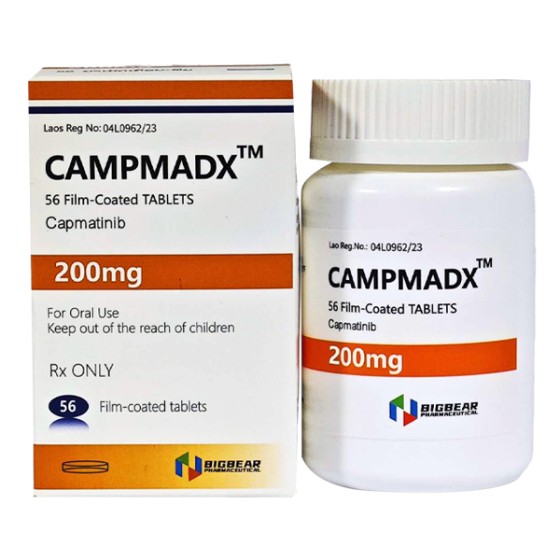
Global Pricing and Accessibility:Originator drug pricing varies significantly across countries and regions.In European and select Asia-Pacific markets,per-cycle costs typically range from several thousand to tens of thousands of US dollars,with out-of-pocket expenses substantially reduced for patients with comprehensive health insurance coverage.In certain emerging markets(such as Laos),locally approved generic versions have become available,containing essentially the same active pharmaceutical ingredient as the originator,with per-cycle costs generally in the range of several hundred to just over one thousand US dollars,offering an economically accessible alternative for patients with limited or no insurance coverage.Patients should prioritize legitimate medical channels when selecting drug sources and make comprehensive decisions based on their insurance status,financial circumstances,and quality assurance systems.
2.Capmatinib vs.Peers:Selective MET Inhibitor Comparison
The two globally approved highly selective MET inhibitors for MET exon 14 skipping mutation NSCLC are capmatinib and tepotinib.Both belong to the Type Ib MET inhibitor class but differ in molecular structure,pharmacokinetics,and safety profiles.
Efficacy Data Comparison:In the pivotal GEOMETRY mono-1 Phase II trial,capmatinib achieved an objective response rate(ORR)of 68.3%in treatment-naïve patients,with a median progression-free survival(PFS)of 12.4 months and median overall survival(OS)of 20.8 months.In previously treated patients,the ORR was 41%with a median PFS of 5.4 months.Tepotinib,in the VISION study,reported treatment-naïve ORR of approximately 44%–57%and previously treated ORR of approximately 41%–50%,with median OS reaching 29.7 months in the treatment-naïve population.Numerically,capmatinib shows a slight ORR advantage in treatment-naïve patients,while tepotinib demonstrates impressive OS data in the same population.Both agents exhibit favorable intracranial activity against brain metastases.No head-to-head randomized Phase III trial has directly compared the two agents.
Safety Differences:Capmatinib has a relatively high incidence of peripheral edema(approximately 50%or more),with nausea and blood creatinine elevation also commonly reported.Tepotinib similarly features peripheral edema as its primary adverse event,but reports of liver enzyme elevation are relatively more frequent,and gastrointestinal reactions such as diarrhea occur at slightly higher rates.Both agents require vigilance for the potential risk of interstitial lung disease(ILD)/pneumonitis.
Selection Strategy:Overall,both agents demonstrate comparable efficacy.Clinical selection should comprehensively consider patient comorbidities(such as baseline hepatic and renal function),expected tolerance to specific adverse events,dosing convenience(capmatinib twice daily vs.tepotinib once daily),and drug accessibility to achieve individualized precision treatment.
3.First-Line Strategy:Capmatinib Monotherapy Standard
For patients with MET exon 14 skipping mutation metastatic NSCLC who have not received prior systemic therapy,capmatinib monotherapy is a standard first-line treatment option recommended by international guidelines.
Dosing Regimen:The recommended dose is 400 mg taken orally twice daily,with or without food.Tablets should be swallowed whole and must not be crushed,chewed,or split.If a dose is missed or vomiting occurs after dosing,no supplementary dose is needed;the patient should resume at the next scheduled time.Treatment should continue until disease progression or unacceptable toxicity.
Clinical Benefits:In the GEOMETRY mono-1 study,treatment-naïve patients achieved an ORR exceeding 68%,median PFS of 12.4 months,and median OS exceeding 20 months,demonstrating capmatinib's outstanding efficacy as a first-line targeted therapy.This regimen requires no combination chemotherapy,offers convenient dosing,and is suitable for most patients with good performance status,particularly those wishing to avoid chemotherapy toxicity.For patients with lower tumor burden and milder symptoms,monotherapy alone can achieve deep and durable disease control.
Intracranial Efficacy:Capmatinib possesses excellent blood-brain barrier penetration.In treatment-naïve patients with concurrent brain metastases,intracranial ORR can exceed 50%,providing significant therapeutic benefit for this poor-prognosis subgroup.
4.Later-Line Strategy:Clinical Benefits and Management in Pretreated Patients
For patients with MET exon 14 skipping mutations who have progressed after prior immunotherapy,platinum-based chemotherapy,or other systemic treatments,capmatinib as a later-line therapy continues to deliver meaningful clinical benefits.
Efficacy Outcomes:In previously treated populations,capmatinib achieves an ORR of approximately 41%–50%,with a median duration of response exceeding 9 months and median PFS of approximately 5.4 months.Although these figures are lower than first-line results,they remain clinically valuable for patients who have undergone multiple prior treatment lines and may have declining performance status.
Dose Management and Monitoring:The later-line dose is identical to first-line treatment(400 mg twice daily).However,because patients may have accumulated organ function impairment from prior treatments(such as hepatic/renal decline or reduced bone marrow reserve),closer adverse event monitoring is required.If Grade 3 or higher adverse events occur(such as severe liver enzyme elevation,interstitial pneumonitis,or severe peripheral edema),treatment should be suspended.Upon recovery to Grade 1 or baseline,therapy should be restarted at a reduced dose(first to 300 mg twice daily,then further to 200 mg twice daily if necessary).If 200 mg twice daily remains intolerable,permanent discontinuation is required.
5.Combination Strategies and Emerging Directions
Capmatinib combination strategies with other agents remain in active exploration and have not yet achieved standard recommendation status.
Combination with Immune Checkpoint Inhibitors:Preclinical models suggest synergistic antitumor effects between MET inhibitors and PD-1/PD-L1 antibodies.However,clinical trials have revealed significantly increased rates of hepatotoxicity and interstitial pneumonitis with combination regimens,leading to premature termination of some studies.This combination is not currently recommended as routine practice and is being cautiously explored only within strictly designed clinical trial frameworks.
Combination with Chemotherapy:Combining capmatinib with pemetrexed,platinum agents,and other chemotherapy drugs theoretically enables synergistic tumor cell killing through different mechanisms.However,chemotherapy-related myelosuppression and gastrointestinal toxicity may overlap with targeted therapy adverse events,requiring careful multidisciplinary team evaluation.This strategy is similarly limited to clinical research exploration.
Clinical Practice Recommendations:In current standard practice,capmatinib is primarily used as monotherapy.Combination regimens should only be considered when there are compelling clinical indications(such as extremely high disease burden or rapid progression risk),the patient has good hepatic and renal function and excellent performance status,and the decision is made by an experienced multidisciplinary team with rigorous monitoring.
6.Efficacy Assessment and Safety Monitoring Essentials
Imaging Evaluation:CT or MRI assessments should be performed every 6 to 9 weeks during treatment to objectively evaluate tumor response.Patients who achieve remission should continue treatment until disease progression and must not discontinue medication independently based on symptom improvement or imaging response.
Peripheral Edema Management:Peripheral edema is the most common capmatinib adverse event,typically mild to moderate.Early intervention is recommended,including limb elevation,moderate physical activity,compression stockings,and short-term diuretic use when necessary.If edema progresses to Grade 3 or higher,dose interruption or reduction per adjustment protocols is required.
Hepatic and Renal Function Monitoring:Alanine aminotransferase(ALT),aspartate aminotransferase(AST),and total bilirubin should be monitored before treatment initiation and every 2 to 4 weeks during therapy.Capmatinib may cause blood creatinine elevation due to inhibition of renal tubular creatinine secretion,which does not necessarily reflect true renal function decline;comprehensive assessment using cystatin C and other markers is recommended.
Interstitial Lung Disease Vigilance:If patients develop new or worsening respiratory symptoms such as dyspnea,cough,or fever,capmatinib should be immediately suspended and pulmonary imaging performed.Once drug-related ILD/pneumonitis is confirmed,permanent discontinuation and standard treatment with corticosteroids are required.
[ 免责声明 ] 本页面内容来自公开渠道(如FDA官网、Drugs官网、原研药厂官网等),仅供持有医疗专业资质的人员用于医学药学研究参考,不构成任何治疗建议或药品推荐。所涉药品可能未在中国大陆获批上市,不适用于中国境内销售和使用。如需治疗,请咨询正规医疗机构。本站不提供药品销售或代购服务。