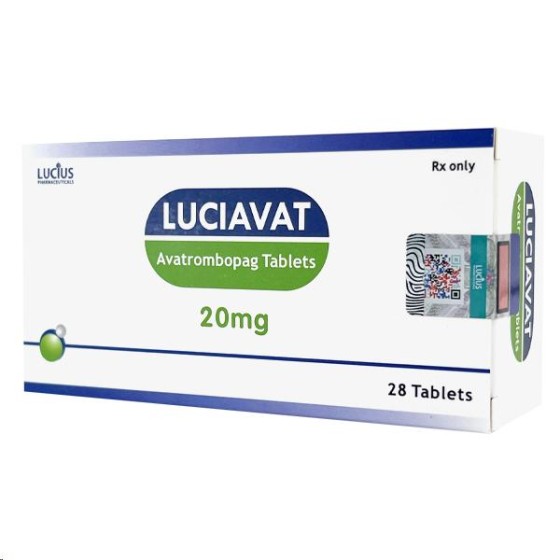
.jpeg)
Avatrombopag Complete Guide: Efficacy, Indications, and TPO-RA Drug Comparisons
1.Mechanism of Action and Core Efficacy
Avatrombopag(brand name Doptelet)is an oral small-molecule non-peptide thrombopoietin receptor agonist(TPO-RA).It selectively binds to the transmembrane domain of the thrombopoietin receptor(c-Mpl),activating downstream signaling pathways including JAK-STAT,MAPK,and PI3K,to stimulate the proliferation,differentiation,and maturation of bone marrow megakaryocytes,thereby effectively promoting platelet production.
Unlike recombinant human thrombopoietin(rhTPO),avatrombopag is administered orally,contains no metal-chelating groups,has low immunogenicity,and does not require injection,offering significantly greater convenience.
Core efficacy is demonstrated in two major areas:
Rapid platelet count elevation:Used for short-term perioperative platelet support in patients with chronic liver disease-associated thrombocytopenia.A 5-day short course significantly raises platelet levels to meet surgical safety requirements.
Long-term platelet maintenance:Used for sustained treatment of chronic immune thrombocytopenia(ITP),continuously stimulating platelet production to help patients maintain safe platelet count ranges.
2.Three Approved Indications and Dosing Regimens
Indication 1:Chronic Liver Disease-Associated Thrombocytopenia(Perioperative)
Indicated for adult patients with chronic liver disease-associated thrombocytopenia who are scheduled for invasive procedures.In this setting,avatrombopag is administered as a short 5-day oral course,with the daily dose(40 mg or 60 mg)determined by baseline platelet count.Platelet elevation is typically observed within 3 to 5 days of dosing,with procedures scheduled 5 to 8 days after the last dose,eliminating the need for long-term medication.
Indication 2:Chronic Immune Thrombocytopenia(ITP)—Adults
Indicated for adult patients with chronic ITP who have had an insufficient response to previous treatments.ITP treatment requires long-term maintenance,starting at 20 mg once daily taken with food.The dose is periodically adjusted based on platelet counts,with a maximum of 40 mg daily.The treatment goal is to maintain platelets at a safe level(typically≥50×10⁹/L)rather than pursuing normalization.
Indication 3:Chronic Immune Thrombocytopenia(ITP)—Pediatric
Indicated for pediatric patients aged 1 year and older with persistent or chronic ITP who have had an insufficient response to prior treatments.Avatrombopag is one of the few TPO-RAs approved for use in young children with ITP,providing an important oral treatment option for pediatric patients.Pediatric dosing requires individualized adjustment based on body weight and platelet counts.
3.Comprehensive Comparison:Avatrombopag vs.Eltrombopag
Avatrombopag and eltrombopag both belong to the TPO-RA class but differ significantly across several key dimensions.
Chemical Structure and Dosing Convenience:Avatrombopag contains no metal-chelating groups and is unaffected by polyvalent cations such as calcium,iron,magnesium,or aluminum,allowing administration with food and significantly improving patient adherence.Eltrombopag contains metal-chelating groups and must be taken on an empty stomach(1 hour before or 2 hours after meals),with at least a 2-hour separation from calcium-or iron-containing foods such as dairy products,imposing more dosing restrictions.
Indication Focus:Eltrombopag is also approved for first-line treatment of severe aplastic anemia(SAA)in combination with immunosuppressive therapy,possessing more robust evidence in the SAA field.Avatrombopag currently has limited research data in SAA.
Onset Speed:In perioperative chronic liver disease patients,avatrombopag shows efficacy within 3 to 5 days,meeting the need for rapid short-term platelet elevation.Eltrombopag typically requires 1 to 2 weeks before significant platelet increases are observed in ITP patients.
Safety Differences:Both agents require regular hepatic function monitoring,but hepatotoxicity reports are relatively fewer with avatrombopag.Eltrombopag more commonly causes liver enzyme elevations,which may require dose reduction or discontinuation in some patients.
Efficacy Comparison:In ITP treatment,overall response rates are comparable between the two agents.Selection may be guided by individual patient factors,dosing convenience needs,comorbidities,and drug accessibility.
4.Comparative Analysis:Avatrombopag vs.Hetrombopag
Hetrombopag is a domestically developed TPO-RA with a molecular structure similar to eltrombopag,also containing metal-chelating groups and therefore requiring fasting administration,representing a convenience gap compared to avatrombopag.
Indication Coverage:Hetrombopag is approved for both ITP and SAA,similar to eltrombopag,offering broader coverage than avatrombopag in the SAA domain.
Perioperative Management:In perioperative platelet management for chronic liver disease,avatrombopag has a dedicated 5-day short-course regimen with a clear clinical positioning,while hetrombopag has relatively limited evidence in this setting.
Pediatric Applications:Avatrombopag is approved for ITP patients aged 1 year and older,with more extensive clinical data and application experience in the pediatric field.Hetrombopag's pediatric data are still being accumulated.
Dosing Convenience:Avatrombopag is unrestricted by diet or metal ions,offering particular advantages for patients who concurrently require iron or calcium supplementation,such as those with liver disease complicated by malnutrition.
5.Which TPO-RA Is Stronger—A Clinical Scenario-Based Evaluation
No head-to-head randomized controlled trials have directly compared avatrombopag with eltrombopag or hetrombopag.From indirect comparisons,overall ITP response rates across the three agents in large-scale clinical trials fall within the 70%–85%range,with no statistically significant differences.Therefore,evaluating"which is stronger"must be based on specific clinical scenarios rather than generalized efficacy comparisons.
Rapid Perioperative Platelet Elevation:In chronic liver disease patients requiring short-term rapid platelet elevation to meet surgical requirements,avatrombopag's 5-day short-course regimen and 3-to-5-day onset speed confer an irreplaceable clinical position.Other TPO-RAs have relatively weak evidence in this scenario.
Long-Term ITP Maintenance:In long-term ITP management,efficacy among the three agents is comparable.Selection depends more on dosing convenience(avatrombopag being superior),patient adherence,concomitant medication needs,and drug accessibility.
Severe Aplastic Anemia(SAA):In SAA treatment,eltrombopag and hetrombopag have more clearly defined indications and more robust evidence bases,making them preferred choices in this field.Avatrombopag's role in SAA awaits further validation.
6.Adverse Reactions and Monitoring Essentials
Common Adverse Reactions:Avatrombopag's adverse reactions are generally mild,primarily including headache,fatigue,nausea,abdominal pain,and diarrhea,mostly mild to moderate in severity and typically not requiring discontinuation.
Thromboembolic Risk:As with all TPO-RA agents,long-term use requires attention to thromboembolic event risk.Platelet counts should be regularly monitored during treatment to avoid excessive platelet elevation(recommended maintenance range:50×10⁹/L to 200×10⁹/L).Patients with a history of thrombosis,hypercoagulable states,or other thrombotic risk factors require cautious use and enhanced monitoring.
Hepatic Function Monitoring:Alanine aminotransferase(ALT),aspartate aminotransferase(AST),and bilirubin levels should be checked every 2 to 4 weeks during treatment,especially during the initial phase.Although avatrombopag carries a lower hepatotoxicity risk than eltrombopag,chronic liver disease patients inherently have baseline hepatic dysfunction,making close monitoring essential.
Platelet Monitoring Frequency:ITP patients should undergo weekly platelet count testing during treatment initiation and dose adjustment phases,with intervals extended to every 2 to 4 weeks once dosing is stabilized.Perioperative short-course patients should have platelet levels confirmed to be at a safe threshold before surgery.
[ 免责声明 ] 本页面内容来自公开渠道(如FDA官网、Drugs官网、原研药厂官网等),仅供持有医疗专业资质的人员用于医学药学研究参考,不构成任何治疗建议或药品推荐。所涉药品可能未在中国大陆获批上市,不适用于中国境内销售和使用。如需治疗,请咨询正规医疗机构。本站不提供药品销售或代购服务。