.jpeg)
Capmatinib (Tabrecta): Oral Targeted Therapy for MET Exon 14 Skipping-Mutated NSCLC
MET exon 14(METex14)skipping mutations occur in approximately 3%–4%of non-small cell lung cancer(NSCLC)cases.Although uncommon,the alteration is a recognized oncogenic driver:skipping of exon 14 removes the juxtamembrane domain containing the Cbl E3 ubiquitin ligase binding site,impairing MET protein degradation and resulting in sustained downstream signaling.Patients with this mutation respond poorly to conventional chemotherapy and immunotherapy and carry an unfavorable prognosis,making MET-directed precision inhibition clinically important.
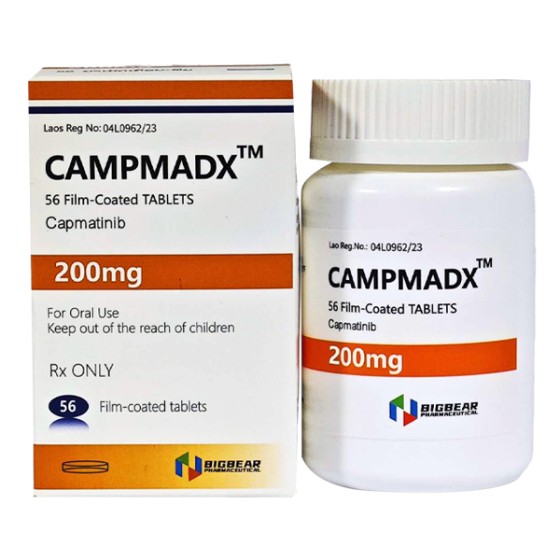
Capmatinib(Tabrecta;Novartis)is an oral,highly selective type Ib MET tyrosine kinase inhibitor.It binds competitively to the ATP-binding site of the MET kinase domain,inhibiting MET receptor phosphorylation and blocking activation of downstream pathways including PI3K/AKT and RAS/MAPK,thereby suppressing tumor cell proliferation,migration and survival.It received FDA accelerated approval in May 2020 and was converted to regular approval in August 2022 on the basis of confirmatory data,for adult patients with metastatic NSCLC whose tumors harbor a mutation leading to MET exon 14 skipping as detected by an FDA-approved test,regardless of prior treatment.
The pivotal evidence comes from the phase 2 GEOMETRY mono-1 trial(NCT02414139),a multicohort,open-label study.Among 97 patients with METex14 skipping,the objective response rate(ORR)was 68%in treatment-naive patients with a median duration of response(DOR)of 12.6 months and median progression-free survival(PFS)of 12.4 months;in previously treated patients,ORR was 41%with a median DOR of 9.7 months and median PFS of 5.4 months.Among evaluable patients with baseline brain metastases,confirmed intracranial responses were observed in 7 of 13 patients(approximately 54%),including 4 complete responses,indicating clinically meaningful intracranial activity.The confirmatory dataset supporting regular approval—63 additional patients with 22 months of further follow-up—showed a median DOR of 16.6 months in treatment-naive patients and an ORR of 44%in previously treated patients.Capmatinib is recommended in international guidelines such as the NCCN Guidelines for this population.
As with all targeted agents,acquired resistance is a central challenge,divided into on-target and off-target mechanisms.On-target resistance arises from secondary mutations in the MET kinase domain,most frequently at residues D1228 and Y1230(reported in some literature as Y1248);these residues are key anchoring points for type Ib inhibitors,and their mutation reduces drug binding affinity while the kinase remains active.Off-target resistance involves bypass pathway activation,including EGFR,HER3,KRAS and PIK3CA alterations,loss of MET amplification,and—in a minority of patients—histologic transformation such as adenocarcinoma-to-small-cell conversion.Management strategies include switching to a type II MET inhibitor(e.g.,cabozantinib,merestinib)for on-target resistance,although clinical evidence remains limited;combination approaches with MEK inhibitors,EGFR inhibitors or immunotherapy are under investigation,with early experience highlighting tolerability challenges that inform future regimen optimization.Repeat tissue or liquid biopsy at progression is recommended to define the resistance mechanism before selecting subsequent therapy.
The recommended dose is 400 mg(two 200 mg tablets)orally twice daily,with or without food,with doses spaced approximately 12 hours apart.Tablets should be swallowed whole and not chewed,split or crushed.A missed dose may be taken if more than 6 hours remain before the next scheduled dose;otherwise it should be skipped,and no replacement dose is given after vomiting.Dose reduction for toxicity proceeds stepwise to 300 mg twice daily,then 200 mg twice daily;treatment should be permanently discontinued if 200 mg twice daily is not tolerated.
Most adverse events are low grade.Peripheral edema is the most characteristic event,occurring in approximately half of patients(grade 3 in about 9%),presenting as swelling of the lower limbs,periorbital region or soft tissue;management includes limb elevation,sodium restriction and compression stockings,with treatment interruption or dose reduction for moderate-to-severe cases and diuretics where appropriate under medical supervision.Nausea(approximately 44%)and vomiting(approximately 28%)occur mostly early in treatment and can be mitigated by taking the drug with food,smaller frequent meals and antiemetics as needed.Common laboratory abnormalities include increased blood creatinine,ALT/AST elevations(grade 3–4 in about 7%)and amylase/lipase elevations(grade 3–4 in about 8.6%);liver function should be assessed before initiation and every 2 weeks during the first 3 months,then monthly,with renal function and pancreatic enzymes monitored periodically.Marked transaminase elevation warrants interruption with dose reduction on recovery.Two uncommon but serious risks require vigilance:interstitial lung disease/pneumonitis(approximately 4.6%overall,grade 3 in about 1.9%,including fatal cases),for which new or worsening dyspnea,cough or fever should prompt immediate interruption,evaluation,and permanent discontinuation if confirmed;and pancreatitis,which should be evaluated promptly in patients presenting with severe upper abdominal pain and elevated amylase/lipase.
Capmatinib is indicated for patients with metastatic NSCLC whose tumors are confirmed to harbor a METex14 skipping mutation,regardless of prior therapy;the standard dose is 400 mg twice daily;after progression,repeat biopsy to characterize the resistance mechanism is advised,with subsequent options including an alternative MET inhibitor,combination strategies,or enrollment in a clinical trial.The drug is contraindicated in patients with hypersensitivity to any component,and sun exposure should be limited during treatment.All treatment decisions should be made under specialist supervision,with medication obtained through legitimate channels and regular follow-up monitoring.
[ 免责声明 ] 本页面内容来自公开渠道(如FDA官网、Drugs官网、原研药厂官网等),仅供持有医疗专业资质的人员用于医学药学研究参考,不构成任何治疗建议或药品推荐。所涉药品可能未在中国大陆获批上市,不适用于中国境内销售和使用。如需治疗,请咨询正规医疗机构。本站不提供药品销售或代购服务。