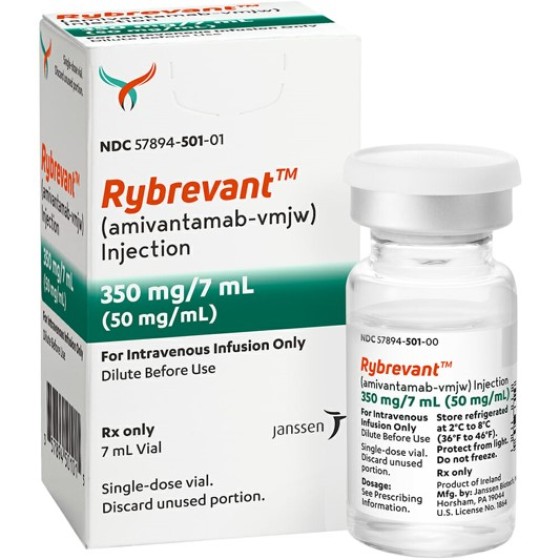
.jpeg)
Amivantamab Plus Lazertinib: A Chemotherapy-Free First-Line Option in EGFR-Mutated NSCLC
Amivantamab(Rybrevant;Janssen)plus lazertinib(Lazcluze)is approved in the United States,the European Union and other markets for the first-line treatment of adults with locally advanced or metastatic non-small cell lung cancer(NSCLC)whose tumors harbor EGFR exon 19 deletions or exon 21 L858R substitution mutations,as detected by an approved test.
The two agents are complementary rather than merely additive.Amivantamab is a fully human EGFR/MET bispecific antibody:it blocks ligand binding extracellularly,drives receptor internalization and degradation,and—via its afucosylated Fc domain—mediates ADCC and macrophage-mediated trogocytosis,while also covering MET bypass activation,a common resistance escape route.Lazertinib is a third-generation oral EGFR-TKI active against sensitizing mutations and T790M,with good central nervous system penetration.Together they achieve bidirectional blockade of EGFR signaling.
The pivotal evidence comes from the phase 3 MARIPOSA trial(NCT04487080).A total of 1074 treatment-naive patients were randomized 2:2:1 to the combination,osimertinib,or lazertinib monotherapy,the third arm serving to assess the contribution of components.Median progression-free survival was 23.7 months with the combination versus 16.6 months with osimertinib(HR,0.70;95%CI,0.58–0.85;P<0.001).Objective response rates were comparable,but duration of response extended to 25.8 versus 16.8 months.The final overall survival analysis reported in 2025,at a median follow-up of 37.8 months,showed a 25%reduction in the risk of death(HR,0.75;95%CI,0.61–0.92;P=0.005);median OS was not reached with the combination versus 36.7 months with osimertinib,with 3-year survival of 60%versus 51%,published in the New England Journal of Medicine.
The benefit carries a higher toxicity burden.Grade≥3 adverse events occurred in 80%of patients on the combination versus 52%on osimertinib,and treatment-related adverse events led to discontinuation in 10%versus 3%.Key management requirements include:venous thromboembolism in 36%of patients(grade 3 in 10%),warranting prophylactic anticoagulation for the first four months,with vitamin K antagonists not recommended;rash in 86%(grade 3 in 26%)with a median onset of 14 days,managed with proactive skin care and sun protection;infusion-related reactions in 63%,mitigated by split dosing on days 1 and 2 of week 1 with premedication using antihistamines,antipyretics and corticosteroids.Stomatitis,ocular toxicity and interstitial lung disease/pneumonitis also require monitoring;amivantamab should be withheld for suspected ILD and permanently discontinued if confirmed.
The regimen is not appropriate for every patient.EGFR mutation subtype must be established before initiation,and treatment decisions should integrate disease stage,prior therapy,performance status,thrombotic risk and organ function,with multidisciplinary coordination throughout.
[ 免责声明 ] 本页面内容来自公开渠道(如FDA官网、Drugs官网、原研药厂官网等),仅供持有医疗专业资质的人员用于医学药学研究参考,不构成任何治疗建议或药品推荐。所涉药品可能未在中国大陆获批上市,不适用于中国境内销售和使用。如需治疗,请咨询正规医疗机构。本站不提供药品销售或代购服务。