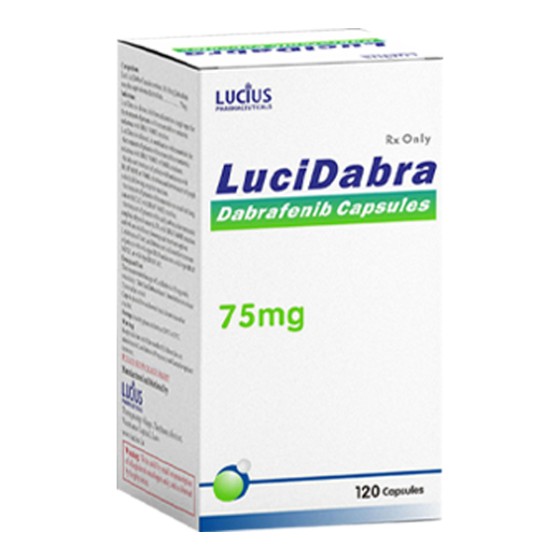
.jpeg)
Dabrafenib (TAFINLAR): Indications, Adverse Effect Management, and Dose Modification Guide
1.Drug Positioning and Mechanism of Action
Dabrafenib(brand name TAFINLAR)is an oral,ATP-competitive BRAF kinase inhibitor developed by Novartis,with high selectivity for BRAF V600E,V600K,and V600D mutant isoforms.BRAF is a critical serine/threonine kinase within the RAS-RAF-MEK-ERK(MAPK)signaling cascade.Activating mutations at the V600 position lead to constitutive kinase activity,driving uncontrolled tumor cell proliferation and survival.
In clinical practice,dabrafenib is almost always combined with the MEK inhibitor trametinib(brand name MEKINIST),which targets MEK1/MEK2 downstream of BRAF in the same pathway.This vertical dual blockade strategy enhances antitumor efficacy while significantly reducing the incidence of secondary cutaneous squamous cell carcinoma and keratoacanthoma seen with BRAF inhibitor monotherapy.The combination has become the standard targeted therapy for BRAF V600–mutant solid tumors.
2.Approved Indications:From Melanoma to Tumor-Agnostic Coverage
The dabrafenib-plus-trametinib combination holds approvals across multiple tumor types,making it one of the broadest BRAF-targeted regimens available.
In melanoma,the combination is approved for first-line and subsequent treatment of unresectable or metastatic melanoma harboring BRAF V600E or V600K mutations.It is also approved as adjuvant therapy following complete resection in patients with BRAF V600E or V600K–mutant melanoma with lymph node involvement.
In non-small cell lung cancer(NSCLC),the combination is approved for metastatic NSCLC with BRAF V600E mutations,providing an effective targeted option for this rare molecular subtype.
In thyroid cancer,the combination is approved for locally advanced or metastatic anaplastic(undifferentiated)thyroid cancer with BRAF V600E mutations—a highly aggressive subtype with historically very limited therapeutic options.
For tumor-agnostic use,the combination is approved for adults and children aged 6 years and older with unresectable or metastatic solid tumors harboring BRAF V600E mutations that have progressed on prior treatment,including low-grade gliomas.This landmark approval marks the transition from tumor-specific to histology-agnostic precision medicine.
Importantly,dabrafenib is contraindicated in BRAF wild-type melanoma,as BRAF inhibitors can paradoxically activate the MAPK pathway in the absence of V600 mutations and potentially promote tumor growth.All patients must have confirmed BRAF V600 mutation status by a validated assay before initiating therapy.
3.Adverse Effect Landscape:Pyrexia as the Hallmark Signal
The adverse-effect profile of the dabrafenib-trametinib combination spans multiple organ systems.Pyrexia is the most characteristic and frequent adverse event,occurring in 50%to 60%of patients,typically within the first one to two weeks of treatment.Fever may range from low-grade to severe hyperpyrexia accompanied by rigors,hypotension,and dehydration.
Cutaneous adverse effects include rash,photosensitivity,keratoacanthoma,and cutaneous squamous cell carcinoma(significantly reduced with the combination versus monotherapy).Gastrointestinal effects such as nausea,vomiting,diarrhea,and decreased appetite are common,along with fatigue,arthralgia,headache,and musculoskeletal pain.
Laboratory abnormalities requiring monitoring include hepatic enzyme elevations and hypertension.Hematologic toxicities such as anemia and neutropenia occur at relatively low rates with the combination but remain possible.Ocular toxicities(uveitis,retinal vein occlusion)and cardiac effects(reduced left ventricular ejection fraction)are uncommon but potentially serious.
4.Pyrexia:Graded Management and Prevention
Pyrexia is the most critical clinical management challenge with the dabrafenib-trametinib combination.Patients should have antipyretics(acetaminophen or ibuprofen)readily available from the start of treatment.
For low-grade fever(38.0°C–38.5°C),antipyretics and continued monitoring are appropriate while maintaining the current dose.For temperatures exceeding 38.5°C or fever persisting beyond 24 hours,dabrafenib(and trametinib if needed)should be withheld,aggressive hydration initiated,and infection excluded.For severe hyperpyrexia(≥39°C)with rigors,hypotension,or dehydration,immediate drug cessation,active cooling,intravenous fluids,and short-course corticosteroids(e.g.,prednisone)may be required.
Once temperature normalizes and infection is excluded,therapy may resume at one dose level lower.If recurrent severe pyrexia persists despite dose reduction,permanent discontinuation should be considered.Patients should measure and record temperature daily,especially during the first two weeks of therapy.
5.Cutaneous,Gastrointestinal,and Other Toxicity Management
For photosensitivity and rash,patients should strictly avoid sun exposure,use broad-spectrum SPF 50+sunscreen,and wear protective clothing.Emollients and moderate-potency topical corticosteroids may be applied for symptomatic relief.New proliferative skin lesions should be promptly evaluated by a dermatologist with excision if indicated.
Gastrointestinal symptoms are managed with dietary modification(small,frequent meals;avoidance of greasy,spicy foods)and symptomatic medications such as ondansetron for nausea and loperamide for diarrhea.Arthralgia and musculoskeletal pain respond to NSAIDs or acetaminophen.
Blood pressure should be monitored regularly;new or worsening hypertension requires active antihypertensive management.Hepatic function should be checked monthly,particularly during the first three months.Ophthalmologic examinations are recommended at baseline and periodically during treatment.
6.Dose Modification:Reduction Protocol and Restart Timing
The standard recommended dose of dabrafenib is 150 mg taken orally twice daily;trametinib is 2 mg once daily.Both drugs should be taken on an empty stomach(at least 1 hour before or 2 hours after meals).Capsules must be swallowed whole and must not be opened,crushed,or chewed.
For Grade 3 adverse events,dabrafenib(and trametinib if applicable)should be withheld until toxicity resolves to Grade 1 or baseline.Therapy then resumes at one dose level lower:dabrafenib reduced from 150 mg BID to 100 mg BID;trametinib from 2 mg QD to 1.5 mg QD.If Grade 3 toxicity recurs,further reduction is permitted(dabrafenib to 75 mg BID;trametinib to 1 mg QD).If Grade 3 toxicity persists at the lowest dose,or any Grade 4 event occurs,permanent discontinuation is generally recommended.
Interstitial pneumonitis,severe pyrexia syndrome with hemodynamic instability,acute pancreatitis,and serious ocular toxicity(e.g.,retinal vein occlusion)warrant immediate and permanent discontinuation with appropriate supportive care.All dose-modification decisions must be made under oncologist supervision;patients should never self-adjust or discontinue therapy.
7.Special Populations and Drug Interactions
Elderly patients(≥65 years)may have reduced hepatic and renal function,increasing adverse-effect susceptibility;enhanced monitoring during the initial treatment period is recommended.Mild hepatic impairment(Child-Pugh A)does not require dose adjustment;data are limited for moderate-to-severe impairment(Child-Pugh B/C).Mild-to-moderate renal impairment generally does not necessitate adjustment.
Women of childbearing potential should use highly effective contraception during treatment and for at least 2 weeks after the last dose.Men should use contraception during treatment and for 2 weeks after discontinuation.
Dabrafenib is metabolized primarily by CYP3A4 and CYP2C8 and is also an inducer of these enzymes.Co-administration with strong CYP3A4 inhibitors may elevate dabrafenib exposure.Conversely,dabrafenib may reduce the efficacy of CYP3A4 substrate drugs including oral contraceptives,warfarin,and statins.Patients should disclose all medications,supplements,and herbal products before starting therapy.
8.Structured Monitoring and Long-Term Management
Baseline assessments before treatment initiation should include comprehensive hepatic and renal function panels,complete blood count,ECG,blood pressure measurement,and ophthalmologic examination.
During treatment,patients should self-monitor temperature and blood pressure daily.Hepatic function is checked monthly(every two weeks during the first three months).Complete blood counts are repeated monthly.Imaging-based efficacy assessments are performed every 8 to 12 weeks.Dermatologic evaluation is recommended monthly to detect secondary skin neoplasms early.
Patients should maintain a personal treatment diary documenting daily temperature,skin changes,gastrointestinal symptoms,and any other adverse effects for efficient communication at follow-up visits.Balanced nutrition,moderate physical activity,and adequate rest support functional status throughout long-term targeted therapy.
[ 免责声明 ] 本页面内容来自公开渠道(如FDA官网、Drugs官网、原研药厂官网等),仅供持有医疗专业资质的人员用于医学药学研究参考,不构成任何治疗建议或药品推荐。所涉药品可能未在中国大陆获批上市,不适用于中国境内销售和使用。如需治疗,请咨询正规医疗机构。本站不提供药品销售或代购服务。