.jpeg)
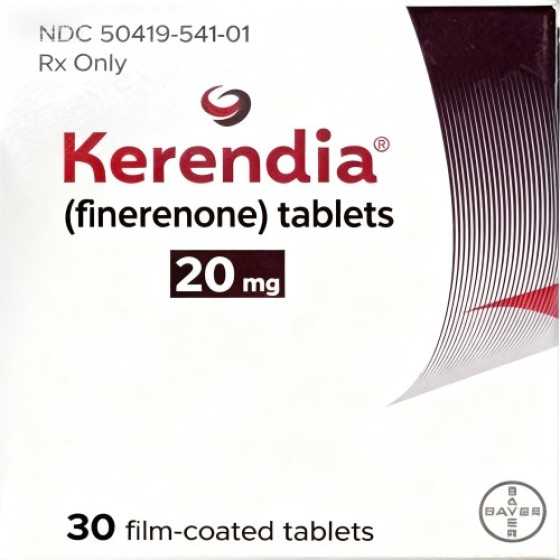
Finerenone (Kerendia) for Diabetic CKD and HF with LVEF≥40%: Albuminuria, Dosing, Hyperkalemia
1.Position and Eligible Patients
Finerenone is a nonsteroidal,selective mineralocorticoid receptor antagonist.It blocks aldosterone/cortisol overactivation of the mineralocorticoid receptor,reducing inflammation,fibrosis,and sodium/water retention in kidney and heart.
Two main settings:
Type 2 diabetes–related CKD in adults:albuminuria or raised UACR,aiming to reduce sustained eGFR decline,end-stage kidney disease,cardiovascular death,nonfatal myocardial infarction,and heart-failure hospitalization;usually initiated when eGFR≥25 and potassium is controlled.
Heart failure with LVEF≥40%in adults:reduce cardiovascular death,heart-failure hospitalization,and urgent heart-failure visits;can be considered with or without diabetes.
Avoid unsupported use:do not start if potassium>5.0 mmol/L,eGFR<25,acute decompensated heart failure,Addison disease,known hypersensitivity,or with strong CYP3A inhibitors.Type 1 diabetic CKD requires label-specific and specialist judgement.
2.Dosing and Administration
Before start:serum potassium,eGFR;review liver tests,blood pressure,and concomitant drugs.
Diabetic CKD:eGFR≥60→20mg once daily;eGFR≥25 and<60→10mg once daily;usual target 20mg once daily,uptitrated by potassium.
HF with LVEF≥40%:eGFR≥60 may start 20mg once daily with target 40mg once daily;eGFR≥25 and<60 may start 10mg once daily with target 20mg once daily,adjusted by potassium and label.
Administration:swallow whole with water,with or without food;if a dose is missed,take it the same day,otherwise skip and resume the schedule—do not double.
Monitoring and titration:check potassium and eGFR at 4 weeks.On 10mg,potassium≤4.8→increase to 20mg;4.8–5.0→stay 10mg;>5.5→hold,then reconsider 10mg restart once≤5.0.On 20mg,≤4.8 or 4.8–5.0→maintain per protocol;>5.5→hold and restart low once controlled.
Acute eGFR drop:a small early fall is common;a drop>30%from baseline needs evaluation for volume loss and concomitant nephrotoxins before deciding to hold,reduce,or continue.
3.Albuminuria and Response Monitoring
UACR reduction takes weeks.Phase II data at 90 days showed placebo-corrected reductions around 25%–38%;FIDELIO and FIGARO showed approximately 31%–32%relative UACR reduction versus placebo at month 4,maintained during treatment.No UACR change after 6 days is expected and not a reason to change dose.
Practical plan:potassium/eGFR at 4 weeks;UACR reassessment at 4–12 weeks for early response and later per specialist schedule;track blood pressure,glucose,volume status,and heart-failure symptoms.UACR improvement does not justify stopping RAS blockers,SGLT2 inhibitors,or glucose-lowering therapy on its own.
4.Combinations
ACEI/ARB:common in diabetic CKD;enhances albuminuria and renal protection but needs closer potassium/blood-pressure monitoring.
SGLT2 inhibitors:complementary renal and cardiac protection;watch volume status,transient eGFR decline,and genital/urinary infections.
Potassium-sparing diuretics and other MRAs:contraindicated combinations for routine use because of hyperkalemia.
Potassium supplements and trimethoprim/cotrimoxazole:use cautiously,monitor potassium.
CYP3A:strong inhibitors contraindicated;moderate inducers/inhibitors need monitoring;avoid grapefruit juice.
Pregnancy,lactation,under 18,severe hepatic impairment:do not start routinely without specialist assessment.
5.Safety and Long-Term Management
Hyperkalemia is the most frequent concern,reported in roughly 14%–18%across clinical data and causing discontinuation in about 1%–2%in pivotal trials;low sodium,hypotension,transient eGFR decline,mild GI symptoms,and pruritus can also occur.Management:
Hyperkalemia:hold at>5.5,correct causes,restart low-dose once≤5.0;recurrent or refractory cases require nephrology/cardiology review.
Hyponatremia/hypotension:adjust volume,diuretics,and other antihypertensives rather than stopping finerenone alone.
Long-term use:finerenone provides continued renal and cardiac protection;albuminuria may rebound within weeks after stopping.Continue,reduce,or stop based on potassium,renal function,volume,drug interactions,and tolerability—not on a single blood-pressure reading or single UACR value.
[ 免责声明 ] 本页面内容来自公开渠道(如FDA官网、Drugs官网、原研药厂官网等),仅供持有医疗专业资质的人员用于医学药学研究参考,不构成任何治疗建议或药品推荐。所涉药品可能未在中国大陆获批上市,不适用于中国境内销售和使用。如需治疗,请咨询正规医疗机构。本站不提供药品销售或代购服务。