.jpeg)
Finerenone: Indications, Dosing Strategy, and Combination Therapy
Positioning and Dual Indications
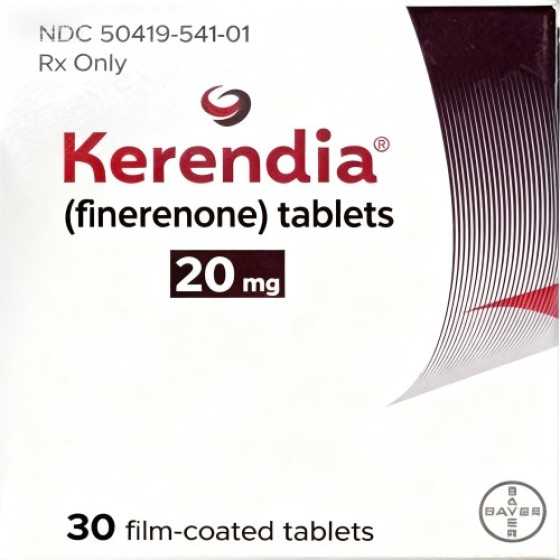
Finerenone(Kerendia)is a non-steroidal,selective mineralocorticoid receptor antagonist(MRA).It is the first non-steroidal MRA to demonstrate clear dual kidney and cardiovascular benefit in diabetic kidney disease,adding a third therapeutic pathway beyond RAAS inhibitors and SGLT2 inhibitors.
Its indications span two areas:reducing the risk of sustained eGFR decline,end-stage kidney disease,cardiovascular death,non-fatal myocardial infarction,and hospitalization for heart failure in adults with chronic kidney disease(CKD)associated with type 2 diabetes;and reducing the risk of cardiovascular death,heart failure hospitalization,and urgent heart failure visits in adults with heart failure and a left ventricular ejection fraction(LVEF)of≥40%.
Required Assessment Before Initiation
Serum potassium and eGFR must be measured before starting therapy.Treatment should not be initiated if serum potassium exceeds 5.0 mEq/L,and use is not recommended in patients with eGFR below 25 mL/min/1.73m².Both parameters should be rechecked at week 4 to establish the basis for subsequent dose adjustment.
Dosing:Stratified by eGFR,Titrated by Potassium
In patients with CKD associated with type 2 diabetes,the starting dose is stratified by eGFR:20 mg once daily for eGFR≥60,and 10 mg once daily for eGFR 25–60.The target dose is 20 mg once daily,adjusted after 4 weeks according to serum potassium.
In patients with heart failure,the starting dose is likewise determined by eGFR,but the target daily dose may be 20 mg or 40 mg—40 mg for eGFR≥60 and 20 mg for eGFR 25–60—again titrated in steps guided by potassium levels.
How It Compares with Related Agents
Finerenone's comparators include the steroidal MRAs(spironolactone,eplerenone)as well as SGLT2 inhibitors and RAAS inhibitors.
Against spironolactone and eplerenone,its principal advantages are a non-steroidal structure and high receptor selectivity,which translate into markedly lower rates of hyperkalemia and sex hormone–related adverse effects.Against SGLT2 inhibitors,the two are mechanistically complementary in renal protection,and combining them may provide additive kidney and cardiac benefit.In heart failure populations,finerenone delivers efficacy broadly comparable to SGLT2 inhibitors through a different mechanism,and the combination may synergistically reduce heart failure hospitalization.
Importantly,finerenone is not a replacement for existing therapies but an addition to them,especially for patients who remain at risk of progression despite RAAS inhibitor and SGLT2 inhibitor therapy.
Choosing Between Two Treatment Paths
A kidney-dominant path applies to patients with CKD and type 2 diabetes,where the goal is to slow renal function decline and reduce cardiovascular events.Finerenone is added on top of background RAAS inhibitor therapy,with the starting dose set by eGFR and titration to 20 mg daily guided by potassium.
A heart failure–dominant path applies to patients with heart failure and LVEF≥40%,where the goal is to reduce cardiovascular death and heart failure hospitalization.Starting and target doses are again determined by eGFR and adjusted stepwise according to serum potassium.
The choice depends on the dominant underlying condition and the primary target-organ involvement,but the dosing principles and monitoring requirements overlap substantially,and an individual patient may meet the criteria for both.
Combination Strategies
Finerenone is generally combined with a RAAS inhibitor(ACEI or ARB),which constitutes standard background therapy.In patients with significant albuminuria,an SGLT2 inhibitor can be added;current evidence suggests this combination further reduces albuminuria and slows eGFR decline without increasing the risk of hyperkalemia.Patients with hypertension may also receive calcium channel blockers,diuretics,or beta-blockers,and those with heart failure may receive an ARNI,provided potassium and renal function are monitored closely.
Combining finerenone with another MRA such as spironolactone or eplerenone is not recommended.
Safety Monitoring and Dose Adjustment
Hyperkalemia is the most common adverse reaction,making regular serum potassium monitoring the cornerstone of safe use.If potassium exceeds 5.5 mEq/L,treatment should be interrupted or the dose reduced;once potassium falls to≤5.0 mEq/L,therapy may be resumed at a lower dose.Beyond hyperkalemia,hypotension,dizziness,and mild fluctuations in renal function may occur.
Regarding interactions,finerenone is metabolized primarily by CYP3A4:strong CYP3A4 inhibitors should be avoided,and moderate inhibitors require caution with intensified monitoring.No starting-dose adjustment is needed in older patients,though their risk of hyperkalemia is greater.Mild hepatic impairment requires no dose adjustment,whereas data in moderate to severe impairment remain limited.
[ 免责声明 ] 本页面内容来自公开渠道(如FDA官网、Drugs官网、原研药厂官网等),仅供持有医疗专业资质的人员用于医学药学研究参考,不构成任何治疗建议或药品推荐。所涉药品可能未在中国大陆获批上市,不适用于中国境内销售和使用。如需治疗,请咨询正规医疗机构。本站不提供药品销售或代购服务。