
.jpeg)
Romiplostim instructions
1. Common name: Romiplostim(Romiplostim)
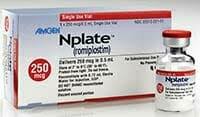
Product name: Nplate
All names: Romiplostim, Romiplostim, NPLATE, NPLATE, AMG531
2. Indications:
1. Immune thrombocytopenia (ITP):
Romiplostim is indicated for the treatment of adult patients with immune thrombocytopenia who have an inadequate response to corticosteroids, immunoglobulins, or splenectomy, and for the treatment of pediatric patients 1 year and older with ITP for at least 6 months.
2. Hematopoietic syndrome of acute radiation syndrome:
Romigrastim may improve survival rates in adult and pediatric patients (including term neonates) who receive acute myelosuppressive doses of radiation.
3. Use restrictions: Romigrastim should only be used in patients with ITP whose degree of thrombocytopenia and clinical conditions increase the risk of bleeding. Not indicated for the treatment of thrombocytopenia due to myelodysplastic syndrome (MDS) or thrombocytopenia due to any cause other than ITP, and should not be used to attempt to normalize platelet counts.
3. Usage and dosage:
1. Immune thrombocytopenia (ITP):
(1) Adult patients:
The initial dose of romiplostim is 1 mcg/kg. Actual body weight at the start of treatment should always be used when calculating initial dosage. Future dose adjustments for adults are based solely on changes in platelet count. Adjust the weekly dose of romiplostim in 1 mcg/kg increments until the patient's platelet count reaches ≥50×109/L to reduce the risk of bleeding. Do not exceed the maximum weekly dose of 10 mcg/kg. In clinical studies, most adult patients who responded to romiplostim achieved and maintained platelet counts ≥50 × 109/L at a median dose of 2-3 mcg/kg.
If platelet count<50×109/L, increase the dose by 1mcg/kg; platelet count is continuous2 If >200×109/L and ≤400×109/L, reduce the dose by 1mcg/kg; Platelet count>400×109/L, do not administer. Continue to evaluate platelet counts weekly. After the platelet count drops to <200×109/L, continue using romiplostim at a reduced dose of 1 mcg/kg.
(2) Pediatric patients:
The initial dose of romiplostim is 1mcg/kg. Actual body weight at the start of treatment should always be used when calculating initial dosage. For pediatric patients, future dose adjustments are based on changes in platelet count and body weight. It is recommended that body weight be re-evaluated every 12 weeks and dosage adjustments should be similar to those for adult patients. In a pediatric placebo-controlled clinical study, patients received a median dose of 5.5 mcg/kg of romiplostim at weeks 17-24.
(3) Dose adjustment:
Based on the need to reduce bleeding risk, use the lowest dose of romiplostim to achieve and maintain platelet counts≥50×109/L, injected subcutaneously weekly, and adjust the dose based on platelet count response. If platelet counts have not increased to a level sufficient to avoid clinically important bleeding after 4 weeks of treatment with romiplostim at a maximum weekly dose of 10 mcg/kg, discontinue romiplostim. Collect complete blood counts(CBCs), including platelet counts, weekly during the dose-titration phase of romigrastimtreatment and then monthly after a stable romigrastim dose has been established. After discontinuing romiplostim, obtain a complete blood count, including platelet count, weekly for at least2 weeks.
2. Hematopoietic syndrome of acute radiation syndrome:
Applicable to adult and pediatric patients(including term newborns)The recommended dose of romiplostim is10mcg/kg, once subcutaneously. Administer this dose as soon as possible after suspected or confirmed exposure to a radiation level greater than 2 Gray (Gy). Romiplostim should be used regardless of whether a complete blood count(CBC) can be obtained.
4. Adverse reactions:
The safety profile of romiplostim was similar in all patients regardless of the duration of ITP, with adverse reactions occurring in patients with ITP lasting up to 12 months: bronchitis, sinusitis, vomiting, arthralgia, myalgia, headache, dizziness, diarrhea, upper respiratory tract infection, cough, nausea, and oropharyngeal pain.
5. Storage:
Romiplostim for injection is a sterile, preservative-free, white solid lyophilized powder . Store in the original carton in a refrigerator at 2-8°C (36°F to 46°F) to avoid light and do not freeze. If desired, unopened vials of romiplostim may be stored in the original carton at room temperature (maximum 25°C (77°F)) for up to 30 days at a time. Once stored at room temperature, do not return to the refrigerator. Discard romigrastim if not used within 30 days.
Storage of Reconstituted Solution: Reconstituted products containing undiluted Sterile Water for Injection (USP) may be retained in the original vial at room temperature 25°C (77°F) or refrigerated at 2-8°C (36°F to 46°F) for up to 24 hours after reconstitution. Products reconstituted with sterile water for injection, USP, may be stored in syringes at room temperature 25°C (77°F) for up to 4 hours. Protect product from light. Don't shake.
Storage of diluted solutions(after initial reconstitution): Reconstitute with 0.9% Sodium Chloride Injection and further dilute Released products, USP, may be stored in syringes at room temperature 25°C (77°F) or refrigerated in the original vial at 2-8°C (36°F to 46°F) for no more than 4 hours prior to administration. Protect product from light. Don't shake.
6. Special groups:
Serious adverse reactions may occur in breastfed children with romigrastim, and women are advised not to breastfeed during treatment with romigrastim.
7. Mechanism of action:
Romiplostim activates the intracellular transcription pathway throughc-Mpl, binds to and activates the TPO receptor to increase platelet production. Its function is similar to that of thrombopoietinSimilar to (TPO), which is an endogenous glycoprotein hormone that regulates platelet production in the bone marrow.
[ 免责声明 ] 本页面内容来自公开渠道(如FDA官网、Drugs官网、原研药厂官网等),仅供持有医疗专业资质的人员用于医学药学研究参考,不构成任何治疗建议或药品推荐。所涉药品可能未在中国大陆获批上市,不适用于中国境内销售和使用。如需治疗,请咨询正规医疗机构。本站不提供药品销售或代购服务。


