
.jpeg)
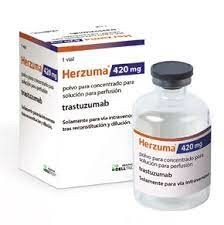
Herzuma (trastuzumab-pkrb) instructions
1. All names: Herzuma, trastuzumab-pkrb injection, CT-P6
2. Indications:
1. Adjuvant breast cancer: Herzuma (trastuzumab-pkrb) is suitable for adjuvant treatment of HER2-overexpressing lymph node-positive or node-negative cancers (ER/PR negative or with a high-risk feature). Herzuma is available as part of a regimen consisting of doxorubicin, cyclophosphamide, and paclitaxel or docetaxel; as part of a regimen consisting of docetaxel and carboplatin; and as a single agent after multimodal anthracycline-based therapy.
2. Metastatic breast cancer (MBC): Herzuma can be used in combination with paclitaxel for the first-line treatment of HER2-overexpressing metastatic breast cancer; it can also be used as a single drug to treat HER2-overexpressing breast cancer in patients who have received one or more chemotherapy regimens for metastatic disease.
3. Metastatic gastric cancer (MGC): Herzuma can be used in combination with cisplatin and capecitabine or 5-fluorouracil to treat patients with HER2-overexpressing metastatic gastric or gastroesophageal junction adenocarcinoma who have not previously received treatment for metastatic disease.
3. Usage and dosage:
1. Before medication: Assessment of HER2 protein overexpression and HER2 gene amplification should be performed by a laboratory with proven capabilities using an FDA-approved breast or gastric cancer-specific test. Doctors will select patients based on HER2 protein overexpression or HER2 gene amplification in tumor specimens. Because of differences in gastric and breast histopathology, including incomplete membrane staining and more frequent heterogeneous expression of HER2 in gastric cancer, evaluation of HER2 protein overexpression and HER2 gene amplification in metastatic gastric cancer should be performed using FDA-approved tests specific to gastric cancer.
2. Recommended dosage: Do not give it by intravenous injection or push injection, and do not mix it with other drugs. Do not use Herzumain place of adotrastuzumabemtansine.
(1) Adjuvant breast cancer: Patients need to use Herzuma for a total of 52 weeks of treatment. It is not recommended to extend adjuvant treatment for more than one year.
When used in combination, give 4 mg/mL intravenously over 90 minutes during the first 12 weeks (paclitaxel or docetaxel) or 18 weeks (docetaxeland carboplatin) of chemotherapy. kg initial dose, then 2 mg/kg as an intravenous infusion over 30 minutes weekly; one week after the last weekly dose of Herzuma, 6 mg/kg as an intravenous infusion over 30 to 90 minutes every three weeks.
When used as a single agent within three weeks of completing a multimodal anthracycline chemotherapy regimen, Herzuma is administered at an initial dose of 8 mg/kg as an intravenous infusion over 90 minutes, followed by subsequent doses of 6 mg/kg as an intravenous infusion over 30 to 90 minutes every three weeks.
(2)Metastatic breast cancer (MBC): When Herzuma is given alone or in combination with paclitaxel, the initial dose is 4 mg/kg as an intravenous infusion over 90 minutes, followed by 2 mg/kg as an intravenous infusion over 30 minutes once weekly until disease progression.
(3) Metastatic gastric cancer (MGC): Herzuma is administered as an initial dose of 8 mg/kg as an intravenous infusion over 90 minutes, followed by 6 mg/kg as an intravenous infusion over 30 to 90 minutes every three weeks until disease progression.
3. Missing dose:
If a patient misses a dose of Herzuma by one week or less, the regular maintenance dose should be administered as soon as possible (weekly schedule: 2 mg/kg; three-week schedule: 6 mg/kg). Don’t wait until the next planning cycle. Subsequent maintenance doses of Herzuma should be administered after 7 or 21 days on a weekly or three-week schedule, respectively.
If a patient misses a dose of Herzuma by more than one week, a reloading dose of Herzuma (weekly schedule: 4 mg/kg; three-week schedule: 8 mg/kg) should be administered as soon as possible within approximately 90 minutes. Subsequent maintenance doses of Herzuma (weekly regimen: 2 mg/kg; three-week regimen: 6 mg/kg) should be administered after 7 or 21 days according to the weekly or three-week regimen, respectively.
4. Adverse reactions:
The most common adverse reactions in patients with metastatic breast cancer receiving adjuvant therapy with Herzuma are fever, nausea, vomiting, infusion reactions, diarrhea, infection, worsening cough, headache, fatigue, dyspnea, rash, neutropenia, anemia, and myalgia. Adverse reactions requiring interruption or discontinuation of Herzuma therapy include heart failure, significant decrease in left ventricular function, serious infusion reactions, and pulmonary toxicity.
The most common adverse reactions associated with Herzuma treatment for metastatic gastric cancer include neutropenia, diarrhea, fatigue, anemia, stomatitis, weight loss, upper respiratory tract infection, pyrexia, thrombocytopenia, mucosal inflammation, nasopharyngitis, and dysgeusia. In the absence of disease progression, the most common adverse reactions leading to discontinuation of Herzuma treatment were infection, diarrhea, and febrile neutropenia.
After Herzuma was put on the market, there have been adverse events such as infusion allergic reactions, oligohydramnios or oligohydramnios, including pulmonary hypoplasia, skeletal abnormalities and neonatal death, glomerular disease, immune thrombocytopenia, tumor lysis syndrome (TLS).
5. Storage:
Store Herzuma vials in a refrigerator at 2°C to 8°C (36°F to 46°F) until reconstituted. Diluted Herzuma infusion solutions should not be used for more than 24 hours and discard after 24 hours; reconstituted Herzuma should be stored in a refrigerator at 2°C to 8°C (36°F to 46°F); discard unused Herzuma after 28 days.
6. Special groups:
1. Women: It is recommended that women of childbearing potential use effective contraceptive measures during treatment with Herzuma and within 7 months after the last dose of Herzuma.
7. Mechanism of action:
The HER2 (or c-erbB2) proto-oncogene encodes a 185 kDa transmembrane receptor protein that is structurally related to the epidermal growth factor receptor. Both in vitro and animal experiments have shown that trastuzumab products can inhibit the proliferation of human tumor cells that overexpress HER2. Herzumais a mediator of antibody-dependent cellular cytotoxicity (ADCC). In vitro, Herzumaproduct-mediated ADCC has been shown to preferentially act on cancer cells that overexpress HER2 compared with cancer cells that do not.
[ 免责声明 ] 本页面内容来自公开渠道(如FDA官网、Drugs官网、原研药厂官网等),仅供持有医疗专业资质的人员用于医学药学研究参考,不构成任何治疗建议或药品推荐。所涉药品可能未在中国大陆获批上市,不适用于中国境内销售和使用。如需治疗,请咨询正规医疗机构。本站不提供药品销售或代购服务。


