
.jpeg)
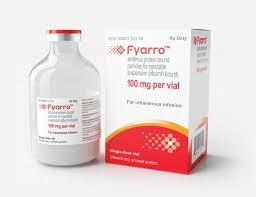
Instructions for sirolimus albumin-bound nanoparticle injection (FYARRO)
1. Name: FYARRO, sirolimus protein-bound particles for injectable suspension
2. Indications:
Sirolimus albumin-bound nanoparticle injection (FYARRO) is indicated for the treatment of adult patients with locally advanced unresectable or metastatic malignant perivascular epithelioid cell tumor (PEComa).
3. Usage and dosage:
1. Recommended dose:The recommended dose of sirolimus albumin-bound nanoparticle injection is100 mg/m2, which should be infused intravenously for 30 minutes on days 1 and 8 of each 21-day cycle until disease progression or unacceptable toxicity occurs.
2. Dose adjustment: If the patient experiences adverse reactions after infusion of sirolimus albumin-bound nanoparticle injection , the first dose should be reduced to 75mg/m2 (25% of the recommended dose), the second dose should be reduced to 56mg/m2 (The first dose reduction25%), The third dose should be reduced to 45mg/m2 (The second dose reduction25%). Patients who cannot tolerate it after the third dose reduction should permanently discontinue sirolimus albumin-bound nanoparticle injection.
3. Interaction: When used concurrently with moderate or weak cytochrome P-450 3A4 (CYP3A4) inhibitors, reduce the dose of sirolimus albumin-bound nanoparticle injection to 56 mg/m2. Patients should avoid concurrent use with drugs that are strong inhibitors and inducers of CYP3A4 and/or P-glycoprotein (P-gp), as well as grapefruit and grapefruit juice.
4. Patients with liver function impairment: Patients with mild liver function impairment (total bilirubin ≤ ULN, AST > ULN or total bilirubin > 1-1.5 × ULN, any AST) need to reduce the dose of sirolimus albumin-bound nanoparticle injection to 56 mg/m2. Patients with moderate hepatic impairment (total bilirubin >1.5-3.0 × ULN, any AST) require a dose reduction to 75 mg/m2. Avoid use in patients with severely impaired hepatic function.
4. Adverse reactions:
In clinical studies of sirolimus albumin-bound nanoparticle injection, the most common (≥30%) adverse reactions include stomatitis, fatigue, rash, infection, nausea, edema, diarrhea, musculoskeletal pain, weight loss, decreased appetite, cough, vomiting, and dysgeusia. The most common (≥6%) grade 3-4 laboratory abnormalities were lymphopenia, increased glucose, decreased potassium, decreased phosphate, decreased hemoglobin, and increased lipase.
5. Storage:
In order for Sirolimus Albumin-Bound Nanoparticle Injection to maintain its stability, unopened drug vials are stable until the date stated on the packaging when stored in the original packaging at 2°C-8°C (36°F to 46°F). Freezing and thawing will not adversely affect the stability of the product.
1. Stability of reconstituted suspension in vial: Reconstituted sirolimus albumin-bound nanoparticle injection in vial should be used immediately but may be refrigerated at 2°C to 8°C (36°F to 46°F) for up to 6 hours and stored in the original carton to avoid light. Discard any unused portion.
2. Stability of the reconstituted suspension in the infusion bag: The infusion suspension prepared in the infusion bag according to the prescription recommendations should be used immediately, but can be refrigerated at 2°C to 8°C (36°F to 46°F) and protected from light for up to 9 hours.
The total maximum combined refrigeration time for reconstituted sirolimus albumin-bound nanoparticle injection in vials and infusion bags is 15 hours. It can then be stored in the infusion bag at ambient temperature (approximately 25°C) and light for up to 4 hours. Discard any unused portion.
6. Taboo:
Sirolimus Albumin-Bound Nanoparticle Injection is contraindicated in patients with a history of severe allergy to sirolimus, other rapamycin derivatives, or albumin.
7. Mechanism of action:
Sirolimus in Sirolimus Albumin-Bound Nanoparticle Injection is a mechanistic target inhibitor of rapamycin kinase (mTOR, formerly known as the mammalian target of rapamycin). mTOR is a serine-threonine kinase located downstream of the PI3K/AKT pathway, controlling key cellular processes such as cell survival, growth and proliferation, and is commonly dysregulated in several human cancers. In cells, sirolimus binds to the immunophilin FK-binding protein-12 (FKBP-12), producing an immunosuppressive complex.
Sirolimus-FKBP-12 complex binds to and inhibits activation of the mechanistic target of rapamycin complex 1 (mTORC1) . In vitro and in vivo studies have shown that sirolimus inhibitsmTOR reduces cell proliferation, angiogenesis, and glucose uptake. In a nonclinical study of athymic mice bearing human tumor xenografts, intravenous administration of sirolimus albumin-bound nanoparticle injections resulted in higher sirolimus tumor accumulation, inhibition of mTOR targets in tumors, and tumor growth inhibition compared with oral administration of the same total weekly dose of sirolimus.
8. Special groups:
1. Women: Due to the possibility of serious adverse reactions in breastfed infants from sirolimus albumin-bound nanoparticle injection , women are advised not to breastfeed during drug treatment and within 2 weeks after the last dose; it is recommended that women of reproductive potential use effective contraceptive measures during drug treatment and within 12 weeks after the last dose.
2. Men: It is recommended that men with female partners of reproductive potential use effective contraceptive measures during treatment with sirolimus albumin-bound nanoparticle injection and within 12 weeks after the last dose of the drug.
The original drug of sirolimus albumin-bound nanoparticle injection has not yet been marketed in China, so it is not included in medical insurance. The US version of sirolimus albumin-bound nanoparticle injection Original drug, specifications The price of each 100mg tube may be around RMB 60,000 (the price may fluctuate due to the exchange rate), which is relatively expensive. Currently, there is no generic version of Sirolimus Albumin-Bound Nanoparticle Injection on the market. For more drug information and specific prices, please consult Yaode Medical Consultants.
[ 免责声明 ] 本页面内容来自公开渠道(如FDA官网、Drugs官网、原研药厂官网等),仅供持有医疗专业资质的人员用于医学药学研究参考,不构成任何治疗建议或药品推荐。所涉药品可能未在中国大陆获批上市,不适用于中国境内销售和使用。如需治疗,请咨询正规医疗机构。本站不提供药品销售或代购服务。


