
.jpeg)
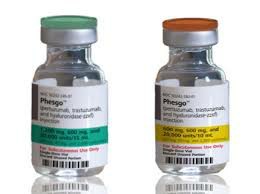
Instructions for Phesgo (Pertuzumab, Trastuzumab, and Hyaluronidase-zzxf)
1. Name:Pertuzumab, Trastuzumab, and Hyaluronidase-zzxf, Heshuangtuo subcutaneous injection,
Product name:Phesgo
2. Indications:
1. Early breast cancer (EBC): Phesgo is suitable for use in combination with intravenous chemotherapy:
(1) Neoadjuvant therapy for adult patients with HER2-positive, locally advanced, inflammatory, or early-stage breast cancer (greater than 2 cm in diameter or node-positive) as part of a complete treatment regimen for early-stage cancer.
(2) adjuvant treatment for adult patients with HER2-positive early-stage cancer who are at high risk of recurrence.
2. Metastatic breast cancer (MBC): Phesgo is suitable for combination treatment with docetaxel (docetaxel) for the treatment of adult patients with HER2-positive metastatic breast cancer who have not previously received anti-HER2 treatment or chemotherapy for metastatic disease.
3. Usage and dosage:
1. Before treatment: Select patients based on HER2 protein overexpression or HER2 gene amplification in tumor specimens. Assessment of HER2 protein overexpression and HER2 gene amplification should be performed by a laboratory with proven capabilities using an FDA-approved breast cancer-specific test.
2. Recommended dosage: The initial dose of Phesgo (1200 mg pertuzumab, 600 mg trastuzumab and 30,000 units of hyaluronidase) is 15 mL, administered subcutaneously for about 8 minutes; subsequently Phesgo (600 mg pertuzumab, 600 mg trastuzumab and 20,000 units of hyaluronidase) is administered every 3 weeks at a 10 mL maintenance dose, administered subcutaneously over approximately 5 minutes. Phesgo dosage does not need to be adjusted based on patient weight or concomitant chemotherapy regimen.
(1) Neoadjuvant treatment of breast cancer: As part of the treatment regimen for early-stage breast cancer, give Phesgo every 3 weeks for 3-6 cycles. After surgery, patients should continue to receive Phesgo for 1 year of treatment (up to 18 cycles) or until disease recurrence or uncontrollable toxicity, whichever occurs first, as part of a complete treatment regimen for early-stage cancer.
(2) Adjuvant treatment of breast cancer: Take Phesgo every 3 weeks for 1 year (up to 18 cycles) or until disease recurrence or uncontrolled toxicity, whichever occurs first, as part of a complete regimen for early-stage cancer, including standard anthracycline and/or taxane chemotherapy. StartPhesgo on day 1 of the first taxane-containing cycle.
(3) Metastatic breast cancer: When administered with Phesgo, the recommended initial dose of docetaxel is 75 mg/m2 administered as an intravenous infusion. If the initial dose is well tolerated, the dose may be increased to 100 mg/m2 every 3 weeks. TakePhesgo until disease progression or uncontrollable toxicity, whichever occurs first.
3. Management: Phesgo is only used for subcutaneous injection in the thigh, not intravenous injection. Do not use Phesgoinstead ofpertuzumab, trastuzumab, ado-trastuzumab emtansine, or fam-trastuzumab deruxtecan. Observe the patient for at least 30 minutes after the first dose of Phesgo and for at least 15 minutes after each maintenance dose of PHESGO for signs or allergic symptoms or administration-related reactions. Medications to treat such reactions, as well as first aid equipment, should be available immediately.
Patients currently receiving intravenous pertuzumab and trastuzumab can transition to Phesgo. In patients receiving intravenous pertuzumab and trastuzumab 6 weeks after the last dose, administer Phesgo as a maintenance dose and every 3 weeks for subsequent doses. In patients receiving intravenous pertuzumab and trastuzumab ≥6 weeks after the last dose, administer Phesgo at its recommended dose.
4. Dosage adjustment:
(1) For delayed or missed doses of Phesgo, if the time between two consecutive injections is less than 6 weeks, give the maintenance dose of Phesgo without waiting for the next scheduled dose; if the time between two consecutive injections is 6 weeks or longer, re-administer Phesgo and re-apply at its recommended dose.
4. Adverse reactions:
The most common side effects in Phesgo's clinical studies can include hair loss, diarrhea, nausea, anemia (low red blood cell count), weakness and joint pain. The most common serious side effects include neutropenia (low white blood cell count) with or without fever, heart failure (when the heart cannot pump blood properly), fever, blood or lung infection (sepsis, pneumonia) and decreased neutrophil (a type of white blood cell) count. PhesgoAfter being launched on the market, adverse events such as glomerulopathy, immune thrombocytopenia, and tumor lysis syndrome(TLS) have occurred.
5. Storage:
1. Store Phesgo vials in the original carton in a refrigerator at 2-8°C (36-46°F) to avoid light. Do not freeze. Don't shake.
2. If the dose is not to be administered immediately and the PPhesgo solution has been removed from the vial into the syringe, replace the transfer needle with the syringe closure cap. Attach a peel-off label to the syringe and store the syringe in the refrigerator at 2-8°C (36-46°F) for up to 24 hours and at room temperature at 20-25°C (68-77°F) for up to 4 hours to avoid unnecessary storage.
6. Taboo:
Phesgo is contraindicated in patients with known hypersensitivity to pertuzumab, trastuzumab, hyaluronidase, or any of its excipients.
7. Mechanism of action:
Pertuzumab targets the extracellular dimerization domain (subdomain II) of HER2, thereby blocking ligand-dependent heterodimerization of HER2 with other HER family members, including EGFR, HER3, and HER4. Thus, pertuzumab inhibits ligand-initiated intracellular signaling through two major signaling pathways, mitogen-activated protein (MAP) kinase and phosphoinositide 3-kinase (PI3K). Inhibition of these signaling pathways can lead to cell growth arrest and apoptosis, respectively. Trastuzumab binds to subdomain IV of the extracellular domain of the HER2 protein to inhibit ligand-independent, HER2-mediated cell proliferation and the PI3K signaling pathway in human tumor cells overexpressing HER2.
Both pertuzumab and trastuzumab-mediated antibody-dependent cell-mediated cytotoxicity (ADCC) were shown to preferentially act on cancer cells that overexpress HER2 compared with cancer cells that do not express HER2. While pertuzumab alone inhibited the proliferation of human tumor cells, the combination of pertuzumab and trastuzumab enhanced antitumor activity in a HER2-overexpressing xenograft model.
Hyaluronidase (hyaluronic acid) is a polysaccharide found in the extracellular matrix of subcutaneous tissue. It is depolymerized by the naturally occurring hyaluronidase enzyme. Unlike the stable structural components of the interstitial matrix, hyaluronic acid has a half-life of approximately 0.5 days. Hyaluronidase increases the permeability of subcutaneous tissue by depolymerizing hyaluronic acid. In administered doses, the hyaluronidase in Phesgo acts transiently and locally. The effect of hyaluronidase is reversible, and the permeability of the subcutaneous tissue is restored within 24-48 hours. Hyaluronidase has been shown to increase the absorption of trastuzumab products into the systemic circulation when injected subcutaneously in animals.
[ 免责声明 ] 本页面内容来自公开渠道(如FDA官网、Drugs官网、原研药厂官网等),仅供持有医疗专业资质的人员用于医学药学研究参考,不构成任何治疗建议或药品推荐。所涉药品可能未在中国大陆获批上市,不适用于中国境内销售和使用。如需治疗,请咨询正规医疗机构。本站不提供药品销售或代购服务。


