
.jpeg)
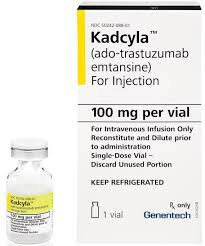
Instructions for Ado-trastuzumab emtansine
1. Generic name: Trastuzumab
Product name:KADCYLA/Hersele
All names: Ado-trastuzumab emtansine, Ado-trastuzumab emtansine, TDM-1
2. Indications:
1. Metastatic breast cancer (MBC): Ado-trastuzumab emtansine, as a single drug, is suitable for the treatment of patients with HER2-positive metastatic breast cancer who have previously received trastuzumab and taxane, respectively or in combination. Patients should have any of the following conditions:
(1) received prior treatment for metastatic disease, or
(2) Disease recurrence during or within six months of completion of adjuvant therapy.
2. Early Breast Cancer (EBC): As a single agent, EBC is indicated for the adjuvant treatment of patients with HER2-positive early breast cancer who have residual invasive disease after receiving taxane- and trastuzumab-based neoadjuvant therapy.
3. Usage and dosage:
1. Medication selection: Select patients based on HER2 protein overexpression or HER2 gene amplification in tumor specimens. Assessment of HER2 protein overexpression and/or HER2 gene amplification should be performed by a laboratory with demonstrated capabilities using an FDA-approved breast cancer-specific test. Do not substitute trastuzumab for trastuzumab.
2. Recommended dose: The recommended dose of trastuzumab is 3.6mg/kg, intravenously infused once every 3 weeks (21-day cycle). Do not administer trastuzumab in doses greater than 3.6 mg/kg. Patients with metastatic breast cancer (MBC) should receive treatment until disease progression or uncontrollable toxicity; patients with early-stage breast cancer (EBC) should receive a total of 14 cycles of treatment unless disease relapse or uncontrollable toxicity occurs.
(1) First infusion: The infusion time exceeds 90 minutes. During the infusion and at least 90 minutes after the first dose, observe whether the patient develops fever, chills or other infusion-related reactions.
(2) Subsequent infusions: If the previous infusion is well tolerated, administer within 30 minutes. Observe the patient during and for at least 30 minutes after the infusion.
3. Dosage adjustment: If the patient experiences adverse reactions after using Trastuzumab, the doctor will adjust the dose according to the adverse reactions. The first dose will be reduced to 3mg/kg, and the second dose will be reduced to 2.4mg/kg. If the patient needs to further reduce the dose, Trastuzumab treatment should be stopped. And after reducing the dose, do not increase the dose of trastuzumab.
If the scheduled dose is delayed or missed, give the dose as soon as possible. Adjust the dosing schedule to maintain an interval of three weeks between doses. Administer the infusion at the dose and rate that the patient tolerated during the most recent infusion. If a patient experiences an infusion-related reaction, slow down or interrupt the trastuzumab infusion rate. Trastuzumab was permanently discontinued due to life-threatening infusion-related reactions.
4. Adverse reactions:
In clinical studies of trastuzumab in the treatment of metastatic breast cancer, the most common (≥25%) adverse reactions were fatigue, nausea, musculoskeletal pain, bleeding, thrombocytopenia, headache, elevated transaminases, constipation, and epistaxis. In clinical studies of trastuzumab in early-stage breast cancer, the most common adverse reactions (≥25%) were fatigue, nausea, elevated transaminases, musculoskeletal pain, bleeding, thrombocytopenia, headache, peripheral neuropathy, and arthralgia. After trastuzumab was marketed, spontaneously reported adverse reactions included tumor lysis syndrome and skin/tissue necrosis after extravasation.
5. Storage:
Store vials of trastuzumab injection in a refrigerator at 2°C to 8°C (36°F to 46°F) until reconstituted. Do not freeze or shake. Diluted trastuzumab should be administered immediately for infusion. If not used immediately, the solution can be stored in the refrigerator at 2°C to 8°C (36°F to 46°F) for up to 24 hours before use. If not used immediately, discard unused trastuzumab after 24 hours.
6. Special groups:
1. Women: Use of trastuzumab during pregnancy may cause embryo-fetal damage. Advise females of reproductive potential to use an effective method of contraception during treatment and for 7 months after the last dose; advise females not to breastfeed during treatment and for 7 months after the last dose.
2. Males: Due to potential genotoxicity, it is recommended that male patients with female partners of reproductive potential use effective contraception during treatment with trastuzumab and for 4 months after the last dose.
7. Overdose:
There is no known antidote for trastuzumab overdose. In clinical trials, overdoses of trastuzumab at approximately twice the recommended dose have been reported, resulting inGrade 2 thrombocytopenia (resolved after 4 days) and one death. In the fatal case, the patient mistakenly received 6 mg/kg of trastuzumab and died approximately 3 weeks after the overdose; the cause of death and causal relationship to trastuzumab have not been determined.
8. Mechanism of action:
Trastuzumab is aHER2-targeted antibody-drug conjugate. The antibody is humanized anti-HER2 IgG1, trastuzumab, and the small molecule cytotoxin DM1 is a microtubule inhibitor. Upon binding to subdomain IV of the HER2 receptor, trastuzumab undergoes receptor-mediated internalization and subsequent lysosomal degradation, resulting in the intracellular release of DM1-containing cytotoxic catabolites. The binding of DM1 to tubulin disrupts the microtubule network in cells, leading to cell cycle arrest and apoptotic cell death. In addition, in vitro studies have shown that, similar to trastuzumab, trastuzumab inhibits HER2 receptor signaling, mediates antibody-dependent cell-mediated cytotoxicity, and inhibits shedding of the HER2 extracellular domain in human breast cancer cells overexpressing HER2.
[ 免责声明 ] 本页面内容来自公开渠道(如FDA官网、Drugs官网、原研药厂官网等),仅供持有医疗专业资质的人员用于医学药学研究参考,不构成任何治疗建议或药品推荐。所涉药品可能未在中国大陆获批上市,不适用于中国境内销售和使用。如需治疗,请咨询正规医疗机构。本站不提供药品销售或代购服务。


