
.jpeg)
How effective is dabrafenib?
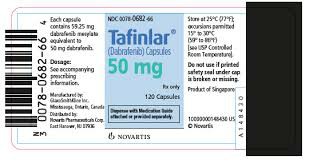
Dabrafenib (Dabrafenib) is a BRAF kinase inhibitor, mainly used to treat patients with BRAF V600E or V600K gene mutation malignant melanoma (MM) and non-small cell lung cancer (NSCLC). Its therapeutic effect has been verified in multiple clinical trials. The following are some key clinical trial data to demonstrate the efficacy of dabrafenib in cancer treatment.
1. Malignant melanomaBRIM series of clinical trials: The initial clinical trials mainly focused on patients with malignant melanoma. The BRIM series of clinical trials is a key trial to evaluate the efficacy of dabrafenib in this patient population.
In the BRIM-3 trial, patients with BRAF V600E mutated malignant melanoma were treated with either dabrafenib or the chemotherapy drug dexamethasone (Dacarbazine). The results showed that patients treated with dabrafenib were significantly better than the chemotherapy group in terms of progression-free survival (Progression-Free Survival, PFS) and overall survival (Overall Survival, OS).
2. The BREAK-MB trial of non-small cell lung cancer: The BREAK-MB trial is mainly aimed at patients with non-small cell lung cancer who carry the BRAF V600E mutation. In this multicenter, open-label clinical trial, patients received dabrafenib. The results showed that dabrafenib showed significant activity in this patient population, causing tumor shrinkage and improved overall survival time in some patients.
3. Combined therapyCOMBI-d and COMBI-vTrials: Because monotherapy may lead to the development of resistance, several studies have explored the efficacy of dabrafenib in combination with the MEK inhibitor trametinib. The COMBI-d trial and the COMBI-v trial were each studied in patients with BRAF V600E/K mutated malignant melanoma.
In theCOMBI-d trial, patients received a combination of dabrafenib and trametinib, and the combination group achieved significant improvements in progression-free survival and overall survival compared with patients who received dabrafenib alone.
Similar results were obtained in the COMBI-v trial, showing that the combination treatment group showed better results in terms of survival time and tumor shrinkage than the single-agent treatment group.
4. Research on drug resistance: However, clinical trials have also revealed that some patients may develop resistance to dabrafenib during treatment. This makes researchers pay more attention to the study of drug resistance mechanisms to find new treatment strategies.
5. Studies on different populations: Some studies have also explored the efficacy of dabrafenib in different populations, including elderly patients and patients with impaired liver function. These studies help to better understand the therapeutic efficacy and safety of dabrafenib in different patient populations.
Overall, clinical trial data show that dabrafenib has a significant therapeutic effect on patients with malignant melanoma and non-small cell lung cancer carrying BRAF V600E or V600K gene mutations. However, considering factors such as drug resistance, individualized treatment strategies and monitoring are still necessary to better manage patients' condition. At the same time, further research on dabrafenib treatment is still ongoing to continuously improve its therapeutic effect and promote the development of personalized treatment.
Dabrafenib is already on the market in China and has been included in medical insurance. Patients can buy it domestically. The price is about 10,000 yuan in China. The price is still relatively expensive. Please consult the local hospital pharmacy for specific prices. Dabrafenib, which is relatively cheap abroad, is mainly a generic drug, mainly a Laotian generic drug. The price is about two to three thousand yuan, which is much cheaper than domestic drugs. The ingredients of foreign generic drugs and domestic original drugs are basically the same.
[ 免责声明 ] 本页面内容来自公开渠道(如FDA官网、Drugs官网、原研药厂官网等),仅供持有医疗专业资质的人员用于医学药学研究参考,不构成任何治疗建议或药品推荐。所涉药品可能未在中国大陆获批上市,不适用于中国境内销售和使用。如需治疗,请咨询正规医疗机构。本站不提供药品销售或代购服务。


