
.jpeg)
ROAR Study Updates Dabrafenib/Trametinib Cure Benefits in BRAF V600E+ATC
The combination of dabrafenib and trametinib is more effective in patients with BRAF, based on findings from the Phase 2 ROAR study (NCT02034110) of patients with various rare cancers with BRAF V600E mutations. Demonstrated promising anti-tumor activity in patients with V600E-mutated anaplastic thyroid cancer (ATC). Preliminary results from the ROAR study led to the FDA's accelerated approval of dabrafenib/trametinib in 2022 for the treatment of patients with unresectable or metastatic solid tumors harboring BRAF V600E mutations , with results announced for 206 patients, including 36 patients with ATC. These are the final data on the primary endpoint of overall response rate (ORR), secondary endpoints of duration of response (DOR), progression-free survival (PFS), overall survival (OS) and incidence of adverse events (AEs).
Among 36 patients in the ATC cohort who received dabrafenib/trametinib, the investigator-assessed ORR was 56%. Among responders, 8% achieved complete response (CR). A partial response (PR) was observed in 47% of patients, with the remaining patients having stable disease (SD; 31%), or progressive disease (PD; 11%), according to investigator assessment, with a median investigator-assessed duration of response (DOR) of 14.4 months (7.4 months not reached [NR]).
However, independent radiologic evaluation showedthe ORR was 53%. The CR rate observed was 6%, PR rate 47%, SD rate 22%, and PD rate 22%. The median observed DOR was 13.6 months (range 3.8-39.4). The median DOR by independent radiological assessment was 13.6 months (range 3.8-39.4). Investigator-assessed survival showed a median PFS of 6.7 months (range 4.7-13.8). According to independent radiologic evaluation, the median PFS was 5.5 months (range 3.7-12.9). Median OS was 14.5 months (95% CI, 6.8-23.2).
All 36 patients in the ATC cohort experienced any grade AE. The most common AEs occurred in more than 20% of patients and included fever (47.2%), anemia (36.1%), fatigue (36.2%), nausea (33.3%), and rash (27.8%). In the study, AEs of particular concern that frequently occurred in ATC patients included skin toxicity (50.0%), pyrexia (47.2%), and bleeding (33.3%). Common serious AEs in the ATC cohort were pneumonia (22.2%) and pleural effusion (8.3%). Among all serious AEs observed in the ATC group, pyrexia, decreased neutrophil count, and leukopenia were considered treatment-related.
It is worth noting that 66.7% of ATC patients died during the study period. The main causes of death were non-cardiovascular causes (58.3%) and arterial thromboembolism (55.6%). AEs leading to treatment discontinuation occurred in 16.7% of patients and included dyspnea and pleural effusion, each in 5.6%, and nausea, decreased ejection fraction, and pneumonitis, in 2.8% each.
At baseline,83% of patients in the ATC cohort had an ECOG performance score of 1, while 11% had a score of 0 and the remaining 6% had a score of 2. Time since last diagnosis is 125.0 days. All patients in the ATC cohort had measurable disease at screening, and 81% had non-target lesions at that time. 97% of patients had IVC disease and 3% had stage IV disease. In terms of previous treatment, 50% of patients had received 1 radiotherapy, 31% had received 2 radiotherapy, and 19% had received 0 radiotherapy. Prior anticancer therapy was the prior treatment for all patients in the ATC cohort, with most patients receiving chemotherapy (98%), radiotherapy (83%), and surgery (83%).
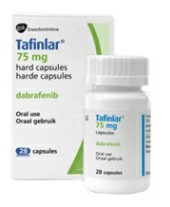
The original drug of dabrafenib is relatively expensive and has been covered by medical insurance since it was launched in China. Currently only eligible patients are reimbursed. The price of each box of 50mg*120 capsules may be around around 10,000. The Turkish version of the original drug Dabrafenib sold overseas, Specifications 75mg*120 capsules, may cost around 10,000 per box (the price may fluctuate due to exchange rates). There are also relatively cheap generics of dabrafenib sold overseas, and their pharmaceutical ingredients are basically the same as those of the original drugs sold domestically and abroad. For example, Specifications produced by Laos Pharmaceutical Factory The price of 75mg*120 tablets per box may be more than 4,000 yuan (the price may fluctuate due to exchange rates).
[ 免责声明 ] 本页面内容来自公开渠道(如FDA官网、Drugs官网、原研药厂官网等),仅供持有医疗专业资质的人员用于医学药学研究参考,不构成任何治疗建议或药品推荐。所涉药品可能未在中国大陆获批上市,不适用于中国境内销售和使用。如需治疗,请咨询正规医疗机构。本站不提供药品销售或代购服务。


