
.jpeg)
Dabrafenib, tramatinib and Navitoclax combination shows promise for metastatic melanoma
Based on clinical study results, the phase 2 CTEP-P9466 trial (NCT01989585) evaluating dabrafenib in combination with tramatinib (Mekinist) and navitoclax in BRAF The co-primary endpoint of complete response (CR) rate versus historical controls was achieved in patients with V600-mutated metastatic melanoma.
The results showed that patients who received the triple combination (n=25) experienced an 84% overall response rate (ORR), including a 20% CR rate and a 64% partial response rate (PR). In this group, 12% of patients had stable disease and 4% had progressive disease. The ORR of patients (n=25) who received dabrafenib plus tramacitinib alone was 80%, with a CR rate of 16%, a PR rate of 64%, and an SD rate of 8%. No patients developed PD in this arm. Patients in the triplet group experienced an average maximum tumor reduction of -68.8% (minimum, -2.1%; maximum, -100%), compared with a minimum of -63.1% (minimum6.7%; maximum, -100%). The mean maximum tumor regression was -63.6% (standard deviation, 27.1) for triplet versus -63.9% (standard deviation, 27.1) for triplet (P=0.88). Although BRAF/MEK inhibitors are highly effective treatment standards for BRAF-mutant melanoma, resistance to MAPK pathway inhibition limits the durability of responses.
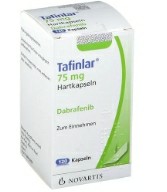
The investigators hypothesized that administering navitoclax before a dualBRAF inhibitor regimen and then continuing the combination would improve response and survival outcomes by inhibitingBCL-2. Previous data from the Phase 1 dose-escalation portion of CTEP-P9466 showed the triplet produced clinical efficacy in 20 patients with BRAF-mutant solid tumors, including 10 patients with metastatic melanoma. The recommended Phase 2 doses (RP2D) of the combination are dabrafenib 150 mg twice daily, tramatinib 2 mg daily, and navitoclax 225 mg daily.
The trial recruitedPatients 18 years of age or older with histologically confirmed BRAF v 600-mutant (E/K) advanced melanoma and measurable disease. Patients who were previously treated with ICIs were allowed but were not eligible if they were previously exposed to a BRAF inhibitor. Patients with brain metastases were also eligible as long as they had received treatment for at least 3 months before inclusion. Also requires an ECOG performance status of 0 or 1. Key secondary endpoints include ORR, progression-free survival (PFS), and overall survival (OS).
With a median follow-up of 27.4 months, the median PFS was 20.9 months (95% CI, 11.3-not reached [NR]) in the triplet arm and 21.7 months (95% CI, 9.6-NR) in the triplet arm (log-rank P=0.7). Further efficacy analysis showed that compared with dabrafenib and tramatinib alone, patients treated with navitoclax, dabrafenib and tramatinib had a trend towards improved OS. The 2-year OS rate of the experimental group was 74% (95% CI, 50%-87%), and that of the dual group was 57% (95% CI, 34%-74%) (P=0.16). In patients with lower baseline tumor burden, the 2-year OS rates were 80% (95% CI, 50%-93%) and 59% (95% CI, 32%-79%) for doublets and triplet, respectively (P=0.06). Across the entire population, median OS was 36 months (95% CI, 23-NR).
Regarding safety, 2 patients in each study group discontinued treatment due to treatment-related adverse effects (TRAEs). On average, patients in the triplet group experienced 12.9 cycles of treatment, while patients in the doublet group experienced 12.1 cycles of treatment. Most TRAEs are primary and secondary. TRAEs of any grade observed in more than 50% of patients included nausea (n=36), diarrhea (n=32), fatigue (n=31), and pyrexia (n=28).
The original drug of dabrafenib is relatively expensive and has been covered by medical insurance since it was launched in China. Currently only eligible patients are reimbursed. The price of each box of 50mg*120 capsules may be around around 10,000. The Turkish version of the original drug Dabrafenib sold overseas, Specifications 75mg*120 capsules, may cost around 10,000 per box (the price may fluctuate due to exchange rates). There are also relatively cheap generics of dabrafenib sold overseas, and their pharmaceutical ingredients are basically the same as those of the original drugs sold domestically and abroad. For example, Specifications produced by Laos Pharmaceutical Factory The price of 75mg*120 tablets per box may be more than 4,000 yuan (the price may fluctuate due to exchange rates).
[ 免责声明 ] 本页面内容来自公开渠道(如FDA官网、Drugs官网、原研药厂官网等),仅供持有医疗专业资质的人员用于医学药学研究参考,不构成任何治疗建议或药品推荐。所涉药品可能未在中国大陆获批上市,不适用于中国境内销售和使用。如需治疗,请咨询正规医疗机构。本站不提供药品销售或代购服务。


