
.jpeg)
Must-read for patients: Overview of basic information in the instructions for mobosertinib
1. Name: Mobocertinib, Mobocertinib, Mobocertinib succinate , TAK-788
Product name:Exkivity, Anweili
2. Indications:
Mobocertinib is indicated for the treatment of adult patients with locally advanced or metastatic non-small cell lung cancer (NSCLC) with epidermal growth factor receptor (EGFR) exon 20 insertion mutations whose disease has progressed on or after platinum-based chemotherapy.
3. Usage and dosage:
1. Before treatment: Doctors will select patients with locally advanced or metastatic non-small cell lung cancer to receive mobosetinib treatment based on the presence of EGFR exon 20 insertion mutations. Before treatment, doctors will also assess QTc and electrolytes to correct abnormalities in sodium, potassium, calcium and magnesium.
2. Recommended dose: The recommended dose of mobosetinib is 160 mg taken orally once daily until disease progression or unacceptable toxicity occurs; take mobosetinib at the same time every day with or without food.
3. Dosage adjustment: If the patient experiences adverse reactions during treatment with mobosetinib, the doctor will adjust the drug dose according to the severity of the condition; the first dose of mobosetinib can be reduced to taken orally once a day120mg; the second dose can be reduced to 80mg taken orally once a day.
(1) Coadministration: Avoid the concomitant use of mobosetinibwith moderateCYP3A inhibitors. If this cannot be avoided, reduce the dose by approximately 50% (i.e., from 160 to 80 mg, 120 to 40 mg, or 80 to 40 mg) and monitor the QTc interval more frequently. After discontinuation of the moderate CYP3A inhibitor, wait 3 to 5 elimination half-lives before resuming the dose before taking the moderate CYP3A inhibitor.
(2) Patients with severe renal impairment: Reduce the mobosetinib dose by approximately 50% (i.e., from 160 to 80 mg, 120 to 40 mg, or 80 to 40 mg) and monitor the QTc interval more frequently in patients with severe renal impairment.
4. Adverse reactions:
In clinical studies of moboxetinib, the most common (>20%) adverse reactions were diarrhea, rash, nausea, stomatitis, vomiting, decreased appetite, paronychia, fatigue, dry skin, and musculoskeletal pain. The most common (≥2%) grade 3 or 4 laboratory abnormalities were lymphopenia, increased amylase, increased lipase, decreased potassium, decreased hemoglobin, increased creatinine, and decreased magnesium. Serious adverse reactions occurred in ≥2% of patients, including diarrhea, dyspnea, vomiting, pyrexia, acute kidney injury, nausea, pleural effusion, and heart failure.
5. Storage:
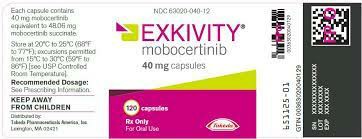
Mobosertinib is available as 40 mg capsules and can be stored20°C to 25°C (68°F to 77°F); permitted excursions are 15°C to 30°C (59°F to 86°F).
6. Special groups:
1. Women: Taking moboxetinib by pregnant women will cause harm to the fetus. Because mobosetinib may render hormonal contraceptives ineffective, advise women of reproductive potential to use effective non-hormonal contraceptives during treatment with the drug and for 1 month after the last dose; advise women not to breastfeed during treatment with the drug and for 1 week after the last dose.
2. Men: According to animal studies, mobosetinib may damage the fertility of male animals with reproductive potential. It is recommended that men who are female partners of reproductive potential use effective contraceptive measures during drug treatment and within 1 week after the last dose.
7. Mechanism of action:
Mobosetinib is a kinase inhibitor of the epidermal growth factor receptor (EGFR) that irreversibly binds to and inhibits EGFR exon 20 insertion mutations at lower concentrations than wild-type (WT) EGFR. After oral administration of moboxetinib, two pharmacologically active metabolites (AP32960 and AP32914) with similar inhibitory effects on moboxetinib were found in plasma. In vitro, mobosetinib also inhibits the activity of other EGFR family members (HER2 and HER4) and an additional kinase (BLK) at clinically relevant concentrations (IC50 values u200bu200b<2 nM).
In cultured cell models, mobosetinib inhibited cell proliferation driven by different EGFR exon 20 insertion mutation variants at concentrations 1.5- to 10-fold lower than WT-EGFR signaling inhibition. In animal tumor implantation models, mobosertinib demonstrated antitumor activity against xenografts harboring EGFR exon 20 insertions NPH or ASV.
[ 免责声明 ] 本页面内容来自公开渠道(如FDA官网、Drugs官网、原研药厂官网等),仅供持有医疗专业资质的人员用于医学药学研究参考,不构成任何治疗建议或药品推荐。所涉药品可能未在中国大陆获批上市,不适用于中国境内销售和使用。如需治疗,请咨询正规医疗机构。本站不提供药品销售或代购服务。


