
.jpeg)
Ramucirumab (ramucirumab) detailed instructions
1. Indications and Usage
Ramucirumab (ramucirumab)isa human vascular endothelial growth factor receptor2 (VEGFR 2) antagonist suitable for:
For the treatment of advanced or metastatic gastric or gastroesophageal junction adenocarcinoma that has progressed during or after prior fluoropyrimidine- or platinum-containing chemotherapy, as a single agent or in combination with paclitaxel.
In combination with erlotinib, it is indicated for the first-line treatment of metastatic non-small cell lung cancer with epidermal growth factor receptor (EGFR) exon 19 deletion or exon 21 (L858R) mutation.
In combination with docetaxel, it is indicated for the treatment of metastatic non-small cell lung cancer that has progressed during or after platinum-based chemotherapy. Patients with EGFR or ALK genomic tumor abnormalities should have disease progression on an FDA-approved therapy for these abnormalities before receiving treatment with cilenza.
In combination withFOLFIRI, for the treatment of metastatic colorectal cancer that has progressed on or after prior treatment with bevacizumab, oxaliplatin, and a fluoropyrimidine.
As a single agent, it is used to treat patients with hepatocellular carcinoma who have alpha-fetoprotein≥400 ng/mL and have received sorafenib treatment.
2. Dosage and usage
For intravenous infusion use only. Do not give by intravenous push or bolus injection.
Premedicate before each infusion.
Gastric cancer: Ramucirumab at 8 mg/kg once every 2 weeks as a single agent or paclitaxel once a week.
Non-small cell lung cancer:
Take erlotinib daily and ramucirumab 10 mg/kg every 2 weeks.
Take ramucirumab at 10 mg/kg on day of a 21 day cycle before docetaxel.
Colorectal Cancer:Take ramucirumab at 8 mg/kg every 2 weeks before taking FOLFIRI.
Hepatocellular carcinoma:88mg/kg oframucirumab given once every two weeks.
Three. Dosage form and strength
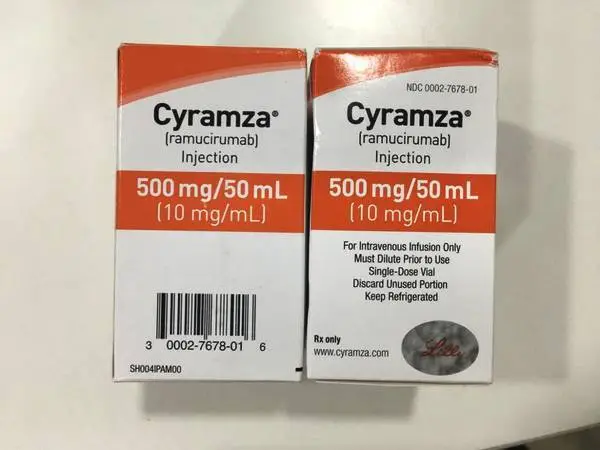
Injection: 100mg/10ml (10mg/ml) or 500mg/50ml (10mg/ml) solution
Four. Contraindications
None
Five. Warnings and Precautions
Bleeding: Ramucirumab may increase the risk of bleeding and gastrointestinal bleeding, including serious and fatal events. Ramucirumab should be permanently discontinued in patients who develop severe bleeding.
Gastrointestinal perforation: Ramucirumab increases the risk of gastrointestinal perforation, which may be fatal. Ramucirumab should be permanently discontinued in patients who develop gastrointestinal perforation.
Impaired wound healing:Discontinue silamza 28 days before elective surgery. Do not take ramucirumab for at least2 weeks after major surgery, until the wound is completely healed. The safety of resuming ramucirumab after resolution of wound healing complications has not been established.
Arterial Thromboembolic Events: Serious and sometimes fatal acute respiratory tract infections may occur with ramucirumab. Patients with ATE should permanently discontinue ramucirumab.
Hypertension:Monitor blood pressure and treat high blood pressure. Discontinue ramucirumab in patients with severe hypertension. Ramucirumab should be permanently discontinued in patients with hypertension uncontrolled by antihypertensive therapy and in hypertensive crisis or hypertensive encephalopathy.
Infusion-related reactions (IRR):Monitor for signs and symptoms during infusion. Reduce the infusion rate of Grade 1 or Grade 2IRR and Permanently discontinue the infusion rate of Grade or Grade Grade IRR.
Exacerbation of existing liver damage: Patients with Child-Pugh B or C cirrhosis may develop new or worsening encephalopathy, ascites, or hepatorenal syndrome.
Posterior reversible encephalopathy syndrome: Permanently discontinued Ramucirumab .
Proteinuria includes nephrotic syndrome:Monitor for proteinuria. Ramucirumab should be discontinued in patients with urine protein levels greater than or equal to 2 g/span>per 24 hours. Permanently discontinue ramucirumab if urine protein levels exceed 3 grams per 24 hours or if nephrotic syndrome occurs.
Thyroid Dysfunction:Monitor thyroid function during treatment.
Embryo-Fetal Toxicity:Can cause fetal harm. Inform women of reproductive potential of potential risks to the fetus and use effective contraceptive measures.
6. Adverse reactions
The most common adverse reactions observed in patients with gastric cancer treated with single agent ramucirumab were hypertension and diarrhea, which occurred more frequently than placebo by 10% and 2%.
The most common adverse reactions observed in patients receiving ramucirumab in combination with paclitaxel were fatigue, asthenia, neutropenia, diarrhea, and epistaxis, which occurred more frequently than in patients treated with placebo plus paclitaxel ≥30% and ≥2% compared with placebo plus paclitaxel.
The most common adverse reactions observed in patients treated with selenza and erlotinib at rates ≥30% and ≥2% compared with placebo were infection, hypertension, stomatitis, proteinuria, alopecia, and epistaxis. The most common laboratory abnormalities with an incidence difference between the two groups of ≥30% and ≥2% were elevated alanine aminotransferase, elevated aspartate aminotransferase, anemia, thrombocytopenia, and neutropenia.
The most common adverse reactions observed in patients receivingramucirumab in combination with docetaxel were neutropenia, fatigue/asthenia, and stomatitis/ span>Mucosal inflammation, with an incidence greater than ≥30% and ≥2% in patients treated with placebo plus docetaxel.
Most common adverse effects observed in patients treated with ramucirumab and FOLFIRI compared with placebo FOLFIRI The incidence of reactions was ≥30% and ≥2%, including diarrhea, neutropenia, decreased appetite, epistaxis, and stomatitis. (6.1)
The most common adverse reactions observed in HCCpatients treated with single agent cilenza at rates ≥15% and ≥2% compared with placebo were fatigue, peripheral edema, hypertension, abdominal pain, decreased appetite, proteinuria, nausea, and ascites. The most common laboratory abnormalities were thrombocytopenia, hypoalbuminemia, and hyponatremia, with an incidence rate of ≥30% and a difference of ≥2% between the two groups.
7. Use among specific groups of people
Breastfeeding:Breastfeeding is not recommended.
Ramucirumab This drug is available in Hong Kong, and the retail price in Hong Kong pharmacies is about 500mg3 around 10,000. If you want to get more quality information, you can contact usYaoDe, YaoDe will do its best to learn more about overseas high-quality drugs for you.
xa0
xa0
[ 免责声明 ] 本页面内容来自公开渠道(如FDA官网、Drugs官网、原研药厂官网等),仅供持有医疗专业资质的人员用于医学药学研究参考,不构成任何治疗建议或药品推荐。所涉药品可能未在中国大陆获批上市,不适用于中国境内销售和使用。如需治疗,请咨询正规医疗机构。本站不提供药品销售或代购服务。


