
.jpeg)
Eltrombopag/eltrombopag instructions
1. Common name: Eltrombopag,Eltrombopag
Product name: Revolade,Revolade
Other names: Eltrombopag, Promacta
2. Indications:
1. Treatment of thrombocytopenia (ITP) in patients with persistent or chronic immune thrombocytopenia: Eltrombopag is indicated for the treatment of thrombocytopenia in adult and pediatric patients 1 year and older with persistent or chronic immune thrombocytopenia who have an inadequate response to corticosteroids, immunoglobulins, or splenectomy.
Eltrombopag should be used only in patients with ITP whose degree of thrombocytopenia and clinical conditions increase the risk of bleeding.
2. Treatment of thrombocytopenia in patients with hepatitis C infection: Eltrombopag is used to treat thrombocytopenia in patients with chronic hepatitis C infection in order to initiate and maintain interferon-based therapy.
Eltrombopag should be used only in patients with chronic hepatitis C who have a degree of thrombocytopenia that prevents initiation of interferon-based therapy or limits the ability to maintain interferon-based therapy.
3. Treatment of severe aplastic anemia (AA): Eltrombopag is suitable for use in combination with standard immunosuppressive therapy (IST) as the first-line treatment for adults and children with severe aplastic anemia aged 2 years and above; it is also used to treat patients with severe aplastic anemia who have insufficient response to immunosuppressive therapy.
4. Use restrictions
Eltrombopag is not indicated for the treatment of patients with myelodysplastic syndrome (MDS); the safety and efficacy of eltrombopag in combination with interferon-free direct-acting antivirals for the treatment of chronic hepatitis C infection have not been established.
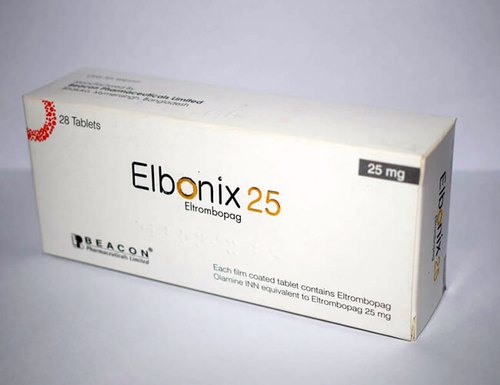
3. Usage and dosage:
1. Recommended dosage:
(1) Persistent or chronic immune ITP: The dosage of eltrombopag for pediatric patients 1 to 5 years old is 25 mg once daily; the dosage for adult and pediatric ITP patients 6 years and above is 50 mg once daily; for patients with ITP and mild, moderate or severe hepatic impairment (Child-Pugh Class A, B, C), the starting dose of eltrombopag is 25 mg once daily. For patients with ITP of East/Southeast Asian ancestry, start eltrombopag at a dose of 25 mg once daily; in patients with ITP and mild, moderate, or severe hepatic impairment, start with eltrombopag at a dose of 12.5 mg once daily.
Studies have shown that after starting eltrombopag, the dose needs to be adjusted to achieve and maintain a platelet count≥50*109/L to reduce the risk of bleeding. Do not exceed the daily dose of 75 mg. Platelet counts usually increase within 1 to 2 weeks after starting treatment with the drug and decrease within 1 to 2 weeks after stopping it. If platelet counts do not increase to a level sufficient to avoid clinically important bleeding after 4 weeks of treatment with a maximum daily dose of 75 mg, discontinue eltrombopag.
(2) Chronic hepatitis C-related ITPITP: The initial dose of eltrombopag for patients is 25 mg once daily; the dose is subsequently adjusted in 25 mg increments every 2 weeks to achieve the target platelet count required to initiate antiviral therapy. Before starting antiviral therapy, monitor platelet counts weekly. Do not exceed daily dose of 100mg. Eltrombopag should be discontinued when antiviral therapy is discontinued.
(3) Heavy dutyAA:
[1] First-line severe diseaseAA: Start eltrombopag at the same time as standard immunosuppressive therapy. Pediatric patients aged 2-5 years old use a dose of 2.5mg/kg; pediatric patients aged 6-11 years old use a dose of 75mg; patients 12 years old and above use a dose of 150mg, once daily for 6 months. The first-line treatment dose is reduced by 50% for patients with severe AA of East Asian/Southeast Asian ancestry or patients with mild, moderate, or severe hepatic impairment.
[2] Refractory severe AAThe initial dose of eltrombopag for patients is 50 mg once daily; for patients with severe AA of East Asian/Southeast Asian ancestry or patients with mild, moderate or severe liver function impairment, the initial dose is 25 mg once daily; subsequently, the dose is adjusted in 50 mg increments every 2 weeks to achieve a platelet count ≥50*109/L. Do not exceed daily dose of 150mg.
If no hematologic response occurs after 16 weeks of treatment with eltrombopag, discontinue treatment; consider discontinuation if new cytogenetic abnormalities are observed; excessive platelet count response or significant liver test abnormalities may also warrant discontinuation of eltrombopag.
2. Medication management: Take eltrombopag without meals or with low-calcium meals (≤50 mg). Take eltrombopag at least 2 hours before or 4 hours after taking other medications (such as antacids), calcium-rich foods (containing >50 mg of calcium, such as dairy products, calcium-fortified juices, and certain fruits and vegetables), or supplements containing polyvalent cations (such as iron, calcium, aluminum, magnesium, selenium, and zinc).
4. Adverse reactions:
In clinical studies of eltrombopag, the most common side effects in adult patients withITP were nausea, diarrhea, and abnormal blood levels of certain liver enzymes. The most serious side effects are bleeding, liver problems, and thromboembolic complications; the most common side effects in pediatric patients include nose and throat infections, cough, fever, abdominal or mouth and throat pain, toothache, and runny nose. Among people with severe AA, the most common side effects include headache, dizziness, cough, pain in the abdomen or mouth and throat, nausea, diarrhea, joint pain, pain in the extremities, fatigue, fever, and abnormal blood levels of certain liver enzymes.
The most common side effects associated with chronic hepatitis C in patients receiving interferon and eltrombopag for ITP include headache, anemia, decreased appetite, cough, nausea, diarrhea, high bilirubin levels in the blood, hair loss, itching, muscle pain, fever, fatigue, influenza-like illness, weakness, chills, and swelling; serious side effects are liver problems and thromboembolic complications. After eltrombopag was marketed, adverse events including hyperpigmentation and yellowing of the skin also occurred.
5. Storage:
Eltrombopag tablets may be storedat room temperature between 20°C and 25°C (68°F and 77°F); tolerances are allowed between 15°C and 30°C (59°F and 86°F). Use original bottles.
6. Mechanism of action:
Eltrombopag is aTPO receptor agonist that interacts with the transmembrane region of the human TPO receptor (also known as cMpl) and initiates a signaling cascade, inducing megakaryocyte proliferation and differentiation, leading to increased platelet production.
[ 免责声明 ] 本页面内容来自公开渠道(如FDA官网、Drugs官网、原研药厂官网等),仅供持有医疗专业资质的人员用于医学药学研究参考,不构成任何治疗建议或药品推荐。所涉药品可能未在中国大陆获批上市,不适用于中国境内销售和使用。如需治疗,请咨询正规医疗机构。本站不提供药品销售或代购服务。


