
.jpeg)
Instructions for OjeMDA (tovorafenib)
1. Name:OjeMDA, tovorafenib
2. Indications:
OjeMDA (tovorafenib) is indicated for the treatment of children 6 months and older with relapsed or refractory low-grade glioma (LGG) with BRAF fusions or rearrangements or BRAF V600 mutations.
This indication received accelerated approval based on response rate and duration of response. Continued approval for this indication may be contingent on verification and description of clinical benefit in confirmatory trials.
3. Usage and dosage:
1. Before treatment: Before starting treatment with OjeMDA, confirm the presence of BRAF fusion or rearrangement or BRAF V600 mutation; liver function tests should also be performed, including alanine aminotransferase (ALT), aspartate aminotransferase (AST) and bilirubin.
2. Recommended dose: OjeMDA can be administered as an immediate-release tablet or oral suspension. The recommended dose of OjeMDA based on body surface area (BSA) is 380 mg/m2 orally once a week. (The maximum recommended dose is 600 mg orally once a week.) , with or without food, until disease progression or intolerable toxicity occurs. The recommended dose for patients with BSA<0.3m2 has not yet been determined.
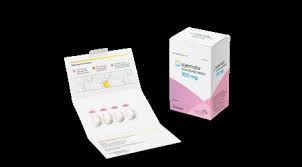
3. Medication management: OjeMDA tablets can be swallowed with water. Do not chew, cut or squeeze.
Oral suspension requires reconstitution: Reconstitute the powder in each supply bottle with exactly 14 mL of room temperature water to form OjeMDA for oral suspension. After reconstitution, each milliliter contains 25mg tovorafenib. Reconstructed product foaming reduces deliverable volume. Each 12 ml bottle of OjeMDA is 300 mg. When the dose is >300 mg, two bottles should be prepared to reach the dose. Divide the dose as evenly as possible between the two bottles (for example, a 325 mg dose would be 6 mL and 7 mL). Administer OjeMDA oral suspension immediately after preparation using the provided oral administration syringe or feeding tube. If OjeMDA for oral suspension is not administered within 15 minutes of preparation, instruct patients to discard.
4. Medication adjustment:
If the following patients miss a dose:Take the missed dose as soon as possible, 3 days or less, and take the next dose on the scheduled date. More than 3 days later, skip the missed dose and take the next dose on the scheduled day. If vomiting occurs immediately after taking a dose, repeat the dose.
4. Adverse reactions:
In clinical studies of OjeMDA, the most common adverse reactions (≥30%) were rash, hair color change, fatigue, viral infection, vomiting, headache, bleeding, pyrexia, dry skin, constipation, nausea, acneiform dermatitis and upper respiratory tract. Respiratory tract infection; the most common grade 3 or 4 laboratory abnormalities (≥2%) were decreased phosphate, decreased hemoglobin, increased creatinine phosphokinase, increased alanine aminotransferase, decreased albumin, lymphopenia, leukopenia, increased aspartate transferase, decreased potassium, and decreased sodium.
5. Supply and storage:
OjeMDA tablets are stored at 20°C to 25°C (68°F to 77°F); tolerances allowed are 15°C to 30°C (59°F to 86°F) when dispensing product in original packaging. Do not remove tablets from blister before use.
OjeMDA for oral suspensionOjeMDA is a white to off-white powder in a clear glass vial packaged with a push-in vial adapter and a 20 ml oral dose syringe; should be stored in pan>20°C to 25°C (68°F to 77°F); tolerances are allowed between 15°C to 30°C (59°F to 86°F). Do not use if safety seal under cap is broken or missing; Suspension must be used immediately after reconstitution; discard vial (including any unused portion) and syringe after administration.
6. Mechanism of action:
Tovorafenib, the component of OjeMDA, is a type II RAF kinase inhibitor of mutant BRAF V600E, wild-type BRAF and wild-type CRAF kinase. tovorafenib demonstrated antitumor activity in cultured cells and xenograft tumor models containing BRAF V600E and V600D mutations, as well as xenograft tumor models containing BRAF fusions.
7. Things to note:
1. Women: According to animal research results and its mechanism of action, OjeMDA taken by pregnant women may cause harm to the fetus. Therefore, it is recommended that females of reproductive potential use effective non-hormonal contraceptives during treatment and for 28 days after the last dose. OjeMDAcan render hormonal contraceptives ineffective; lactating women are advised not to breastfeed during treatment and for 2 weeks after the last dose.
2. Men: According to animal study results, OjeMDA may affect the fertility of male animals with reproductive potential, and the effect is reversible; therefore, it is recommended that male patients with female partners of reproductive potential take the drug during treatment and after the last doseUse effective non-hormonal birth control within 2 weeks.
[ 免责声明 ] 本页面内容来自公开渠道(如FDA官网、Drugs官网、原研药厂官网等),仅供持有医疗专业资质的人员用于医学药学研究参考,不构成任何治疗建议或药品推荐。所涉药品可能未在中国大陆获批上市,不适用于中国境内销售和使用。如需治疗,请咨询正规医疗机构。本站不提供药品销售或代购服务。


