
.jpeg)
Instructions for entrectinib
1. Generic name: Entrectinib,Entrectinib
Product name:Rozlytrek, Luo Shengquan
2. Indications:
1. ROS1-positive non-small cell lung cancer (NSCLC): Entrectinib is suitable for the treatment of adult patients with ROS1-positive metastatic non-small cell lung cancer approved by the U.S. Food and Drug Administration (FDA).
2. NTRK gene fusion-positive solid tumors: Entrectinib is suitable for the treatment of adult and pediatric patients older than 1 month with solid tumors. These patients:
(1) has a neurotrophic tyrosine receptor kinase (NTRK) gene fusion, as detected by an FDA-approved test, and has no known acquired resistance mutations;
(2) is metastatic or surgical resection may result in significant morbidity, as well as disease progression after treatment or the absence of satisfactory alternative therapies.
3. Usage and dosage:
1. Before treatment: Select patients with entrectinib to treat metastatic non-small cell lung cancer based on the presence of ROS1 rearrangements in tumors or plasma samples. The use of plasma samples for testing is only suitable for patients who cannot obtain tumor tissue for testing. Left ventricular ejection fraction (LVEF), serum uric acid levels, QT interval, and electrolytes should also be evaluated.
2. Recommended dosage:
(1) ROS1-positive non-small cell lung cancer: The recommended dose of entrectinib is 600 mg once daily, taken orally with or without food, until disease progression or unacceptable toxicity.
(2) NTRK gene fusion-positive solid tumors: The recommended dose for pediatric patients >1 month to <6 months is 250 mg/m2 once daily; for pediatric patients >6 months, the recommended dose is based on body surface area; for adults with BSA ≥1.5m2, the recommended dose is 600 mg once daily until disease progression or unacceptable toxicity.
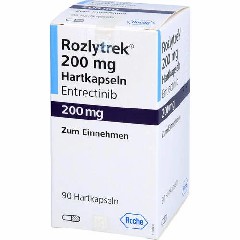
3. Medication management: Entrectinib is available in two dosage forms, which can be administered as capsules to be swallowed whole, capsules made into oral suspensions (or for enteral tube administration), and oral pills to be swallowed with soft food.
(1)The capsules may be swallowed whole or as a prepared oral suspension for patients who are unable to swallow capsules or who require administration via the stomach or nasogastric tube.
(2)If taking capsules as an oral suspension, open the correct number of capsules and pour the contents into room temperature drinking water or milk according to prescription directions. Let the suspension sit for 15 minutes before taking it, then add the prescribed amount of water. If the patientcannot remove the suspension immediately, it can be stored at room temperature for up to2 hours. If it takes more than 2 hours, throw it away.
(3)Pellets can be placed on one or more spoonfuls of soft food (such as applesauce, pudding, yogurt), take them out within 20 minutes after placing them on the food, and then add water. Make sure the patient uses the entire pack of pills and do not use them to make a suspension or give them through a gastric or nasogastric tube.
4. Dose adjustment: For patients who experience adverse reactions during treatment with entrectinib, doctors will adjust the drug dose according to the severity; during the first dose reduction, reduce the once-daily dose to two-thirds of the starting dose; during the second dose reduction, reduce the once-daily dose to one-third of the starting dose. Patients who cannot tolerate it after two dose reductions should permanently discontinue entrectinib.
4. Adverse reactions:
In clinical studies of entrectinib, the most common adverse reactions (≥20%) were fatigue, constipation, dysgeusia, edema, dizziness, diarrhea, nausea, hypoesthesia, dyspnea, myalgia, cognitive impairment, weight gain, cough, vomiting, fever, joint pain and visual impairment; Serious adverse reactions were pneumonia, dyspnea, pleural effusion, sepsis, pulmonary embolism, respiratory failure and fever.
5. Supply and storage:
Enrectinib capsules are stored at 20°C to 25°C (68°F to 77°F); excursions allowed between 15°C to 30°C (59°F to 86°F); store in original container with bottle closed tightly to protect against moisture. If capsules are prepared as an oral suspension using drinking water or milk, storage should not exceed 2 hours below 30°C (86°F). Discard any unused suspension if not used within 2 hours of preparation.
6. Mechanism of action:
Enrectinib is an inhibitor of tropomyosin receptor tyrosine kinase (TRK) TRKA, TRKB and TRKC, proto-oncogene tyrosine protein kinase ROS 1 (ROS 1) and anaplastic lymphoma kinase (ALK). Entrectinib also inhibits JAK2 and TNK2. The main active metabolite of entrectinib, M5, exhibits similar activity against TRK, ROS1, and ALK in vitro. Fusion proteins containing TRK, ROS1, or ALK kinase domains can drive tumorigenic potential through overactivation of downstream signaling pathways, resulting in unfettered cell proliferation.
Enrectinib demonstrated in vitro and in vivo efficacy againstInhibitory effects of NTRK, ROS1 and ALK fusion genes in cancer cell lines of various tumor types. Entrectinib exhibits steady-state brain-to-plasma concentration ratios of 0.4-2.2 in multiple animal species (mice, rats, and dogs) and exhibits in vivo antitumor activity in mice intracranially implanted with TRKA- and ALK-driven tumor cell lines.
[ 免责声明 ] 本页面内容来自公开渠道(如FDA官网、Drugs官网、原研药厂官网等),仅供持有医疗专业资质的人员用于医学药学研究参考,不构成任何治疗建议或药品推荐。所涉药品可能未在中国大陆获批上市,不适用于中国境内销售和使用。如需治疗,请咨询正规医疗机构。本站不提供药品销售或代购服务。


