
.jpeg)
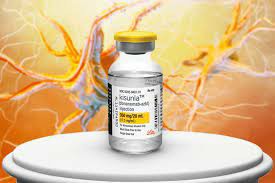
Instructions for Donanemab (donanemab-azbt)-Kisunla
1. Name:donanemab-azbt, Kisunla, donanemab ( transliteration)
2. Indications:
Donanemab-azbt (donanemab-azbt)-Kisunla is indicated for the treatment of Alzheimer's disease (AD). Treatment with KISUNLA should be initiated in patients with mild cognitive impairment or mild dementia stages for whom treatment was initiated in clinical trials.
3. Usage and dosage:
1. Before use: Before starting treatment with Kisunla, it is necessary to confirm the existence of beta amyloid lesions.
2. Recommended dose: The recommended dose of Kisunla is 700mg once every four weeks for a total of three doses, then 1400mg once every four weeks. Kisunla is administered as an intravenous infusion every four weeks for approximately 30 minutes. Kisunla must be diluted before administration.
Consider discontinuing administration of Kisunlabased on reduction of amyloid plaques to minimal levels on amyloidPET imaging. In Study 1, dosing was discontinued based on a decrease in amyloid levels below a predetermined threshold on PET imaging. If an infusion is missed, resume administration as soon as possible at the same dose every 4 weeks.
3. Monitoring of amyloid-related imaging abnormalities and dosing interruption: Kisunla can cause amyloid-related imaging abnormalities - edema (ARIA-E) and - hemosiderin deposition (ARIA-H). Before starting treatment with Kisunla, obtain a recent baseline brain magnetic resonance imaging (MRI). Magnetic resonance imaging was performed before the 2nd, 3rd, 4th, and 7th infusions. If a patient develops symptoms suspected of ARIA, a clinical evaluation, including MRI if necessary, should be performed.
4. Dose adjustment: For patients who develop cerebral hemorrhage with a diameter of >1cm during treatment with Kisunla, suspend dosing until MRI shows stable imaging and symptoms (if present) disappear. Re-dosing should be guided by clinical judgment.
4. Adverse reactions:
In clinical studies of Kisunla, the most common adverse reactions may include infusion-related reactions, with symptoms including flu-like symptoms, nausea, vomiting and changes in blood pressure, and allergic reactions, including anaphylaxis (severe, life-threatening allergic reaction) and angioedema (swelling).
5. Supply and storage:
Kisunla injection is a sterile, preservative-free, clear to milky white, colorless to slightly yellow to slightly brown solution.
1. Unopened vials can be stored refrigerated at 2°C to 8°C (36°F to 46°F). Store the vials in the outer carton away from light. Do not freeze or shake. If refrigeration is not possible, store at room temperature (20°C to 25°C [68°F to 77°F]) for 3 days.
2. Dilute solution: Do not freeze. If not used immediately, refrigerate at 2°C to 8°C (36°F to 46°F) for 72 hours or at room temperature (20°C to 25°C [68°F to 77°F]) for 12 hours.
6. Taboo:
Kisunla is contraindicated in patients with known severe allergic reactions to donanemab-azbt or any excipients, including anaphylaxis.
7. Mechanism of action:
Donanemab-azbt in Kisunla is a humanized immunoglobulin gamma 1 (IgG 1) monoclonal antibody directed against insoluble N-truncated pyroglutamate amyloid beta protein. The accumulation of amyloid beta plaques in the brain is a well-established pathophysiological feature of Alzheimer's disease. Donanemab-azbt reduces amyloid beta plaques, as shown in clinical studies.
[ 免责声明 ] 本页面内容来自公开渠道(如FDA官网、Drugs官网、原研药厂官网等),仅供持有医疗专业资质的人员用于医学药学研究参考,不构成任何治疗建议或药品推荐。所涉药品可能未在中国大陆获批上市,不适用于中国境内销售和使用。如需治疗,请咨询正规医疗机构。本站不提供药品销售或代购服务。


