
.jpeg)
List of Chinese instructions for ivonib/ivitinib
1. Common name: Ivosidenib,Ivosidenib
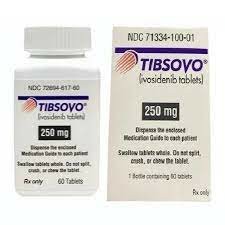
Product name:TIBSOVO, TOSOVO
Other names: Ivitinib
2. Who can take ivonib? Indications?
Ivosidenib/Ivosidenib is suitable for the treatment of the following conditions:
1. Acute myeloid leukemia (AML)
(1) Newly Diagnosed AML: Indicated for use in combination with azacitidine or as monotherapy for newly diagnosed acute myeloid leukemia with a predisposing isocitrate dehydrogenase-1 (IDH1) mutation detected by an FDA-approved test in adults 75 years of age or older or who have comorbidities that preclude the use of intensive induction chemotherapy.
(2) Relapsed or refractory (R/R) AML: Indicated for the treatment of adult patients with R/R AML who have a susceptibility isocitrate dehydrogenase-1 (IDH1) mutation detected by an FDA-approved test.
2. Relapsed or refractory (R/R) myelodysplastic syndrome (MDS): It is suitable for the treatment of adult patients with R/R MDS who have susceptibility to isocitrate dehydrogenase-1 (IDH1) mutations detected by FDA-approved tests.
3. Locally advanced or metastatic cholangiocarcinoma: It is suitable for the treatment of adult patients with previously treated locally advanced or metastatic cholangiocarcinoma who have isocitrate dehydrogenase-1 (IDH1) mutations detected by an FDA-approved test.
3. What are the side effects of Avonib?
In clinical studies of ivonib,Common adverse reactions in AML patients include fatigue, arthralgia, leukocytosis, diarrhea, edema, nausea, dyspnea, mucositis, electrocardiogram QT prolongation, rash, cough, decreased appetite, myalgia, constipation, fever and laboratory abnormalities; common adverse reactions in cholangiocarcinoma patients include fatigue, nausea, abdominal pain, diarrhea, cough, decreased appetite, ascites, vomiting, anemia, rash and laboratory abnormalities.
4. How should I take Avonib?
1. Before treatment: Select patients to receive ivonib treatment based on the presence of IDH1 mutations.
2. Recommended dose: Avosidenib is available in the form of oral tablets, and the recommended dose is 500mg orally administered once daily until disease progression or unacceptable toxicity occurs;
3. Medication management: For patients with AML or MDS who have no disease progression or unacceptable toxicity, continue to use ivonib for at least 6 months to allow time for clinical response.
4. Combination medication: For newly diagnosed patients with AML, start subcutaneous or intravenous administration of azacitidine 75 mg/m2 on day 1 of each 28-day cycle (or days 1-5 and 8-9).
5. How to store Avonib?
Avosidenib is commonly available as 250 mg tablets and can be stored at 20°C to 25°C (68°F to 77°F); tolerances are allowed between 15°C to 30°C (59°F to 86°F).
6. How does Avonib work?
Avosidenib is a small molecule inhibitor that targets the mutant isocitrate dehydrogenase1 (IDH1) enzyme. In patients with AML, predisposing IDH1 mutations are defined as mutations that result in elevated 2-hydroxyglutarate (2-HG) levels in leukemia cells, and efficacy is predicted by: 1) clinically meaningful remission with ivosidenib at recommended doses and/or 2) inhibition of mutant IDH1 enzymatic activity with continued use of ivosidenib at recommended doses according to a validated approach. The most common such mutations in AML patients are R132H and R132C substitutions.
In vitro experiments show that ivosidenib inhibits selected IDH1 R132 mutants at much lower concentrations than wild-typeIDH1. In a mouse xenograft model of IDH1-mutant AML, inhibition of the mutant IDH1 enzyme by ivonib resulted in reduced 2-HG levels and induction of myeloid differentiation in vitro and in vivo. In blood samples from patients with IDH1-mutated acute myeloid leukemia, ivonib reduced in vitro 2-HG levels, reduced blast counts, and increased the percentage of mature myeloid cells.
Avosidenib reduced 2-HG levels in a patient-derived intrahepatic cholangiocarcinoma xenograft mouse model of IDH1 R132C.
7. What will happen if you overdose on ivonib?
There is limited information regardingthe LD50 or overdose with ivosidenib.
8. Who cannot use Avonib?
Avosidenib is associated with a risk of differentiation syndrome, Guillain-Barré syndrome, and embryo-fetal toxicity.
[ 免责声明 ] 本页面内容来自公开渠道(如FDA官网、Drugs官网、原研药厂官网等),仅供持有医疗专业资质的人员用于医学药学研究参考,不构成任何治疗建议或药品推荐。所涉药品可能未在中国大陆获批上市,不适用于中国境内销售和使用。如需治疗,请咨询正规医疗机构。本站不提供药品销售或代购服务。


