
.jpeg)
Chemotherapy plus nintedanib has 'promising' effect on IPF small cell lung cancer
The primary endpoint was met in a study of patients with small cell lung cancer (SCLC) and idiopathic pulmonary fibrosis (IPF) who received carboplatin, etoposide and nintedanib, according to published clinical findings. According to the researchers, the incidence of acute exacerbations of IPF did not exceed a predetermined statistical threshold 28 days after the last dose of cytotoxic chemotherapy. Fatal acute exacerbations occasionally occur during chemotherapy for small cell lung cancer complicated by interstitial pneumonia (IP).
Patients with comorbid IPPatients with comorbid IP are excluded from most pivotal trials of standard lung cancer treatment, so there is an urgent need to establish safe and effective drug treatments, especially for small cell lung cancer with comorbid IPF. In recent years, adding anti-PD-L1 antibodies to platinum plus etoposide has become the standard first-line treatment for ED-SCLC. However, it has been reported that the risk of immune checkpoint inhibitor-induced pneumonia is high in patients with co-existing IP.
In the next round of the multicenter, single-arm, Phase 2 study,researchers evaluated 33 patients with unresectable SCLC and IPF (median age, 73 years; 87.9% male; median FVC percentage 85.2%) to determine the effect of carboplatin and etoposide (cytotoxic chemotherapy) every 3 weeks plus nintedanib 150 mg twice daily on the incidence of exacerbations of IPF (day 28 since the last dose of cytotoxic chemotherapy). Researchers also collected data on adverse events to report on drug safety.
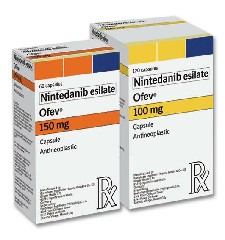
Of the total cohort,51.5% (n=17) had honeycomb lung. During a median observation period of 10.5 months, 29 patients (87.9%) received 4 cycles of cytotoxic chemotherapy, and 26 patients (78.8%; median 5.4 months) received nintedanib maintenance therapy. According to the researchers, disease progression was the reason for treatment discontinuation in 28 patients. The preset statistical threshold for the incidence of acute exacerbation of IPF was 20%, and 28 days after the last dose of cytotoxic chemotherapy, this threshold was not exceeded, with an incidence rate of 3% (95% CI, 0.2%-13.6%). When considering the entire observation period, the researchers found this outcome occurred 12.1% of the time.
Due to a withdrawal of consent, inOther efficacy outcomes, such as response rate and survival, were assessed in 32 patients. In this group of patients, researchers observed an objective response rate of 68.8%. Furthermore, the median overall survival (OS) length (13.4 months) was longer than the median progression-free survival (4.2 months). Although this study cannot draw clear conclusions without a control group, the combination of nintedanib and IPF-[acute exacerbation] may contribute to good OS.
Grading of adverse events according to the Common Terminology Criteria for Adverse Events showed that patients frequently experienced grade 3 or higher neutropenia (81.8%), leukopenia (39.4%), and thrombocytopenia (30.3%). Only one adverse event (acute exacerbation of IPF) was considered a grade 5 event. The NEXT SHIP study met its primary endpoint of IPF incidence [acute exacerbation] and achieved promising efficacy results. Combination therapy of carboplatin, etoposide and nintedanib may be one of the standard treatment options for small cell lung cancer combined with IPF disease.
Due to the small sample size and single-arm design, no firm conclusions can be drawn from this study alone. Therefore, further validation through randomized trials involving larger numbers of patients is needed.
References:https://www.healio.com/news/pulmonology/20240722/chemotherapy-plus-nintedanib-has-promising-efficacy-in-small-cell-lung-cancer-with-ipf
[ 免责声明 ] 本页面内容来自公开渠道(如FDA官网、Drugs官网、原研药厂官网等),仅供持有医疗专业资质的人员用于医学药学研究参考,不构成任何治疗建议或药品推荐。所涉药品可能未在中国大陆获批上市,不适用于中国境内销售和使用。如需治疗,请咨询正规医疗机构。本站不提供药品销售或代购服务。


