
.jpeg)
Chinese instructions for Trientine
1. Common name: Trientine,Trientine
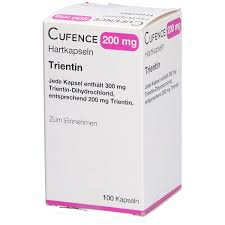
Product name:Cufence, Syprine
2. Indications:
Trientine (Trientine) is indicated for the treatment of patients with hepatolenticular degeneration (Wilson’s disease) who are intolerant to penicillamine. Clinical experience with trientine is limited and alternative dosing regimens are not well characterized; all endpoints for determining dosing in individual patients have not been clearly defined. Trientine and penicillamine are not interchangeable. Trientine should be used when continued treatment with penicillamine cannot be tolerated due to intolerable or life-threatening side effects.
Unlike penicillamine, trientine is not recommended for cystinuria or rheumatoid arthritis. The lack of a sulfhydryl moiety renders it unable to bind cystine and therefore has no role in cystinuria. In15 patients with rheumatoid arthritis, trientine was reported to be ineffective in improving any clinical or biochemical parameters after 12 weeks of treatment. Trientine is not indicated for the treatment of biliary cirrhosis.
3. Usage and dosage:
Dose and/or dose intervals have not been systematically evaluated. However, based on limited clinical experience, the recommended initial dose of trientine is 500-750 mg/day for pediatric patients and 750-1250 mg/day for adult patients, given in two, three, or four divided doses. The maximum dose may be increased to 2000 mg/day for adults and 1500 mg/day for children 12 years of age or younger.
The daily dose of trientine should be increased only if clinical response is inadequate or if free serum copper concentrations are persistently above 20 mcg/dL. The optimal long-term maintenance dose should be determined every 6 to 12 months (see Precautions, Laboratory Testing).
It is important that trientine should be taken on an empty stomach, at least one hour before or two hours after a meal, and at least one hour apart from other medications, food, or milk. Capsules should be swallowed whole with water and should not be opened or chewed.
4. Adverse reactions:
Clinical experience with trientine is limited. The most common side effect is nausea, especially when starting treatment. One in every 100 people will suffer from rash. Duodenitis (inflammation of the duodenum, the part of the intestine that leads outside the stomach) and severe colitis (inflammation of the large intestine causing pain and diarrhea) have also been reported. In some patients, neurological deterioration occurs at the start of treatment, with symptoms including dystonia (involuntary muscle contractions), stiffness, tremor (shaking), and dysarthria (difficulty speaking).
Trientine is not indicated for the treatment of biliary cirrhosis, and the following adverse reactions have been reported in studies of patients with primary biliary cirrhosis receiving trientine hydrochloride: Heartburn; epigastric pain and tenderness; skin thickening, cracking, and flaking; hypochromic microcytic anemia; acute gastritis; aphthous ulcers; abdominal pain; melena; anorexia; malaise; cramps; muscle pain; rhabdomyolysis. A causal relationship between these reactions and drug therapy cannot be excluded or established.
5. Supply and storage:
Trientine capsules are available as hard gelatin capsules. Keep the container tightly closed and store at 2°-8°C (36°-46°F).
6. Taboo:
Trientine capsules are contraindicated in patients who are allergic to this product.
7. Mechanism of action:
Wilson's disease (hepatolenticular degeneration) is an autosomal inherited metabolic defect resulting in an inability to maintain a near-zero balance of copper. Excessive copper accumulation may be due to the liver lacking a mechanism to excrete free copper into the bile. Liver cells store excess copper, but when their capacity is exceeded, copper is released into the blood and absorbed outside the liver. This condition can be treated with a low-copper diet and the use of chelating agents that bind copper to promote its excretion from the body.
Reference materials:https://dailymed.nlm.nih.gov/dailymed/drugInfo.cfm?setid=c34f77a7-996b-4470-b5df-d946a7fe5dbe##
[ 免责声明 ] 本页面内容来自公开渠道(如FDA官网、Drugs官网、原研药厂官网等),仅供持有医疗专业资质的人员用于医学药学研究参考,不构成任何治疗建议或药品推荐。所涉药品可能未在中国大陆获批上市,不适用于中国境内销售和使用。如需治疗,请咨询正规医疗机构。本站不提供药品销售或代购服务。


