
.jpeg)
Introduction to the instructions for filgotinib
1. Common name:Filgotinib
Product name: Jyseleca
Other names: filgotinib (transliteration)
2. Who can take filgotinib? Indications?
Filgotinib (Filgotinib) is indicated for the treatment of the following conditions:
1. Rheumatoid arthritis (RA): Indicated for the treatment of moderately to severely active rheumatoid arthritis in adult patients who have an inadequate response to or are intolerant to one or more disease-modifying antirheumatic drugs (DMARDs). Filgotinib can be used as monotherapy or in combination with methotrexate (MTX).
2. Ulcerative colitis (UC): It is suitable for the treatment of adult patients with moderately to severely active ulcerative colitis who have insufficient response, loss of response, or intolerance to conventional therapies or biological agents.
3. What are the side effects of filgotinib?
In clinical studies of filgotinib, the most commonly reported adverse reactions were nausea, upper respiratory tract infection (infection of the nose and throat), urinary tract infection, dizziness, and lymphopenia (low levels of lymphocytes, a type of white blood cell).
4. How should you take filgotinib?
1. Recommended dosage:
(1)Rheumatoid arthritis (RA): The recommended dose of filgotinib in adult patients is 200 mg once daily; for long-term treatment, the lowest effective dose should be used.
(2) Ulcerative colitis (UC): The recommended dose of filgotinib during initial induction therapy is 200 mg once daily. For UC patients who do not show adequate therapeutic effect within the first 10 weeks of treatment, an additional 12 weeks of induction therapy with filgotinib 200 mg once daily may provide further relief of symptoms. Patients who do not show any therapeutic effect after 22 weeks of treatment should discontinue filgotinib.
The recommended dose for maintenance therapy with filgotinib is 200 mg once daily. For long-term treatment, the lowest effective dose should be used.
2. Medication management: Figotinib is taken orally and can be taken with or without food. Whether the tablets can be divided, crushed, or chewed has not been studied and it is recommended that the tablets be swallowed whole.
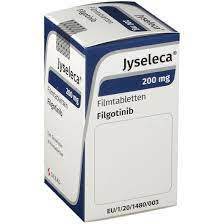
5. How to store filgotinib?
Filgotinib should be stored in its original packaging to protect it from moisture. Keep the bottle tightly closed.
6. How does filgotinib work?
Figotinibis a competitive reversible inhibitor of adenosine triphosphate (ATP) of the JAK family. JAKs are intracellular enzymes that transmit signals resulting from the interaction of cytokines or growth factor receptors on the cell membrane. JAK1 plays an important role in mediating inflammatory cytokine signaling, JAK2 plays a key role in mediating myelopoiesis and erythropoiesis, and JAK3 plays a key role in immune homeostasis and lymphopoiesis. In the signaling pathway, JAK phosphorylates and activates signal transducer and activator of transcription (STAT), which regulates intracellular activities, including gene expression. Figotinibregulates these signaling pathways by preventing STAT phosphorylation and activation.
In biochemical tests, filgotinib preferentially inhibits the activity of JAK1, and the potency of filgotinib on JAK1 is more than 5 times higher than that of JAK2, JAK3 and TYK2. In human cell assays, filgotinib preferentially inhibits JAK1/JAK3-mediated signaling downstream of heterodimeric cytokine receptors for interleukin (IL)-2, IL-4 and IL-15, JAK1/2-mediated IL-6, and JAK1/TYK2-mediated type I interferons, with functional selectivity over cytokine receptors that signal through paired JAK2 or JAK2/TYK2. In in vitro experiments, GS-829845, the main metabolite of filgotinib, was approximately 10 times less active than filgotinib while exhibiting similar JAK1 preferential inhibitory activity. In an in vivo rat model, overall pharmacodynamic effects are primarily driven by metabolites
7. What will happen if you overdose on filgotinib?
In clinical studies, filgotinib has been administered at doses up to 450 mg following single and once-daily dosing without dose-limiting toxicities. Adverse effects were comparable to those observed at lower doses, and no specific toxicities were noted. Pharmacokinetic data after a single dose of 100 mg filgotinib in healthy subjects showed that approximately 50% of the administered dose was eliminated within 24 hours after administration, and 90% of the administered dose was eliminated within 72 hours. In the event of overdose, it is recommended that patients be monitored for signs and symptoms of adverse reactions. Treatment of filgotinib overdose includes general supportive measures, including monitoring of vital signs and observation of the patient's clinical status. It is unknown whether filgotinib can be removed by dialysis.
8. Who cannot use filgotinib?
Figotinib is contraindicated in the following patients:
1. Patients who are allergic to active substances and any excipients;
2. Active pulmonary tuberculosis (TB) or active severe infection;
3. Pregnancy.
Reference materials:https://www.medicines.org.uk/emc/product/11809/smpc#gref
[ 免责声明 ] 本页面内容来自公开渠道(如FDA官网、Drugs官网、原研药厂官网等),仅供持有医疗专业资质的人员用于医学药学研究参考,不构成任何治疗建议或药品推荐。所涉药品可能未在中国大陆获批上市,不适用于中国境内销售和使用。如需治疗,请咨询正规医疗机构。本站不提供药品销售或代购服务。


