
.jpeg)
What does the instructions for Tarlatamab-Imdelltra contain?
1. Name:Imdelltra, Tarlatamab-dlle, tarlatumab (transliteration)
2. Who can use talatumumab? Indications:
Talatumumab is approved for the treatment of adult patients with extensive-stage small cell lung cancer (ES-SCLC) whose disease has progressed during or after platinum-based chemotherapy. The drug provides a new treatment option for patients who are ineffective with traditional chemotherapy and can significantly improve their survival rate and quality of life.
3. How should talatumumab be used?
1. Medication instructions:
Before administering ImdelltraIt is important to ensure that the patient is adequately hydrated to prevent dehydration and other related complications. Assess complete blood count, liver enzymes, and bilirubin levels before each dose as clinically indicated to monitor the patient's health. To reduce the incidence and severity of cytokine release syndrome (CRS), an ascending dose regimen is used. Use recommended concomitant medications (such as dexamethasone) before and after the Imdelltra infusion in Cycle 1 to reduce the risk of a CRS reaction.
Imdelltra should only be used by medical professionals with appropriate medical support and must be administered in a monitored environment to ensure prompt management of severe reactions, such as CRS and neurotoxicity.
2. Medication dosage:
Imdelltra treatment plans are typically 28-day (4-week) long cycles, using the recommended ascending dosing schedule.
Imdelltra should be administered intravenously within one hour of each dose to reduce the incidence and severity of CRS.
The incremental scheme is as follows: 1) The first cycle (Cycle 1) uses a dose of 1mg on the 1st day, and a dose of 10mg on the 8th and 15th days. 2) Use 10mg dose on day 1 and day 15 of the second cycle (cycle 2). 3) Use a 10 mg dose on days 1 and 15 of the third and fourth cycles (cycle 3). 4) Use a 10 mg dose on days 1 and 15 of the fifth cycle and subsequent cycles.
Following an escalating dose regimen, dosing is administered every two weeks until disease progression or unacceptable toxicity.
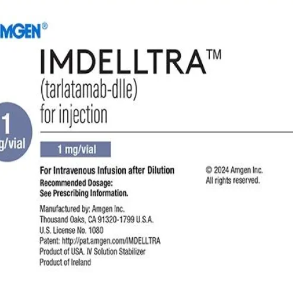
3. Dosage adjustment:
It is not recommended to reduce the dosage of Imdelltrabut if adverse reactions occur, adjustments should be made accordingly under the guidance of a doctor. If CRS, neurological problems, or other serious side effects occur, Imdelltra treatment may be temporarily stopped or completely discontinued to ensure patient safety.
4. What are the side effects of talatumumab?
In clinical studies of Imdelltra, a variety of adverse reactions have been observed, the most common of which include cytokine release syndrome, fatigue, pyrexia, dysgeusia, decreased appetite, musculoskeletal pain, constipation, anemia, and nausea; the most common (≥2%) grade 3 or 4 laboratory abnormalities include lymphocytes Decreased, decreased sodium, increased uric acid, decreased total neutrophil count, decreased hemoglobin, increased activated partial thromboplastin time, decreased potassium, increased aspartate aminotransferase (AST), decreased leukocytes, decreased platelets, increased alanine aminotransferase (ALT),
5. How is talatumumab supplied and stored?
InjectionImdelltra is a sterile, preservative-free white to slightly yellow solution, available in 2mg, 10mg and other specifications. Vials of Imdelltra and IV Solution Stabilizer (IVSS) should be stored refrigerated in their original cartons at 2°C to 8°C (36°F to 46°F) and protected from light until use. Do not freeze and can be stored in the original carton at room temperature between 20°C to 25°C (68°F to 77°F) for up to 24 hours to avoid the effects of light on the medication.
6. How does talatumumab work?
Tarlatamab-dlle, the core component of Imdelltra, is a bispecific T cell binder that can simultaneously bind to DLL3 expressed on the surface of cells (including tumor cells) and CD3 expressed on the surface of T cells. This mechanism not only effectively activates T cells, but also promotes the release of inflammatory cytokines and ultimately leads to the lysis of DLL3-expressing cells. Studies have shown that Tarlatamab displays significant anti-tumor activity in mouse models of small cell lung cancer.
Reference materials:https://www.drugs.com/mtm/tarlatamab.html
[ 免责声明 ] 本页面内容来自公开渠道(如FDA官网、Drugs官网、原研药厂官网等),仅供持有医疗专业资质的人员用于医学药学研究参考,不构成任何治疗建议或药品推荐。所涉药品可能未在中国大陆获批上市,不适用于中国境内销售和使用。如需治疗,请咨询正规医疗机构。本站不提供药品销售或代购服务。


