
.jpeg)
Gilteritinib: Efficacy, Medication Guide and Latest Advances for FLT3-Mutated AML
Acute myeloid leukemia(AML)is one of the most common types of acute leukemia in adults.FLT3 gene mutation is among the most prevalent driver mutations in AML,and patients carrying this mutation generally face high relapse rates and poor prognosis.With the rapid advancement of precision targeted therapy,FLT3 inhibitors have completely reshaped the treatment landscape of this high-risk leukemia subtype.As a representative second-generation FLT3 inhibitor,Gilteritinib(brand name:XOSPATA)brings long-term survival hope to numerous patients with relapsed/refractory FLT3-mutated AML,supported by solid clinical evidence and continuously improving global accessibility.
Precision Targeted Mechanism:Highly Selective FLT3 Inhibition
Developed by Astellas Pharma,Gilteritinib is an oral second-generation FLT3 inhibitor with high potency and selectivity.In the molecular classification of AML,FLT3 mutations mainly include two subtypes:internal tandem duplication(ITD)and tyrosine kinase domain(TKD)mutations,which occur in approximately 30%of all AML patients.These mutations cause persistent activation of FLT3 receptor tyrosine kinase,driving uncontrolled proliferation of leukemia cells and serving as a core driver of poor patient outcomes.
Gilteritinib specifically binds to the FLT3 receptor and inhibits its kinase activity,precisely blocking the abnormal signaling pathway that drives leukemia cell proliferation,thereby inducing tumor cell apoptosis.Compared with first-generation FLT3 inhibitors,Gilteritinib has stronger target selectivity and lower off-target toxicity.It exerts significant inhibitory effects on both FLT3-ITD and FLT3-TKD mutations,covering the vast majority of AML patients with FLT3 mutations.
Clinical Evidence:Establishing Standard of Care Status
The efficacy and safety of Gilteritinib have been strongly supported by multiple international multicenter clinical studies.Its core approval basis comes from the phase III ADMIRAL trial(NCT02421939),which first demonstrated that Gilteritinib significantly prolongs overall survival compared with salvage chemotherapy in patients with relapsed/refractory FLT3-mutated AML.The long-term follow-up results of the COMMODORE trial,published in Annals of Hematology in January 2026,further consolidated its status as a standard of care in this field.
The COMMODORE trial is an international,multicenter,open-label phase III clinical study that enrolled 276 patients with relapsed/refractory FLT3-mutated AML from multiple countries and regions across Asia and Europe,with Asian populations accounting for 88%of the cohort.Patients were randomized 1:1 to receive either 120mg of Gilteritinib once daily or standard salvage chemotherapy.After a median follow-up of 34.6 months,key efficacy data showed that the median overall survival(OS)in the Gilteritinib group reached 10.3 months,compared with only 5.4 months in the chemotherapy group,with a hazard ratio(HR)of 0.612—meaning Gilteritinib reduced the risk of death by nearly 40%.The median event-free survival(EFS)was 2.1 months versus 0.6 months(HR=0.589),and the complete response(CR)rate in the Gilteritinib group reached 20.4%,nearly double that of the chemotherapy group(11.5%).
Of greater clinical value,22.6%of patients in the Gilteritinib group successfully underwent hematopoietic stem cell transplantation(HSCT)after treatment,compared with only 7.9%in the chemotherapy group,indicating that Gilteritinib can bridge more patients to transplant eligibility.The study concluded that long-term Gilteritinib treatment significantly improves clinical outcomes and is well tolerated in relapsed/refractory FLT3-mutated AML patients with a predominantly Asian population,providing high-quality evidence for clinical practice in the Asia-Pacific region.
In the field of post-transplant maintenance therapy,a systematic review and meta-analysis published in AJMC in April 2026 further verified the long-term value of Gilteritinib.The study included 2 randomized controlled trials and 6 observational cohort studies,covering a total of 134 adult patients.Results showed that among patients receiving Gilteritinib as post-transplant maintenance therapy,the 1-year overall survival rate ranged from 72.3%to 100%,and the 2-year overall survival rate ranged from 55.8%to 60.0%.The 1-year and 2-year relapse-free survival(RFS)rates ranged from 46.7%to 100%and 55.8%to 60.0%,respectively.The study suggested that sustained inhibition of FLT3 tyrosine kinase activity by a highly selective second-generation inhibitor such as Gilteritinib can eliminate residual FLT3-driven leukemia cells in the body and restore normal hematopoiesis,thereby reducing the risk of post-transplant relapse and improving long-term patient outcomes.
In addition,a network meta-analysis of FLT3 inhibitors showed that Gilteritinib increased the complete response rate to 1.75 times that of conventional treatment regimens.The accumulation of a series of high-quality clinical evidence has not only established Gilteritinib’s status as the standard of care for relapsed/refractory FLT3-mutated AML,but also further highlighted the fundamental role of genetic testing in the precision diagnosis and treatment of AML.
Global Treatment Access:Diverse Options for Different Needs
As a standard therapy recommended by global clinical guidelines,Gilteritinib has been approved for marketing in many countries and regions.Currently,there are two main categories available on the market:branded originator drugs and legitimate generic drugs,which can accommodate patients with different financial circumstances.
Branded Gilteritinib is available in regions including Europe,the United States and Hong Kong,China.Pricing varies across regions,but the overall treatment cost is high,with monthly treatment costs ranging from thousands to tens of thousands of US dollars,placing significant financial pressure on most patients for long-term use.
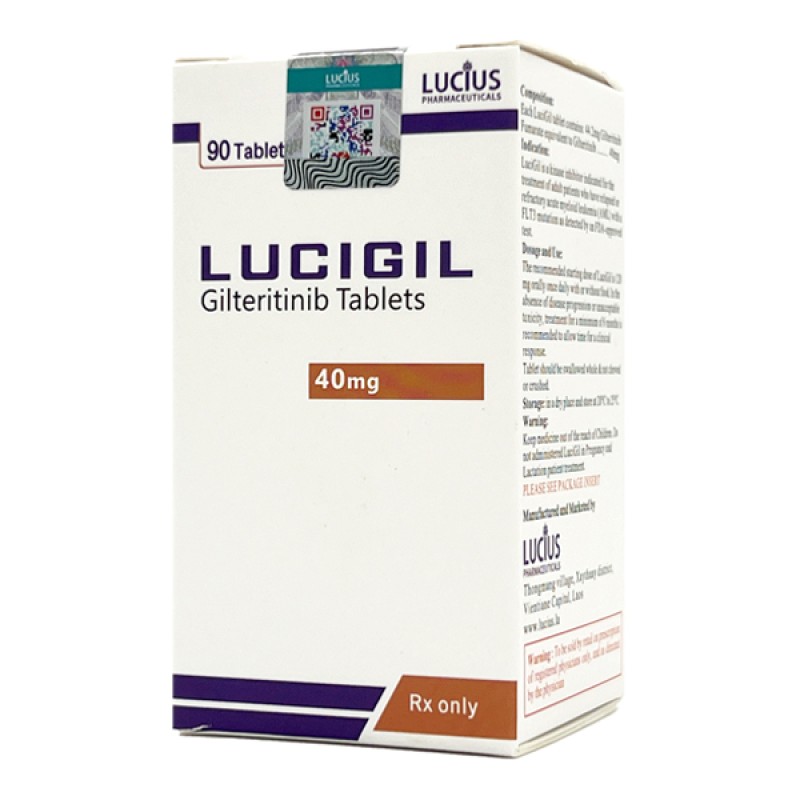
To address the high cost of branded drugs,several countries have approved the marketing of compliant generic drugs.The Ministry of Health of Laos has approved multiple pharmaceutical manufacturers to produce generic Gilteritinib,which have consistent active ingredients and dosage forms as the originator drug and have passed bioequivalence verification,with significant price advantages.For example,Gilteritinib(40mg×90 tablets per box)produced by Lucius Pharmaceuticals of Laos is priced at approximately 350 US dollars per box.The 90-tablet package exactly meets the standard monthly dosage for adult patients,with a monthly treatment cost only about one-tenth of the branded drug,greatly lowering the financial threshold for long-term medication.
Important Risk Notice:When choosing overseas generic drugs,patients should purchase them through formal platforms with legal cross-border medical service qualifications or licensed overseas pharmacies,and must use them with the informed consent of the attending physician.When purchasing,patients should carefully check the drug packaging,traceability code and production batch number,and avoid purchasing counterfeit or substandard drugs through informal channels such as personal purchasing agents,which may delay treatment.
Medication Guidelines and Adverse Event Management
The standard recommended dose of Gilteritinib is 120mg once daily(3 tablets of 40mg strength),taken orally as a whole.It can be administered with or without food.To maintain stable blood drug concentration,patients are advised to take the medication at a fixed time every day.
If grade 3 or 4 adverse reactions occur during treatment,the physician may adjust the dose to 80mg once daily(2 tablets)based on patient tolerance.If intolerance persists,the dose can be further reduced to 40mg once daily(1 tablet).If adverse reactions remain intolerable at the lowest dose,discontinuation should be considered.In case of a missed dose,if it is more than 12 hours before the next scheduled dose,the missed dose can be taken immediately.If less than 12 hours remain,skip the missed dose and resume the regular schedule the next day.Do not take a double dose to make up for a missed dose.
Gilteritinib is generally well tolerated,and most adverse reactions are mild to moderate and clinically manageable.The following common adverse reactions require close monitoring during treatment:
Hematological abnormalities:Including anemia,neutropenia and thrombocytopenia,which are the most common adverse reactions.Complete blood count should be monitored weekly in the early stage of treatment.
Gastrointestinal reactions:Common symptoms include nausea,diarrhea and decreased appetite,mostly mild to moderate.Taking the drug with meals or combining with antiemetics and antidiarrheals can effectively relieve symptoms.
Liver function abnormalities:Some patients may experience elevated transaminases or bilirubin.Liver function should be monitored regularly during treatment.
Differentiation syndrome:A small number of patients may develop fever,dyspnea,rapid weight gain and other symptoms in the early stage of treatment.Immediate medical attention is required if these symptoms occur.
Other reactions:Fatigue,myalgia and arthralgia may also occur.Most symptoms can be gradually tolerated with continued treatment,and symptomatic treatment is available when symptoms are prominent.
Patients should strictly follow medical advice for regular follow-ups during treatment,communicate with the attending physician promptly in case of any discomfort,and never adjust the dose or discontinue the drug without medical guidance.
Future Outlook:Advances in First-Line Therapy and Combination Regimens
Beyond its established application in the relapsed/refractory setting,clinical research on Gilteritinib continues to expand.In the first-line treatment setting,Astellas Pharma and the HOVON Foundation announced the overall survival results of the HOVON 156/AMLSG 28-18/PASHA study in March 2026.This phase III clinical trial compared the first-line efficacy of Gilteritinib versus Midostaurin,each combined with chemotherapy,in patients with newly diagnosed FLT3-mutated AML.Although the study did not meet its primary endpoint of overall survival,Gilteritinib demonstrated comparable OS benefit to Midostaurin with a similar safety profile,providing an important reference for the optimization of future first-line treatment regimens.
In pediatric AML,the SKIPPER trial is evaluating the efficacy and safety of Gilteritinib combined with FLAG chemotherapy in pediatric patients with relapsed/refractory FLT3-ITD mutated AML,with preliminary results showing positive efficacy and manageable safety.
Currently,multiple clinical trials of Gilteritinib combined with Venetoclax,Azacitidine and other agents are ongoing worldwide,aiming to overcome drug resistance through multi-target synergy and further deepen treatment response and improve long-term survival.With the release of more clinical data and the continuous improvement of global drug accessibility,Gilteritinib is expected to bring better treatment outcomes to more patients with FLT3-mutated AML.For patients confirmed with FLT3 mutations through genetic testing,choosing an appropriate treatment plan under the guidance of a professional hematologist is the critical first step to achieving a favorable prognosis.
[ 免责声明 ] 本页面内容来自公开渠道(如FDA官网、Drugs官网、原研药厂官网等),仅供持有医疗专业资质的人员用于医学药学研究参考,不构成任何治疗建议或药品推荐。所涉药品可能未在中国大陆获批上市,不适用于中国境内销售和使用。如需治疗,请咨询正规医疗机构。本站不提供药品销售或代购服务。


