
.jpeg)
Canada approves Quizartinib plus chemotherapy for newly diagnosed FLT3-ITD+ AML
Health Canada has approved Quizartinib (Quizartinib) plus standard cytarabine and anthracycline induction, plus standard cytarabine consolidation chemotherapy, and then quizartinib monotherapy as maintenance, for the treatment of adult patients with newly diagnosed FLT3-ITD-positive acute myeloid leukemia (AML).
The regulatory decision is based ondata from the Phase 3 QuANTUM First trial (NCT02668653), which evaluated the combination of cytarabine/anthracycline induction and cytarabine consolidation, continued as maintenance monotherapy. The data showed that this regimen reduced the risk of death by 22.4% in patients with newly diagnosed FLT3-ITD-positive AML compared with standard chemotherapy alone (HR, 0.78; 95% CI, 0.62-0.98; two-sided P=0.0324). Of note, at a median follow-up of 39.2 months, median overall survival (OS) was 31.9 months (95% CI, 21.0 not evaluable) for patients treated with quizartinib (n = 268) compared with 15.1 months (95% CI, 13.2-26.2) for patients in the control arm (n = 271).
The approval of quizartinib in Canada represents a major advance in the treatment of patients with newly diagnosed FLT3-ITD-positive AML, one of the most aggressive and difficult-to-treat subtypes of leukemia. In the QuANTUM First trial, quizartinib was added to standard chemotherapy and maintained, resulting in longer remissions and longer OS, which will be a much-needed new treatment option with the potential to change the way FLT3-ITD-positive AML is treated.
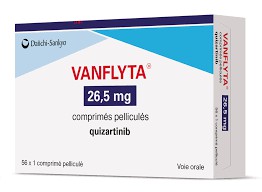
In July 2023, the U.S. Food and Drug Administration approved quizartinib plus standard cytarabine/anthracycline induction, cytarabine consolidation, and maintenance monotherapy after consolidation chemotherapy for the treatment of adult patients with FLT3-ITD-positive AML as detected by an FDA-approved test. The FDA's decision is also supported by data from the QuANTUM First study.
It is worth noting that inIn QuANTUM First, 55% of patients in the cezatinib group and 62% of patients in the placebo group discontinued the study, primarily due to death (90% vs. 94%) or withdrawal of consent (9% vs. 5%). A similar proportion of patients in both groups experienced at least 1 adverse effect (AE; 100% vs. 99%) and 1 grade 3 or higher AE (92% vs. 90%). The most common grade 3/4 adverse events in both groups included febrile neutropenia, hypokalemia, and pneumonia; the other common grade 3/4 adverse event in the quizartinib group was neutropenia.
Despite recent advances inAML treatment, the prognosis of AML patients harboring FLT3-ITD mutations remains challenging. This randomized, placebo-controlled, double-blind study compared a quizartinib-based regimen with placebo in patients with newly diagnosed FLT3-ITD-positive AML at 193 hospitals and clinics in 26 countries in Europe, North America, Asia, Australia and South America. Patients included in the trial, ages 18 to 75, were randomized 1:1 by region, age and white blood cell count at diagnosis to receive either quizartinib or placebo.
Patients received induction therapy with a continuous intravenous (IV) infusion of cytarabine 100 mg/m2 daily from days 1 to 7, an intravenous infusion of daunorubicin 60 mg/m2 daily or idarubicin 12 mg/m2 daily on days 1, 2, and 3, and then oral administration of quizartinib 40 mg or placebo once daily starting on day 8 for 14 days. Patients with complete remission (CR) or CR with incomplete neutrophil or platelet recovery then received standard consolidation therapy, which was high-dose cytarabine plus quizartinib 40 mg once daily or placebo, allogeneic hematopoietic stem cell transplantation, or both, and then continued quizartinib or placebo alone for up to 3 years.
The approval of quizartinib in Canada enables patients diagnosed with FLT3-ITD-positive AML to receive targeted therapies developed specifically for their disease subtype. This milestone reflects our commitment to transforming cancer therapies, [advancing] innovation in hematology and oncology, and creating new standards of care for patients.
Reference materials:https://fanyi.baidu.com/mtpe-individual/transText
[ 免责声明 ] 本页面内容来自公开渠道(如FDA官网、Drugs官网、原研药厂官网等),仅供持有医疗专业资质的人员用于医学药学研究参考,不构成任何治疗建议或药品推荐。所涉药品可能未在中国大陆获批上市,不适用于中国境内销售和使用。如需治疗,请咨询正规医疗机构。本站不提供药品销售或代购服务。


