
.jpeg)
FDA approves garadacimab-ANDEMBRY to prevent attacks of hereditary angioedema
In June 2025, the U.S. Food and Drug Administration (FDA) officially approved garadacimab - ANDEMBRY, the world's first hereditary angioedema (HAE) preventive treatment targeting factor As the only biological agent that directly inhibits factor XIIa, gadaximab intercepts the triggering mechanism of swelling attacks from the source of the cascade reaction, bringing a new long-term control strategy to HAE patients.
HAE is a rare and chronic genetic disease that causes recurrent and unpredictable episodes of angioedema affecting the abdomen, larynx, face, and extremities, and in severe cases, can be life-threatening. Its core pathological mechanism is closely related to the abnormal increase in bradykinin in the body, and factor XIIa is the key plasma protein that initiates the contact system pathway and promotes the kinin release response. By precisely inhibiting XIIa, gadaximab can effectively reduce the production of bradykinin and reduce the probability of attacks from the source.
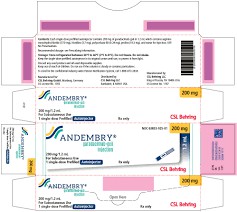
An important feature of this approval is the stable and convenient administration method provided by gadaximab. The drug is self-administered as a monthly subcutaneous injection via a citrate-free auto-injector in approximately 15 seconds or less, significantly reducing the complexity of long-term administration. For patients who require years or even lifelong treatment, this model significantly improves treatment continuity and life convenience.
The FDA approval was based on results from the pivotal Phase 3 placebo-controlled study VANGUARD. The study showed that more than 60% of patients treated with gadaximab remained seizure-free throughout the trial, and the overall frequency of HAE attacks was reduced by more than 99% (median) compared with placebo. The number of attacks requiring on-demand treatment and the number of moderate to severe attacks also dropped significantly, showing a sustained and clinically significant improvement trend. Common adverse reactions are mainly nasopharyngitis and abdominal pain, with an incidence rate of more than 7%. The overall tolerance is good.
Interim data from the open-label extension study further demonstrate the long-term safety of gadaximab. The median follow-up time of the study was approximately 13.8 months. The patient's attack rate maintained a significant decrease, and the types of adverse events were consistent with the key trials. Injection site reaction was the most common local manifestation, with an overall incidence rate of approximately 14%. These results provide a stronger scientific basis for its use as a long-term preventive treatment.
Globally In the field of HAE, the introduction of gadaximab is regarded as an important milestone in preventive treatment. On the one hand, it intervenes in the upper reaches of the disease cascade with a new target mechanism, providing a new option for patients who cannot be completely controlled by traditional drugs; on the other hand, monthly subcutaneous injections greatly improve the convenience of treatment, reduce the burden of frequent injections, and enable patients to maintain long-term management in an easier way.
With U.S. approval, gadaximab’s global accessibility is further expanding. The drug has successively received regulatory approval from many countries and regions, including Australia, the United Kingdom, the European Union, Japan, Switzerland, and the United Arab Emirates, and has gradually become a new choice for HAE prevention and treatment worldwide. For this rare disease patient group, it not only means a higher quality of life, but also represents the treatment landscape entering an innovative stage with targeting XIIa as the core.
Reference materials:https://www.andembryhcp.com/
[ 免责声明 ] 本页面内容来自公开渠道(如FDA官网、Drugs官网、原研药厂官网等),仅供持有医疗专业资质的人员用于医学药学研究参考,不构成任何治疗建议或药品推荐。所涉药品可能未在中国大陆获批上市,不适用于中国境内销售和使用。如需治疗,请咨询正规医疗机构。本站不提供药品销售或代购服务。


