
.jpeg)
Evaluation of the efficacy of Midostaurin in the clinical treatment of patients with leukemia
Midostaurin (trade name Rydapt) is a multi-targeted tyrosine kinase inhibitor (multi-targeted TKI), first developed by Novartis. It can inhibit a variety of signaling pathways related to tumor growth, including FLT3, KIT, PDGFR, VEGFR, PKC, etc. Among them, for FLT3 mutations (especially FLT3-ITD and FLT3-TKD mutation) has significant inhibitory activity and is therefore approved for use in combination with chemotherapy to treat patients with newly diagnosed FLT3 mutant acute myeloid leukemia (AML). In addition, midostaurin is also used to treat rare diseases such as systemic mastocytosis (SM). Its mechanism lies in blocking abnormal kinase signals, inhibiting the proliferation and survival of leukemia cells, thereby delaying disease progression.
The most representative study on the efficacy of midostaurin comes from the RATIFY (CALGB 10603) phase III clinical trial. The study included 717 patients with newly diagnosed FLT3 AML mutations and randomly received standard induction chemotherapy (cytarabine + daunorubicin) combined with midostaurin or placebo. The results showed that the overall survival (OS) of the midostaurin group was significantly prolonged (median OS 74.7 months vs 25.6 months), the complete response rate (CR) was also higher (59% vs 54%). The study also found that midostaurin can reduce the risk of recurrence, especially in young and intermediate-risk patients. This result establishes midostaurin combined with chemotherapy as the first-line standard regimen for FLT3 mutated AML.
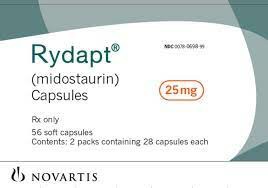
In addition to large randomized trials, multiple real-world studies have further verified the efficacy and safety of midostaurin. In clinical practice, midostaurin and"The combined use of 7+3” induction regimen can achieve complete remission in most patients and has a positive impact on the negative conversion rate of early minimal residual disease (MRD). For patients who successfully respond and receive hematopoietic stem cell transplantation, m Endostaurin maintenance therapy can help reduce the recurrence rate and prolong event-free survival (EFS). At the same time, the toxicity of its combination regimen is generally controllable. Common adverse reactions include nausea, vomiting, fatigue, rash, and mild to moderate liver enzyme elevation, but most patients can continue treatment through symptomatic treatment.
The introduction of midostaurin marks a leap in the era of FLT3mutatedAML treatment from traditional chemotherapy to molecularly targeted combination therapy. Compared with the more selective FLT3 inhibitors (such as giritinib and quizartinib) that are subsequently launched, the advantage of midostaurin lies in its broad-spectrum inhibitory effect, which can simultaneously cover signaling pathways such as KIT, thereby reducing the risk of partial resistance. However, its inhibitory strength on FLT3 is relatively weak, and the effect of long-term maintenance treatment still needs more data to support. Future studies are exploring the potential of midostaurin in combination with BCL-2 inhibitors, hypomethylating drugs (HMA) and other targeted drugs to further improve prognosis and delay recurrence. Overall, midostaurin still occupies an important position in the comprehensive treatment of FLT3 mutated AML, bringing significant survival benefits to patients.
Reference materials:https://www.drugs.com/
[ 免责声明 ] 本页面内容来自公开渠道(如FDA官网、Drugs官网、原研药厂官网等),仅供持有医疗专业资质的人员用于医学药学研究参考,不构成任何治疗建议或药品推荐。所涉药品可能未在中国大陆获批上市,不适用于中国境内销售和使用。如需治疗,请咨询正规医疗机构。本站不提供药品销售或代购服务。


