
.jpeg)
Analysis of the action targets and platelet production mechanism of avatrombopag (Sucoxin)
Avatrombopag (Avatrombopag) is an oral small-molecule thrombopoietic drug that belongs to the thrombopoietin receptor agonist (TPO-RA) class of drugs. The drug simulates the physiological effects of endogenous thrombopoietin (TPO) and specifically activates the TPO receptor (c-Mpl) located on the surface of megakaryocytes, thereby promoting the proliferation, differentiation and maturation of megakaryocytes in the bone marrow. Unlike the first-generation recombinant TPO protein, avatrombopag does not cross-react with circulating anti-TPO antibodies, has stable pharmacokinetics and a long half-life, and therefore has good efficacy and safety in chronic liver disease-related thrombocytopenia and chronic immune thrombocytopenia (ITP).
At the level of molecular mechanism, avatrombopag binds to the transmembrane domain of TPO receptor, triggering a conformational change in the receptor, thereby activating downstream JAK 2/STAT5, PI3K/AKT and MAPK and other signaling pathways. Sustained activation of these signals promotes the entry of megakaryocyte precursor cells into a postmitotic phase, increasing their size, multiplying their nuclei, and accelerating the formation and release of primitive platelets. The unique feature of this drug is that it does not compete with endogenous TPO for binding sites, but synergistically enhances platelet production through a non-overlapping mechanism, thereby making the increase in platelet count more stable and controllable, and avoiding a sudden increase or rebound decrease in platelets due to over-stimulation.
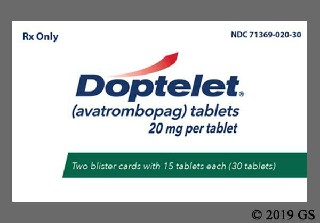
In clinical application, the target of avatrombopag determines its suitability for patients with insufficient platelet production caused by abnormal liver function or immune destruction. Compared with similar drugs such as Eltrombopag (Eltrombopag), avatrombopag does not interfere with the liver transporter system, has a lower risk of liver function damage, and can be used safely in patients with moderate to severe hepatic insufficiency. Its onset time is usually 5 to 8 days, and the platelet count can be maintained for several days after stopping the drug. It is more suitable for short-term platelet enhancement before surgery or long-term maintenance treatment. Clinical trials have confirmed that avatrombopag can effectively reduce the need for preoperative platelet transfusions in patients with liver disease and improve treatment compliance and safety.
It is worth noting that although avatrombopag can significantly promote platelet production, it does not directly improve bleeding tendencies or affect coagulation factor levels. Therefore, it needs to be comprehensively evaluated in conjunction with the patient's overall condition. Excessively elevated platelet levels may increase the risk of thrombosis, and caution should be exercised especially in high-risk patients with atherosclerosis, hypertension, or diabetes. Platelet count should be monitored regularly during use to avoid exceeding the safety threshold (generally not higher than 200×10⁹/L). Overall, avatrombopag promotes the reconstruction of the hematopoietic system by precisely targeting the TPO receptor, providing a new, safer and controllable treatment option for patients with thrombocytopenia.
Reference materials:https://www.drugs.com/
[ 免责声明 ] 本页面内容来自公开渠道(如FDA官网、Drugs官网、原研药厂官网等),仅供持有医疗专业资质的人员用于医学药学研究参考,不构成任何治疗建议或药品推荐。所涉药品可能未在中国大陆获批上市,不适用于中国境内销售和使用。如需治疗,请咨询正规医疗机构。本站不提供药品销售或代购服务。


