
.jpeg)
Sorafenib instructions
1. Generic name: sorafenib
Product name:Nexavar
All names: Sorafenib, Sorafenib, Sorafenib, Nexavar, Nexavar
2. Indications:
1. Hepatocellular carcinoma (HCC): Sorafenib (Sorafenib) is suitable for the treatment of patients with unresectable hepatocellular carcinoma.
2. Renal cell carcinoma (RCC): Sorafenib is suitable for the treatment of patients with advanced renal cell carcinoma.
3. Differentiated thyroid cancer (DTC): Sorafenib is suitable for the treatment of patients with local recurrence or metastasis and progressive differentiated thyroid cancer who are ineffective in radioactive iodine therapy.
3. Usage and dosage:
1. Recommended dose: The recommended dose of sorafenib is 400 mg twice daily without food (at least 1 hour before or 2 hours after meals) until the patient no longer benefits from treatment or until unacceptable toxicity occurs.
2. Dosage adjustment:
For the treatment of hepatocellular carcinoma and renal cell carcinoma, the first dose of sorafenib is reduced to 400 mg orally once daily and the second dose is reduced to 200 mg orally once daily (or 400 mg every other day). For differentiated thyroid cancer, the first dose of sorafenib is reduced to 400 mg orally in the morning and 200 mg orally in the evening, about 12 hours apart (or 200 mg orally in the morning and 400 mg orally in the evening, about 12 hours apart), the second dose is reduced to 200 mg twice a day, and the third dose is reduced to 200 mg twice a day.
3. If the patient does not recover after 30 days of interruption, treatment will be discontinued unless the patient obtains clinical benefit. If the patient requires more than 2 dose reductions, it is recommended to permanently discontinue treatment.
4. Adverse reactions:
According to clinical data, the most common adverse reactions in patients treated with sorafenib hepatocellular carcinoma, advanced renal cell carcinoma, or differentiated thyroid cancer(≥20%) include diarrhea, fatigue, infection, alopecia, hand-foot skin reaction, rash, weight loss, decreased appetite, nausea, gastrointestinal and abdominal pain, hypertension, and bleeding.
Post-marketing adverse events include thrombotic microangiopathy, Stevens-Johnson syndrome and toxic epidermal necrolysis (TEN), angioedema, rhabdomyolysis, osteonecrosis of the jaw, interstitial lung disease-like events, arterial (including the aorta) aneurysm, dissection and rupture.
5. Storage:
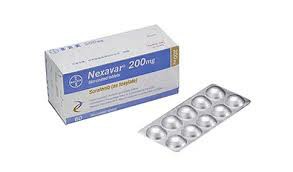
Sorafenib is available as 200 mg round, biconvex, red film-coated tablets. Store at 20°C to 25°C (68°F to 77°F) with a tolerance of 15°C to 30°C (59°F to 86°F). Store in a dry place.
6. Taboo:
Sorafenib is contraindicated in patients with known severe hypersensitivity to sorafenib or any other component thereof, and sorafenib in combination with carboplatin and paclitaxel is contraindicated in patients with squamous cell lung cancer.
7. Mechanism of action:
Sorafenib is a kinase inhibitor that reduces tumor cell proliferation in vitro. Sorafenib inhibits a variety of intracellular (c-CRAF, BRAF and mutant BRAF) and cell surface kinases (KIT, FLT-3, RET, RET/PTC, VEGFR-1, VEGFR-2, VEGFR-3 and PDGFR-1). Several of these kinases are thought to be involved in tumor cell signaling, angiogenesis, and apoptosis. Sorafenib inhibits tumor growth of HCC, RCC and DTC human tumor xenografts in immunodeficient mice. After sorafenib treatment, reduced tumor angiogenesis was observed in HCC and renal cell carcinoma models, and increased tumor cell apoptosis was observed in HCC, renal cell carcinoma, and DTC models.
8. Special groups:
1. Women: Pregnant women taking sorafenib may cause harm to the fetus. It is recommended that women should not breastfeed during treatment and within 2 weeks after the last dose of sorafenib. Women of reproductive potential should use effective contraceptive measures during treatment and within 6 months after the last dose of sorafenib.
2. Men: Based on the results of genotoxicity and animal reproduction studies, it is recommended that men of fertile female partners and pregnant partners use effective contraceptive measures during treatment with sorafenib and for 3 months after the last dose of sorafenib.
SorafenibThe original drug has been launched in China and has entered the scope of medical insurance. Different regions have different reimbursement ratios, and the price after reimbursement may vary. SpecificationsThe price of 0.2g*60 tablets may be around RMB 1,200. The original drug of Sorafenib has also been launched overseas, and there are also generic drugs of Sorafenib produced in other countries. The price of 0.2g*60 tablets produced by a Bangladesh pharmaceutical factory is around RMB 450 (the price may fluctuate due to the exchange rate). The ingredients of the original drug are basically the same as those of the generic drugs. For specific prices and drug details, please consult Yaode Medical Consultant.
[ 免责声明 ] 本页面内容来自公开渠道(如FDA官网、Drugs官网、原研药厂官网等),仅供持有医疗专业资质的人员用于医学药学研究参考,不构成任何治疗建议或药品推荐。所涉药品可能未在中国大陆获批上市,不适用于中国境内销售和使用。如需治疗,请咨询正规医疗机构。本站不提供药品销售或代购服务。


