
.jpeg)
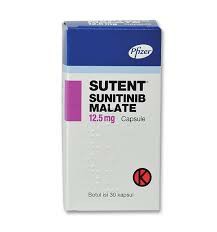
Instructions for Sunitinib
1. Generic name: Sunitinib(Sunitinib)
Product name: SUTENT
All names: Sunitinib, Sutent, Sutent
2. Indications:
1. Gastrointestinal stromal tumor (GIST): Sunitinib is suitable for adult patients with gastrointestinal stromal tumors who are treated with imatinib mesylate or are intolerant to it.
2. Advanced renal cell carcinoma (RCC): Sunitinib is suitable for the treatment of adult patients with advanced renal cell carcinoma, as well as the adjuvant treatment of adult patients with high-risk recurrent renal cell carcinoma after nephrectomy.
3. Advanced pancreatic neuroendocrine tumors (pNET): Sunitinib is indicated for the treatment of progressive, well-differentiated pancreatic neuroendocrine tumors in adult patients with unresectable locally advanced or metastatic disease.
3. Usage and dosage:
1. Recommended dosage:
(1)Patients with gastrointestinal stromal tumor (GIST) and advanced renal cell carcinoma (RCC): The recommended dose of sunitinib is 50 mg orally once daily for 4 weeks, followed by 2 weeks of discontinuation (course 4/2) until disease progression or unacceptable toxicity occurs. Sunitinib can be taken with or without food.
(2)Adjuvant treatment of renal cell carcinoma (RCC) : The recommended dose of sunitinib is 50mg, taken orally once daily for 4 weeks, followed by 2 weeks off (treatment 4/2), for a total of 9 6-week cycles.
(3)Patients with advanced pancreatic neuroendocrine tumors (pNET): The recommended dose of sunitinib is 37.5 mg orally once daily until disease progression or unacceptable toxicity.
2. Dose adjustment: In order to control the adverse reactions caused by sunitinib, the first dose of patients with GIST and RCC is reduced to 37.5 mg, once a day, and the second dose is reduced to once a day, 25 mg each time; for patients with pNET, the first dose is reduced to 25 mg, once a day. If the drug is not tolerated, the drug will be discontinued.
(1) Drug interactions: Strong CYP3A4 inhibitors usually cannot be combined with sunitinib. If this cannot be avoided, the dose should be reduced to the lowest dose. If strong CYP3A4 inducers cannot be avoided with sunitinib, the dose can be considered to be increased to the maximum dose. For patients with GIST and RCC, the dose is increased to 87.5 mg for a 4-week course of treatment, and then discontinued for 2 weeks (treatment course 4/2). For patients with pNET, the dose is increased to 62.5 mg.
(2) Hemodialysis patients with end-stage renal disease: There is usually no need to adjust the initial dose, but the exposure is reduced compared with patients with normal renal function. Based on safety and tolerability, subsequent doses can be gradually increased to 2 times.
4. Adverse reactions:
Based on clinical trial studies, the most common adverse reactions (≥25%) of sunitinib are fatigue/asthenia, diarrhea, mucositis/stomatitis, nausea, decreased appetite/anorexia, vomiting, abdominal pain, hand-foot syndrome, hypertension, bleeding events, dysgeusia/taste changes, dyspepsia, and thrombocytopenia.
After being marketed, Common adverse reactions of sunitinib include thrombocytopenic bleeding, esophagitis, cholecystitis, allergic reaction (angioedema), and serious infection (with or without neutrophilia) granulocytopenia), respiratory, urinary tract, skin infections and sepsis/septic shock, fistula formation, myopathy and/or rhabdomyolysis with or without acute renal failure, renal impairment and/or failure, poor wound healing, etc.
5. Storage:
Sunitinib is available in capsule formulations of 12.5mg, 25mg, 37.5mg and 50mg. It is usually stored at 20°C to 25°C (68°F to 77°F); the allowable deviation is 15°C to 30°C (59°F to 86°F).
6. Special groups:
1. Women: The excretion concentration of sunitinib and its metabolites in rat milk is 12 times higher than the concentration in plasma. Due to the potential for serious adverse reactions in breastfed infants, advise women not to breastfeed during treatment with sunitinib and for at least 4 weeks after the last dose. Women of reproductive potential should use effective contraception during treatment with sunitinib and for at least 4 weeks after the last dose.
2. Males: Males who are female partners of reproductive potential should use effective contraceptive measures during treatment with sunitinib and within 7 weeks after the last dose.
7. Mechanism of action:
Sunitinib is an inhibitor of multiple receptor tyrosine kinases(RTKs), some of which are associated with tumor growth, pathological angiogenesis, and cancer metastasis progression. The inhibitory activity of sunitinib was evaluated against multiple kinases and was identified as an inhibitor of platelet-derived growth factor receptor, vascular endothelial growth factor receptor, stem cell factor receptor, Fms-like tyrosine kinase-3, colony-stimulating factor receptor type 1, and glial cell lineage-derived neurotrophic factor receptor (RET). Inhibition of the activity of these RTKs by sunitinib has been demonstrated in biochemical and cellular analyses, and inhibition of function has been confirmed in cell proliferation assays. In biochemical and cellular analyses, the major metabolites showed similar potency to sunitinib.
8. Notes:
Sunitinib should pay attention to hepatotoxicity, cardiovascular events, QT interval prolongation and torsade de pointes, hypertension, bleeding events and visceral perforation, tumor lysis syndrome, thrombotic microangiopathy, proteinuria, skin toxicity, reversible posterior leukoencephalopathy syndrome, thyroid dysfunction, hypoglycemia, osteonecrosis of the jaw, impaired wound healing and other events.
The original sunitinib drug has been launched in China and has entered the scope of Class B medical insurance. SpecificationsThe price of 12.5mg*28 tablets is around RMB 3,500. The original sunitinib drug has also been launched overseas. The price of 12.5mg*7 tablets is around RMB 1,500 (the price may fluctuate due to the exchange rate). There are also generic drugs produced in other countries. The price of 12.5mg*28 tablets produced by an Indian pharmaceutical factory is around RMB 750 (the price may fluctuate due to the exchange rate). The generic drugs produced abroad are basically the same as the original drugs at home and abroad. There may be differences in the prices of different specifications of drugs.
[ 免责声明 ] 本页面内容来自公开渠道(如FDA官网、Drugs官网、原研药厂官网等),仅供持有医疗专业资质的人员用于医学药学研究参考,不构成任何治疗建议或药品推荐。所涉药品可能未在中国大陆获批上市,不适用于中国境内销售和使用。如需治疗,请咨询正规医疗机构。本站不提供药品销售或代购服务。


