
.jpeg)
Instructions for Ramucirumab
1. Generic name: Ramosumab
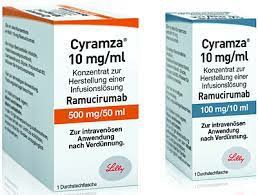
Product name: Cyramza
All names: ramucirumab, Ramucirumab, ramucirumab, ceranza, CYRAMZA
2. Indications:
1. Stomach or gastroesophageal junction (GEJ) adenocarcinoma:
Ramucirumab is indicated as a single agent or in combination with paclitaxel for the treatment of patients with advanced or metastatic adenocarcinoma of the stomach or gastroesophageal junction who have disease progression during or after prior fluoropyrimidine- or platinum-containing chemotherapy.
2. Non-small cell lung cancer (NSCLC):
(1) Ramosumab in combination with erlotinib (erlotinib) is indicated for the first-line treatment of patients with metastatic non-small cell lung cancer whose tumors have epidermal growth factor receptor (EGFR) exon 19 deletions or exon 21 (L858R) substitution mutations.
(2)It is also used in combination with docetaxel (docetaxel) to treat patients with metastatic non-small cell lung cancer who have disease progression during or after platinum-based chemotherapy. Patients with epidermal growth factor receptor (EGFR) or anaplastic lymphoma kinase (ALK) genomic tumor abnormalities should have disease progression on an FDA-approved treatment for these abnormalities before receiving ramucirumab.
3. Colorectal cancer (mCRC):
Ramuscumab in combination withFOLFIRI (irinotecan, leucovorin, and fluorouracil) is indicated for the treatment of patients with metastatic colorectal cancer whose disease has progressed before or after treatment with bevacizumab, oxaliplatin, and fluoropyrimidine.
4. Hepatocellular carcinoma (HCC):
As a single agent, ramucirumab is indicated for the treatment of patients with hepatocellular carcinoma who have alpha-fetoprotein (AFP) ≥ 400ng/mL and have been treated with sorafenib.
3. Usage and dosage:
1. Premedication: Before each infusion of ramucumab, all patients must be pre-injected intravenously with a histamine-1 receptor antagonist (such as diphenhydramine hydrochloride). For patients with grade 1 or 2 IRR, histamine-1 receptor antagonist, dexamethasone (or equivalent), and acetaminophen must be pre-administered before each infusion of ramucumab.
2. Recommended dose: If the first infusion is tolerated, all subsequent infusions of ramucirumab can be given within 30 minutes and continued until disease progression or unacceptable toxicity occurs.
(1) Stomach or gastroesophageal junction (GEJ) adenocarcinoma:
The recommended dose is 8 mg/kg every 2 weeks as an intravenous infusion over 60 minutes, alone or in combination with weekly paclitaxel. When coadministered with paclitaxel, administer ramucirumab before paclitaxel.
(2) Non-small cell lung cancer (NSCLC):
The recommended dose for patients with EGFR exon 19 deletions or exon 21 (L858R) substitution mutations is 10 mg/kg as an intravenous infusion over 60 minutes every 2 weeks. The recommended dose for patients during or after platinum-based chemotherapy is 10 mg/kg as an intravenous infusion over 60 minutes on Day 1 of a 21-day cycle prior to docetaxel infusion.
(3) Colorectal cancer (mCRC): The recommended dose is 8 mg/kg every 2 weeks, administered by intravenous infusion 60 minutes before FOLFIRI administration.
(4) Hepatocellular carcinoma (HCC): The recommended dose is 8 mg/kg every 2 weeks, intravenously infused over 60 minutes.
3. If patients experience serious adverse reactions during treatment with ramucumab, such as bleeding, gastrointestinal perforation, thrombosis, etc., ramucumab should be discontinued.
4. Adverse reactions:
The most common side effects of ramucirumab when used alone include peripheral edema, hypertension, diarrhea, abdominal pain, headache, proteinuria, and thrombocytopenia. When used with chemotherapy, the most common side effects are fatigue or weakness, neutropenia, diarrhea, epistaxis, and stomatitis. Adverse reactions that have occurred after marketing include thrombotic microangiopathy, hemangioma, dysphonia, arterial aneurysm (including aorta), dissection and rupture, heart failure, etc.
5. Storage:
Ramuscumab is a clear to slightly opalescent, colorless to slightly yellow, preservative-free solution that can be stored in the refrigerator at2-8°C (36-46°F), placed in the original carton, away from light until use. Do not freeze or shake vial. Store diluted ramucirumab at 2-8°C (36-46°F) for no more than 24 hours, or at room temperature (below 25°C [77°F]) for no more than 4 hours.
6. Special groups:
1. Women: Based on its mechanism of action, ramucirumab can cause fetal damage when pregnant women take it. Advise females of reproductive potential to use effective contraception during treatment with ramucumab and for 3 months after the last dose and not to breastfeed during treatment with ramucumab and for 2 months after the last dose.
7. Mechanism of action:
Ramosumab is aVEGFR2 antagonist that specifically binds to VEGFR2 and blocks the binding of VEGFR ligands, VEGF-A, VEGF-C and VEGF-D. Therefore, ramucirumab inhibits ligand-stimulated VEGFR2 activation, thereby inhibiting ligand-induced proliferation and migration of human endothelial cells. Ramosumab inhibits angiogenesis in in vivo animal models.
Ramosizumab is usually an injection preparation. The original drug has been on the market in China, but it has been on the market for a short time and has not been included in the medical insurance. The price of 100mg/10mL per box may be around RMB 5,000, and the price of 500mg/50mL per box may be around RMB 17,000. The price of the original Hong Kong version of 100mg/10mL may be around RMB 8,400 per box, and the price of 500mg/50mL per box may be around RMB 28,000 (the price may fluctuate due to exchange rates), and their pharmaceutical ingredients are basically the same. Currently, there are no generic drugs produced and marketed overseas. For specific prices and drug information, please consult Yaode’s medical consultant.
[ 免责声明 ] 本页面内容来自公开渠道(如FDA官网、Drugs官网、原研药厂官网等),仅供持有医疗专业资质的人员用于医学药学研究参考,不构成任何治疗建议或药品推荐。所涉药品可能未在中国大陆获批上市,不适用于中国境内销售和使用。如需治疗,请咨询正规医疗机构。本站不提供药品销售或代购服务。


