
.jpeg)
Instructions for Pemigatinib
1. Generic name: Pemetinib
Product name:Pemazyre
Full names: pemigatinib, pemigatinib, pemetinib, pemetinib, dalbertam, pemazyre
2. Indications:
1. Cholangiocarcinoma (CCA): Pemigatinib is indicated for the treatment of adults with previously treated, unresectable locally advanced or metastatic cholangiocarcinoma harboring fibroblast growth factor receptor 2 (FGFR2) fusions or other rearrangements detected by an FDA-approved test.
2. Myeloid/lymphoid neoplasms (MLNs) with FGFR1 rearrangements: Pemetinib is indicated for the treatment of adults with relapsed or refractory myeloid/lymphoid tumors with fibroblast growth factor receptor 1 (FGFR1) rearrangements.
3. Usage and dosage:
1. Before treatment: Select patients with locally advanced or metastatic cholangiocarcinoma to receive pemetinib based on the presence of FGFR2 fusions or rearrangements detected by FDAapproved tests. There are currently no FDA-approved tests to detect FGFR1 rearrangements in patients with relapsed or refractory myeloid/lymphoid tumors for the selection of patients who receive pemetinib.
2. Recommended dosage:
(1) Cholangiocarcinoma (CCA): The recommended dose for treatment with pemetinib is 13.5 mg orally once a day for 14 days, then stop treatment for 7 days, with a 21-day cycle, and continue treatment until disease progression or unacceptable toxicity occurs. (2) Myeloid/lymphoid neoplasms (MLNs) with FGFR1 rearrangements: The recommended dose of pemetinib for the treatment of myeloid/lymphoid tumors with FGFR1 rearrangements is 13.5 mg, once daily, continuously orally. Continue treatment until disease progression or unacceptable toxicity occurs.
If the patient does not take pemetinib for 4 hours or more or develops vomiting, continue with the next scheduled dose.
3. Dosage adjustment:
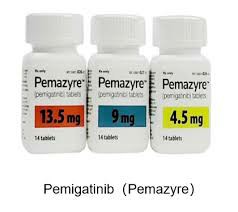
If patients experience adverse reactions during treatment with pemetinib, the dose should be adjusted promptly and the initial dose should be reduced to once daily9 mg, the second dose is reduced to 4.5 mg once daily, and if 4.5 mg once daily is not tolerated, permanently discontinue pemetinib on day 14 of each 21-day cycle.
(1) When coadministered with strong or moderate CYP3A inhibitors: Avoid coadministration of strong and moderate CYP3A inhibitors with pemetinib. If unavoidable, reduce the dose from 13.5 mg to 9 mg or from 9 mg to 4.5 mg. If a strong or moderate CYP3A inhibitor is discontinued, increase pemetinib (after 3 plasma half-lives of the CYP3A inhibitor) to the dose before starting the strong or moderate inhibitor.
(2) Severe renal and hepatic impairment: The recommended dose of pemetinib is 9 mg, according to the schedule specified by the indication (intermittent or continuous).
4. Adverse reactions:
In clinical trials, serious adverse reactions in ≥2% of patients who received pemetinib for cholangiocarcinoma included abdominal pain, pyrexia, cholangitis, pleural effusion, acute kidney injury, infectious cholangitis, dysplasia, hypercalcemia, hyponatremia, small bowel obstruction, and urinary tract infection. Fatal adverse reactions include dysplasia, bile duct obstruction, cholangitis, sepsis, and pleural effusion. Adverse reactions were high in ≥20% of patients with myeloid/lymphoid neoplasms with FGFR1 rearrangements who received pemetinib. Phosphataemia, nail toxicity, alopecia, stomatitis, diarrhea, dry eye, fatigue, rash, abdominal pain, anemia, constipation, dry mouth, epistaxis, serous retinal detachment, limb pain, decreased appetite, dry skin, indigestion, back pain, nausea, blurred vision, peripheral edema, and dizziness.
5. Storage:
Store pemetinib at room temperature20°C to 25°C (68°F to 77°F); tolerance is 15°C to 30°C (59°F to 86°F).
6. Mechanism of action:
Pemetinib is a small molecule kinase inhibitor that acts onIC50 values u200bu200bare less than 2nM for FGFR1, 2 and 3. By activating FGFR amplification and fusion, leading to constitutive activation of FGFR signaling, pemetinib inhibits FGFR1-3 phosphorylation and signaling and reduces cell viability in cancer cell lines. Constitutive FGFR signaling can support the proliferation and survival of malignant cells. Pemetinib showed antitumor activity in mouse xenograft models of human tumors in which alterations in FGFR1, FGFR2, or FGFR3 resulted in constitutive FGFR activation, including a cholangiocarcinoma patient xenograft model expressing an oncogenic FGFR2-Transformer-2β homolog (TRA2b) fusion protein and a KG1 leukemia model harboring an FGFR1 translocation (FGFR1OP2-FGFR1).
[ 免责声明 ] 本页面内容来自公开渠道(如FDA官网、Drugs官网、原研药厂官网等),仅供持有医疗专业资质的人员用于医学药学研究参考,不构成任何治疗建议或药品推荐。所涉药品可能未在中国大陆获批上市,不适用于中国境内销售和使用。如需治疗,请咨询正规医疗机构。本站不提供药品销售或代购服务。


