
.jpeg)
Pralsetinib instructions in Chinese
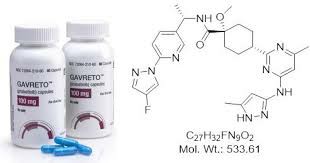
1. Name: pralsetinib capsule, pralsetinib, pralsetinib, pralsetinib, Pujihua, Pujihua, Gavreto, BLU-667
2. Indications:
Pralsetinib (Pralsetinib) is indicated for the treatment of adult patients with metastatic RET fusion-positive non-small cell lung cancer (NSCLC) as detected by an FDA-approved test and is also indicated for the treatment of adult and pediatric patients 12 years of age and older with advanced or metastatic RET fusion-positive thyroid cancer who require systemic therapy and are refractory to radioactive iodine therapy, if radioactive iodine is applicable.
3. Usage and dosage:
1. Before treatment: Before patients are treated with platinib, it is necessary to determine whether there is RET gene fusion in thyroid cancer or non-small cell lung cancer.
2. Recommended dose: The recommended dose of platinib is 400 mg once daily. It is recommended to take it orally on an empty stomach, or not eat at least 2 hours before and at least 1 hour after taking it, and continue treatment until the disease worsens or unacceptable toxicity occurs.
3. Dose adjustment: If the patient experiences adverse reactions after using platinib, it is recommended to adjust the drug dosage under the guidance of a doctor. The first dose is reduced to 300 mg once a day; the second dose is reduced to 200 mg once a day; the third dose is reduced to 100 mg once a day; patients who cannot tolerate oral administration of 100 mg once a day should permanently discontinue platinib.
4. Combined medication:
(1) When used in combination with CYP3A and/or P-gp inhibitors: If the patient is currently taking the recommended dose of 400 mg once a day, it is recommended to reduce it to 200 mg; if it is 300 mg once a day, it is recommended to reduce it to 200 mg; and if the patient is taking the recommended dose of 400 mg once a day, it is recommended to reduce it to 100 mg. After 3 to 5 elimination half-lives of discontinuing the inhibitor, reinstitute platinib at the dose used prior to initiating concomitant use of P-gp and a strong CYP3A inhibitor.
(2) When coadministered with a strong CYP3A inducer: If coadministration with a strong CYP3A inducer cannot be avoided, increase the starting dose of platinib to twice the current dose starting from the 7th day of coadministration with a strong CYP3A inducer. After discontinuing the inducer for at least 14 days, reinstitute platinib at the same dose as before starting the strong CYP3A inducer.
4. Adverse reactions:
In clinical studies, the most common adverse reactions of Platinib (≥25%) were musculoskeletal pain, constipation, hypertension, diarrhea, fatigue, edema, fever and cough. The most common grade 3-4 laboratory abnormalities (≥2%) were lymphopenia, neutropenia, hemoglobin decrease, phosphate decrease, leukopenia, sodium decrease, aspartate aminotransferase (AST) increase, alanine aminotransferase (ALT) increase, calcium decrease, thrombocytopenia, alkaline phosphatase increase, potassium increase, potassium decrease, and bilirubin increase.
5. Storage:
Platinib is normally stored20°C to 25°C (68°F to 77°F); deviations of 15°C to 30°C (59°F to 86°F) are permitted. Pay attention to moisture.
6. Taboo: None.
7. Mechanism of action:
Platinib is a kinase inhibitor of wild-typeRET and oncogenic RET fusions and mutations, with a maximum inhibitory concentration of less than 0.5nM. In the purified enzyme test, platinib inhibited DDR1, TRKC, FLT3, JAK1-2, TRKA, VEGFR2, PDGFRB and FGFR1 at higher concentrations, which can still reach Cmax clinically. In cell experiments, platinib inhibited RET at concentrations that were 14-fold, 40-fold, and 12-fold lower than VEGFR2, FGFR2, and JAK2, respectively.
CertainRET fusion proteins and activating point mutations can drive tumorigenic potential through overactivation of downstream signaling pathways, leading to uncontrolled cell proliferation. Platinib exhibits antitumor activity in cultured cells and in animal tumor implant models harboring oncogenic RET fusions or mutations. Platinib prolongs the survival of mice with intracranial implantation of tumor models expressing KIF5B-RET or CCDC6-RET.
8. Special groups:
1. Women: According to the results of animal studies and the mechanism of action of platinib, taking it by pregnant women may cause harm to the fetus. Advise females of reproductive potential to use an effective non-hormonal method of contraception during treatment with platinib and for 2 weeks after the last dose. Platinib may cause hormonal contraceptives to be ineffective; do not breastfeed during treatment with the drug and for 1 week after the last dose.
2. Men: It is recommended that men with female partners of reproductive potential use effective contraceptive measures during treatment with platinib and within 1 week after the last dose.
[ 免责声明 ] 本页面内容来自公开渠道(如FDA官网、Drugs官网、原研药厂官网等),仅供持有医疗专业资质的人员用于医学药学研究参考,不构成任何治疗建议或药品推荐。所涉药品可能未在中国大陆获批上市,不适用于中国境内销售和使用。如需治疗,请咨询正规医疗机构。本站不提供药品销售或代购服务。


