
.jpeg)
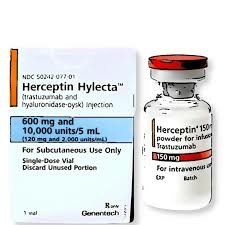
Instructions for Trastuzumab Injection (Subcutaneous Injection) (Herceptin Hylecta)
1. Generic name: Trastuzumab injection (subcutaneous injection)
Product Name: Herceptin Hylecta
All names: trastuzumab injection, trastuzumab and hyaluronidase-oysk, trastuzumab hyaluronidase
2. Indications:
1. Adjuvant breast cancer: Trastuzumab injection (subcutaneous injection ) (Herceptin Hylecta) is suitable for adjuvant treatment of adult patients with HER2-overexpressing lymph node-positive or lymph node-negative (ER/PR negative) or one high-risk feature.
(1) As part of a treatment regimen consisting of doxorubicin, cyclophosphamide, and paclitaxel or docetaxel;
(2) as part of a docetaxel and carboplatin treatment regimen;
(3) is used as a single agent after multimodal anthracycline therapy.
2. Metastatic breast cancer (MBC):
(1) Trastuzumab injection (subcutaneous injection) combined with paclitaxel (paclitaxel) is used in the first-line treatment of HER2-overexpressing metastatic breast cancer;
(2) As a single agent for the treatment of HER2-overexpressing breast cancer in patients who have received one or more chemotherapy regimens for metastatic disease.
3. Usage and dosage:
1. Before treatment: Before patients use trastuzumab injection (subcutaneous injection) , doctors will select patients based on HER2 protein overexpression or HER2 gene amplification in tumor specimens. The evaluation of HER2 protein overexpression and HER2 gene amplification should be performed by a laboratory with proven capabilities using an FDA-approved breast cancer-specific test.
2. Recommended dosage: The recommended dosage of trastuzumab injection (subcutaneous injection ) is 600mg/10,000 units (600mg trastuzumab and 10,000 units hyaluronidase), subcutaneously injected once every three weeks, about 2-5 minutes each time. No loading dose is required, and no dose adjustments are required based on patient weight or different concomitant chemotherapy regimens.
3. Duration of treatment: Patients with adjuvant breast cancer should receive trastuzumab injection (subcutaneous injection) for 52 weeks or until disease recurrence, whichever occurs first; it is not recommended to extend the treatment time for adjuvant breast cancer to more than one year. Patients with metastatic breast cancer (MBC) should receive trastuzumab injection (subcutaneous injection) until the disease progresses.
4. Missed dose: If you miss a dose, it is recommended to take the next dose of 600 mg/10,000 units as soon as possible, and the interval between subsequent doses should not be less than three weeks.
5. Dose adjustment: Assess left ventricular ejection fraction (LVEF) before starting to take trastuzumab injection (subcutaneous injection) and regularly during treatment. Stop taking trastuzumab injection (subcutaneous) for at least 4 weeks if any of the following conditions occur:
(1) The absolute decrease in LVEF is ≥16% compared with before treatment
(2) LVEF is lower than the normal institutional limit, and the LVEF absolute decrease is ≥10% compared with the pretreatment value.
Trastuzumab injection (subcutaneous) may be resumed if within 4-8 weeks, left ventricular ejection fraction returns to normal limits and the absolute decrease from baseline is ≤15%. If LVEF continues to decline (>8 weeks), or if trastuzumab injection (subcutaneous injection) is suspended for more than 3 times due to cardiomyopathy, it will be permanently stopped.
6. Precautions: Trastuzumab injection (subcutaneous injection) is only for subcutaneous injection, and its dosage and administration instructions are different from intravenous infusion trastuzumab products. Do not use trastuzumab injection (subcutaneous) instead of ado-trastuzumab emtansine.
4. Adverse reactions:
In clinical studies of trastuzumab injection (subcutaneous injection), the most common adverse reactions of any grade (occurring in ≥10% of patients) were alopecia, nausea, ARRs, neutropenia, diarrhea, asthenia, fatigue, vomiting, myalgia, decreased appetite, stomatitis, arthralgia, headache, rash, constipation, radiation skin damage, pyrexia, cough, and anemia. Trastuzumab injection (subcutaneous injection) After being put on the market, adverse events such as glomerular disease, tumor lysis syndrome (TLS), oligohydramnios or oligohydramnios, including pulmonary hypoplasia, skeletal abnormalities, and neonatal death, have occurred.
5. Storage:
Store trastuzumab injection (subcutaneous) vials in original cartons in a refrigerator at 2°C to 8°C (36°F to 46°F) to avoid light, do not freeze, and do not shake. Once removed from the refrigerator, trastuzumab injection must be administered within 4 hours and must not be kept above 30°C (86°F). If a syringe containing Trastuzumab Injection (subcutaneous) is not used immediately, store the syringe in the refrigerator (2°C to 8°C) for 24 hours and then at room temperature (20°C to 25°C) for 4 hours. Avoid light. Do not shake or freeze.
6. Special groups:
1. Women: The use of trastuzumab injection (subcutaneous injection) during pregnancy can cause embryonic-fetal damage. It is therefore recommended that women of childbearing potential use effective contraception during treatment and for 7 months after the last dose.
7. Mechanism of action:
Both in vitro and animal experiments have shown that trastuzumab (trastuzumab) can inhibit the proliferation of human tumor cells that overexpress HER2. Trastuzumab is a mediator of antibody-dependent cellular cytotoxicity (ADCC). In vitro, trastuzumab-mediated ADCC has been shown to preferentially act on cancer cells that overexpress HER2 compared with cancer cells that do not. Hyaluronic acid is a polysaccharide found in the extracellular matrix of subcutaneous tissue. It is depolymerized by the naturally occurring hyaluronidase enzyme. Unlike the stable structural components of the interstitial matrix, hyaluronic acid has a half-life of approximately 0.5 days. Hyaluronidase increases the permeability of subcutaneous tissue by depolymerizing hyaluronic acid. At the administered dose, the hyaluronidase in trastuzumab injection (subcutaneous injection) acts transiently and locally.
[ 免责声明 ] 本页面内容来自公开渠道(如FDA官网、Drugs官网、原研药厂官网等),仅供持有医疗专业资质的人员用于医学药学研究参考,不构成任何治疗建议或药品推荐。所涉药品可能未在中国大陆获批上市,不适用于中国境内销售和使用。如需治疗,请咨询正规医疗机构。本站不提供药品销售或代购服务。


