
.jpeg)
Instructions for Lenvatinib
1. Generic name: Lenvatinib
Product name:Lenvima/Lenvima
All names: Lenvatinib, Lenvatinib, Lenvatinib, E7080
2. Indications:
1. Differentiated thyroid cancer (DTC): Lenvatinib is suitable for the treatment of patients with locally recurrent or metastatic, progressive, radioactive iodine-refractory differentiated thyroid cancer.
2. Renal cell carcinoma (RCC): Lenvatinib combined with Pembrolizumab is suitable for first-line treatment of adult patients with advanced renal cell carcinoma; combined with everolimus is suitable for adult patients with advanced renal cell carcinoma who have previously received one anti-angiogenic treatment.
3. Hepatocellular carcinoma (HCC): Lenvatinib is suitable for first-line treatment of patients with unresectable hepatocellular carcinoma.
4. Endometrial cancer (EC): Lenvatinib is used in combination with pembrolizumab to treat patients with advanced endometrial cancer who are mismatch repair proficient (pMMR) or not microsatellite instability high (MSI-H). These patients have disease progression after previous systemic therapy in any case and are not suitable for therapeutic surgery or radiotherapy.
3. Usage and dosage:
1. Before treatment: For pMMR/non-MSI-H advanced endometrial cancer indications, doctors will select patients for lenvatinib combined with pembrolizumab treatment based on the MSI or MMR status in the tumor specimen.
2. Recommended dose: Take lenvatinib once a day, at the same time every day, regardless of whether you eat or not.
(1) Differentiated thyroid cancer (DTC): The recommended dose of lenvatinib is 24 mg orally once daily until disease progression or unacceptable toxicity.
(2) Renal cell carcinoma (RCC): For patients with advanced renal cell carcinoma, the recommended dose of lenvatinib is 20 mg once daily in combination with 200 mg of pembrolizumab as an intravenous infusion over 30 minutes every 3 weeks until disease progression or unacceptable toxicity occurs, or for up to 2 years. After completing 2 years of combination therapy, lenvatinib can be administered as a single agent until disease progression or until unacceptable toxicity develops. For patients with previously treated renal cell carcinoma, the recommended dose of lenvatinib is 18 mg once daily in combination with 5 mg of everolimus orally until disease progression or unacceptable toxicity.
(3) Hepatocellular carcinoma (HCC): The recommended dose of lenvatinib is based on actual body weight: 12 mg orally once daily for patients weighing ≥60 kg, or 8 mg orally once daily for patients weighing <60 kg, until disease progression or unacceptable toxicity.
(4) Endometrial cancer (EC): The recommended dose of lenvatinib is 20 mg once daily, combined with 200 mg pembrolizumab as an intravenous infusion over 30 minutes every 3 weeks until unacceptable toxicity or disease progression occurs.
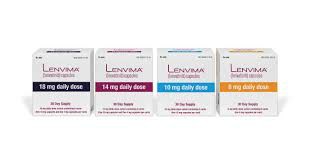
3. Dose adjustment: If a patient experiences adverse reactions after using lenvatinib, the doctor will adjust the drug dosage according to the severity of the condition. When coadministering drugs, adjust the dosage of one or both drugs as appropriate.
(1) Differentiated thyroid cancer (DTC): The first dose is reduced to 20 mg, the second dose is reduced to 14 mg, and the third dose is reduced to 10 mg, taken orally once daily Lenvatinib.
(2) Renal cell carcinoma (RCC), endometrial cancer (EC): The first dose is reduced to 14 mg, the second dose is reduced to 10 mg, and the third dose is reduced to 8 mg, taken orally once a day Lenvatinib.
(3) Hepatocellular carcinoma (HCC): For patients weighing ≥60kg, the first dose is reduced to 8mg once a day, the second dose is reduced to 4mg once a day, and the third dose is reduced to 4mg orally every other day; or for patients weighing <60kg, the first dose is 4mg once a day, and the second dose is reduced to 4mg orally every other day. Patients who cannot tolerate it should stop using lenvatinib.
(4) Patients with severe renal impairment: DTC, RCC or endometrial cancer and patients with severe renal impairment (creatinine clearance less than 30mL/min calculated by the Cockcroft-Gault equation using actual body weight) The recommended dose of lenvatinib is: 14 mg orally once daily for patients with DTC and 10 mg orally once daily for patients with RCC or endometrial cancer.
(5) Patients with severe liver injury: For patients with DTC, RCC or endometrial cancer and severe liver injury (Child-Pugh C), the recommended dose of lenvatinib is: DTC patients take 14 mg orally once a day, and patients with RCC or endometrial cancer take 10 mg orally once a day.
4. Adverse reactions:
In clinical studies of lenvatinib in various cancers, the most common adverse reactions include hypertension, diarrhea, loss of appetite and weight, fatigue, nausea, proteinuria, stomatitis, vomiting, dysphonia (hoarseness), headache, and palmoplantar erythrodysesthesia syndrome (PPE; rash and numbness of the palms and soles). When used in combination with medications, the most common adverse reactions include hypothyroidism, arthralgia, constipation, urinary tract infection, abdominal pain, weakness, anemia, hypomagnesemia, peripheral edema, cough, dyspnea, rash, and bleeding events. After lenvatinib was put on the market, adverse events such as pancreatitis, increased amylase, impaired wound healing, cholecystitis, nephrotic syndrome, arterial (including aortic) aneurysm, dissection and rupture also occurred.
5. Storage:
Lenvatinib Storage temperature is 20°C to 25°C (68°F to 77°F); an excursion of 15°C to 30°C (59°F to 86°F) is allowed.
6. Special groups:
1. Women: Based on findings from animal studies and its mechanism of action, lenvatinib can cause fetal damage when administered to pregnant women and may impair fertility in women of reproductive potential. Therefore, use effective contraception during treatment and for 30 days after the last dose; advise women to stop breastfeeding during treatment and for 1 week after the last dose.
7. Mechanism of action:
Lenvatinib is a kinase inhibitor that inhibits the kinase activity of vascular endothelial growth factor receptorVEGFR1 (FLT1), VEGFR2 (KDR) and VEGFR3 (FLT4). In addition to inhibiting their normal cellular functions, lenvatinib also inhibits other kinases involved in pathogenic angiogenesis, tumor growth, and cancer progression, including the fibroblast growth factor (FGF) receptors FGFR1, 2, 3, and 4; platelet-derived growth factor receptor alpha (PDGFRα), KIT, and RET. Lenvatinib also exhibits antiproliferative activity in hepatocellular carcinoma cell lines dependent on activated FGFR signaling while inhibiting FGF receptor substrate 2α (FRS2α) phosphorylation.
[ 免责声明 ] 本页面内容来自公开渠道(如FDA官网、Drugs官网、原研药厂官网等),仅供持有医疗专业资质的人员用于医学药学研究参考,不构成任何治疗建议或药品推荐。所涉药品可能未在中国大陆获批上市,不适用于中国境内销售和使用。如需治疗,请咨询正规医疗机构。本站不提供药品销售或代购服务。


