
.jpeg)
Instructions for Selegiline Hydrochloride Tablets (Selegiline)
1. Name: Selegiline Hydrochloride Tablets, Selegiline, Imidopyr, Eldepryl
2. Indications:
Selegiline hydrochloride tablets (Selegiline) can be used as an adjuvant treatment for patients with Parkinson's disease who are receiving levodopa/carbidopa (levodopa/carbidopa) and have a reduced quality of response to this therapy. There is no evidence from controlled studies that selegiline has any beneficial effect in the absence of concomitant treatment with levodopa.
3. Usage and dosage:
The recommended dosage regimen of selegiline hydrochloride tablets is 10 mg per day, divided into 5 mg each for breakfast and lunch. There is no evidence that higher doses confer additional benefit. Additionally, higher doses should generally be avoided due to an increased risk of side effects.
After two to three days of treatment with selegiline hydrochloride tablets, you can try to reduce the dose of levodopa/carbidopa. In placebo-controlled trials, the typical number of participants assigned to treatment with selegiline hydrochloride tablets decreased by 10% to 30%. During continued selegiline therapy, further reductions in levodopa/carbidopa may be possible.
4. Adverse reactions:
In prospective premarketing studies, the following events, in order of decreasing frequency, led to the discontinuation of treatment with Selegiline Hydrochloride Tablets: nausea, hallucinations, confusion, depression, loss of balance, insomnia, orthostatic hypotension, increased voluntary movements without exercise, agitation, arrhythmias, bradykinesia, chorea, delusions, hypertension, new or worsening angina, and syncope. Events reported only once as reasons for discontinuation were ankle edema, anxiety, burning lips/mouth, constipation, somnolence/somnolence, dystonia, excessive sweating, increased freezing, gastrointestinal bleeding, alopecia, increased tremor, nervousness, weakness, and weight loss.
5. Storage:
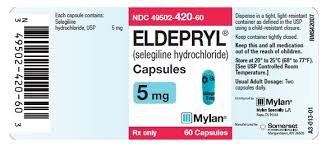
Storage temperature of selegiline hydrochloride tablets is 20° to 25°C (68° to 77°F), as appropriate, in a tight, light-resistant container with a child-proof cover.
6. Taboo:
Selegiline hydrochloride tablets are contraindicated in:
1. Patients who are known to be allergic to the drug;
2. It is prohibited to use it with meperidine. This contraindication usually extends to other opioids.
7. Mechanism of action:
The mechanism of the beneficial auxiliary effect of selegiline hydrochloride tablets in the treatment of Parkinson's disease is not fully understood. Inhibition of the activity of type B monoamine oxidase is generally considered to be the most important; in addition, there is evidence that the active ingredient of Selegiline Hydrochloride Tablets, Selegiline, may increase dopaminergic activity through other mechanisms. Selegiline is best known as an irreversible inhibitor of monoamine oxidase (MAO), an intracellular enzyme associated with the outer mitochondrial membrane. Selegiline inhibits MAO by acting as a "suicide" substrate for the enzyme; that is, it is converted by the MAO into an active moiety that is irreversibly bound to the active site and/or to the enzyme's essential FAD cofactor. Because selegiline has greater affinity for the type B active site than for the type A active site, it can act as a selective inhibitor of type B MAOs if administered at recommended doses.
[ 免责声明 ] 本页面内容来自公开渠道(如FDA官网、Drugs官网、原研药厂官网等),仅供持有医疗专业资质的人员用于医学药学研究参考,不构成任何治疗建议或药品推荐。所涉药品可能未在中国大陆获批上市,不适用于中国境内销售和使用。如需治疗,请咨询正规医疗机构。本站不提供药品销售或代购服务。


