
.jpeg)
Delamanid instructions
1. Indications
Delamanid(Delamanid) is a drug used to treat tuberculosis, with the trade name Deltyba. Delamanid(Delamanid)It is used with other anti-tuberculosis drugs to treat active multidrug-resistant tuberculosis.
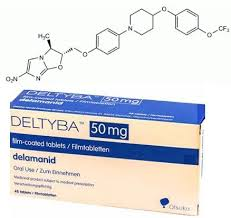
2. Dosage and usage
Delamanid(Delamanid)Adult(18 to64 years old span>)The recommended dose is 100mg twice daily for 24 weeks. Older adults(> 65 years old):There are no data on older adults.
Three. Contraindications
None
Four. side effects
Common side effects include nausea, vomiting, diarrhea, abdominal pain, indigestion, oropharyngeal pain, malaise, fatigue, hypokalemia, decreased appetite, etc.
Five. Mechanism of action
Delamaniis a prodrug that requires biotransformation by the mycobacterialF420coenzyme system, including deazoflavin-dependent nitroreductase(Rv3547), to mediate its antimycobacterial activity against growing and non-growing mycobacteria2 3. Five coenzymesF420genes(fgd, Rv3547,
6. pharmacodynamics
The minimum inhibitory concentration (MIC) of delamanid against Mycobacterium tuberculosis isolates ranges from 0.006 to 0.024g/mL. Among nontuberculous mycobacteria, delamanid has in vitro activity against Mycobacterium kansasii and Mycobacterium bovis2. Delamanidhas no in vitro activity against Gram-negative or Gram-positive bacterial species and no cross-resistance to other anti-tuberculosis drugs. In a murine model of chronic tuberculosis, delamanid reduced Mycobacterium tuberculosis colony counts in a dose-dependent manner. Repeated administration of delamanimay lead to QTc prolongation by inhibiting cardiac potassium channels (hERGchannel). This effect is mainly caused by delamani’s main metabolite DM-6705 6, 2 caused. Animal studies indicate that delamanid may attenuate vitamin K-dependent coagulation and increase prothrombin time (PT) and activated partial thromboplastin time (APTT).
7. Metabolism
Delamanid is metabolized primarily by albumin and to a lesser extentCYP3A4. The metabolism of delamanid may also be regulated, to a lesser extent, by hepatic CYP1A1, CYP2D6, and CYP2E1[31966]. Four major metabolites (M1-M4) were found in the plasma of patients treated with delamanid, of which M1 and M3 accounted for 13%-18%4 of total human plasma exposure. Although they do not retain significant pharmacological activity, they may still cause QT interval prolongation. This is especially true forM1the major metabolite of delamanide(DM-6705). Delamanid is mainly metabolized by serum albumin via6-nitro-2, 3-Dihydroimidazo[2, 1-b]Hydrolytic cleavage of the azole moiety forms M1 (DM-6705). The formation of this major metabolite is thought to be the key starting point for the delamanidmetabolic pathway. M1 (DM-6705)can be further catalyzed through three pathways. In the first metabolic pathway, DM-6705 undergoes hydroxylation of the oxazole moiety to form M2 ((4RS, 5S)-DM-6720), followed by CYP3A4-mediated hydroxyl oxidation and tautomerization of the oxazole to form the iminoketone metabolite M3 ((S)-DM-6718). The second metabolic pathway involves hydrolysis and deamination of azolamine to form M4 (DM-6704), followed by hydroxylation to M6 ((4R, 5S)-DM-6721) and M7 ((4S, 5S)-DM-6722), the azole is oxidized to another ketone metabolite M8 ((S)-DM-6717)4. The third pathway involves hydrolytic cleavage of the azole ring to form M5 (DM-6706).
Russia has original medicines, each box is about 1 more than 1,000. If you want to get more high-quality information, you can contact Yaode, and Yaode will do its best to help you learn more about high-quality overseas drugs.
xa0
[ 免责声明 ] 本页面内容来自公开渠道(如FDA官网、Drugs官网、原研药厂官网等),仅供持有医疗专业资质的人员用于医学药学研究参考,不构成任何治疗建议或药品推荐。所涉药品可能未在中国大陆获批上市,不适用于中国境内销售和使用。如需治疗,请咨询正规医疗机构。本站不提供药品销售或代购服务。


