
.jpeg)
Cabozantinib instructions
1. Indications and usage
1.Medullary thyroid carcinoma
Cabozantinib is indicated for the treatment of progressive metastatic medullary thyroid carcinoma(MTC)
The recommended dose in the labeling is140mg once daily, continued until disease progression or unacceptable toxicity occurs.
2.Renal cell carcinoma
In combination withnivolumab
Indicated for the first-line treatment of advanced renal cell carcinoma(RCC) in combination with nivolumab.
The recommended dose of cabozantinib 40mg once daily plus nivolumab 240 mg intravenously every 2 weeks or 480 mg intravenously every 4 weeks until disease progression or unacceptable toxicity.
Nivolumab only: lasts up to2 years.
3.Hepatocellular carcinoma
Applicable to hepatocellular carcinoma(HCC) patients who have previously received sorafenib treatment.
The recommended dose in the labeling is60mg once daily, continued until disease progression or unacceptable toxicity occurs.
4.Differentiated thyroid cancer
Indicated for adults with locally advanced or metastatic differentiated thyroid cancer(DTC) that have progressed after priorVEGFRtargeted therapy,and adults who are refractory or ineligible for radioactive iodine.
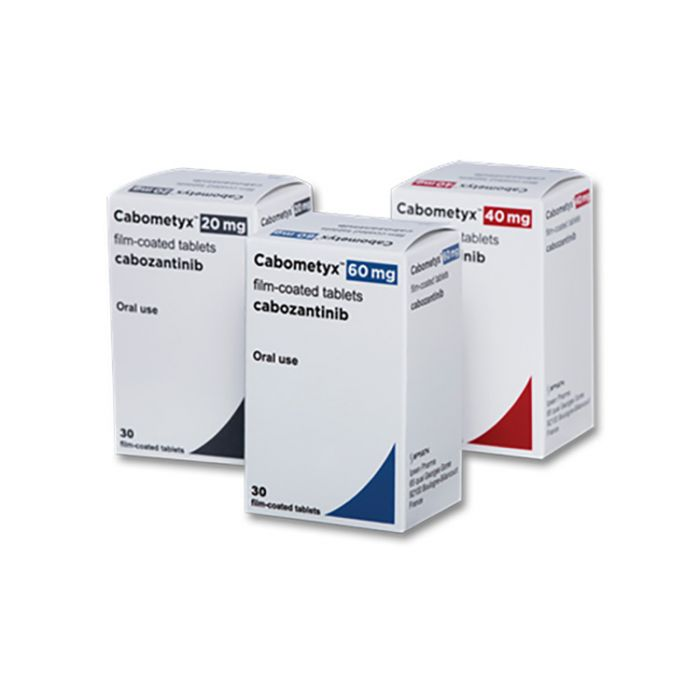
2. Dosage form and strength
Tablets: 20mg, 40mg and 60mg.
Three. Contraindications
None
Warnings and Precautions
Bleeding: Do not use cabozantinib if you have a recent history of bleeding.
Perforations and Fistulas:Monitor for symptoms. Discontinue cabozantinib for grade 4 fistulas or perforations.
thrombotic events:Withhold cabozantinib due to myocardial infarction or serious venous or arterial thromboembolic event.
Hypertension and Hypertensive Crisis:Monitor blood pressure regularly. Interruption of treatment due to hypertension not adequately controlled by antihypertensive therapy. Cabozantinib should be discontinued in cases of hypertensive crisis or severe hypertension uncontrolled by antihypertensive therapy.
Diarrhea:It can be serious. Interrupt CABOMETYX until diarrhea subsides or drops to grade ≤1, then reduce dose and continue. Standard antidiarrheal therapy is recommended.
Palms-Plant red blood cell paresthesia(PPE):Interrupt chin treatment until PPE subsides or drops to 1 grade.
Hepatotoxicity:A higher frequency of hepatotoxicity may occur when used in combination with nivolumab than when used aloneCABOMETYX /span>Grade 3 and Grade 4ALT and AST were elevated. Monitor liver enzymes before starting treatment and periodically during treatment. Consider deactivatingCabozantiniband/or nivolumab, initiate corticosteroid therapy, and /or permanently discontinue the combination due to severe or life-threatening hepatotoxicity.
Adrenal Insufficiency: Primary or secondary adrenal insufficiency may occur when is used concomitantly with nivolumab. For grade 2 or higher adrenal insufficiency, initiate symptomatic treatment, including hormone replacement as clinically indicated. Depending on severity, discontinue use of CABOMETYX and / or nivolumab.
Proteinuria:Monitor urine protein. Interrupt cabozantinib until proteinuria subsides to grade ≤1, then continue cabozantinib after reducing the dose. Discontinue treatment in nephrotic syndrome.
Osteonecrosis of the jaw (ONJ): Osteonecrosis of the jaw(ONJ): At least 3 weeks before invasive dental surgery, and ONJ performed.
Poor wound healing: Discontinue cabozantinib at least before elective surgery. Do not administer for at least 2 weeks after major surgery and wound healing. Recovery after resolution of wound healing complicationsThe safety of cabozantinib has not been established.
Reversible posterior leukoencephalopathy syndrome (RPLS): Discontinue cabozantinib .
Thyroid Dysfunction: Monitor thyroid function before and during cabozantinib treatment.
Hypocalcemia:Depending on the severity of the condition, discontinue cabozantinib, reduce the dose upon recovery, or permanently discontinue cabozantinib.
Embryo-Fetal Toxicity:Can cause fetal harm. Inform women of reproductive potential of the potential risks to the fetus and use effective contraception.
Five. adverse reactions
Cabozantinib (Incidence≥25%):Diarrhea, stomatitis, palms-Plantar dysesthesia syndrome(Hand-foot syndrome), weight loss, decreased appetite, nausea, fatigue, oral pain, hair color change, dysgeusia, high blood pressure, abdominal pain, constipation, AST Elevated concentrations, ALTincreased concentrations, lymphopenia, increased alkaline phosphatase concentrations, hypocalcemia, neutropenia, thrombocytopenia, hypophosphatemia, hyperbilirubinemia.
Cabozantinib (Incidence≥20%):Diarrhea, fatigue, palmar-plantar red paresthesia syndrome(Hand-foot syndrome), decreased appetite, hypertension, nausea, vomiting, weight loss, constipation.
Cabozantinibcombined with nivolumab(Incidence≥20%):Diarrhea, fatigue, hepatotoxicity, palmar-Plantar red blood cell dysesthesia syndrome(Hand-foot syndrome), stomatitis, rash, hypertension, hypothyroidism, musculoskeletal pain, decreased appetite, nausea, dysgeusia, abdominal pain, cough, upper respiratory tract infection.
6. drug interactions
PowerfulCYP3A4Inhibitor
Coadministration of cabozantinib capsule formulations with strong inhibitors of CYP3A4 increases cabozantinib exposure, which may increase the risk of exposure-related adverse reactions. Avoid coadministration of cabozantinib with strong CYP3A4 inhibitors. If coadministration with a strong inhibitor of CYP3A4 cannot be avoided, reduce the cabozantinib dose. Avoid grapefruit or grapefruit juice, which may also increase cabozantinibexposure.
StrongCYP3AInducer
Coadministration of cabozantinibcapsule formulations with strongCYP3A4 inducers may reduce cabozantinib exposure, which may reduce efficacy. Avoid coadministration of cabozantinib with strong CYP3A4 inducers. If coadministration with strong CYP3A4 inducers cannot be avoided, increase the dose of cabozantinib. Avoid St. John's wort, which may also reduce cabozantinib exposure.
7. Used by specific groups of people
Liver function impairment:Patients with moderate hepatic impairment should have a reduced dose of cabozantinib. Use should be avoided in patients with severely impaired liver function.
Lactation:It is recommended not to breastfeed.
Pediatric Applications:Monitoring of open growth plates in adolescent patients. If abnormalities occur, consider interrupting or discontinuing cabozantinib.
8. clinical pharmacology
1.Mechanism of action
In vitro biochemistry and / or cellular assays show that cabozantinib inhibits MET, VEGFR-1< /span>, -2 and -3, AXL, RET, ROS1, TYRO3, MER, K Tyrosine kinase activities of IT, TRKB, FLT-3, and TIE-2. These receptor tyrosine kinases are involved in normal cellular functions and pathological processes, such as tumorigenesis, metastasis, tumor angiogenesis, drug resistance, and maintenance of the tumor microenvironment.
2.Pharmacodynamics
The exposure -reaction or - safety relationship to cabozantinib is unknown.
cardiac electrophysiology
A randomized, double-blind, placebo-controlled trial evaluated the effect of cabozantinib on the QTc interval in patients with medullary thyroid cancer taking cabozantinib capsule formulation. A mean increase of QTcFof 10 - 15 ms was observed 4 weeks after initiating treatment. The relationship between concentration and QTc cannot be determined. No changes in cardiac waveform morphology or new rhythms were observed. No patients in this study had confirmed QTcF > 500 ms, METEOR, CABOSUNThere were also no patients with confirmed QTcF > 500 ms in , asterial, CHECKMATE-9ER or COSMIC-311.
3.Pharmacokinetics
Repeated daily administration of cabozantinibcapsule formulations for 19 consecutive19 days resulted in 4to5 times the mean capozantinib accumulation(based onAUC );reaches a steady state on day 15.
absorb
The median time to peak cabozantinib concentration (Tmax) ranged from 3 to 4 hours after dosing. CAn increase of 19%maximum compared to the capozantinib capsule formulation was observed after a single dose of 140 mg. The AUCdifference between CABOMETYX and cabozantinib capsule formulations was observed to be less than 10%.
food effect
Cabozantinib's Cmaximum and AUC increased by 41% and 57% respectively.
allocate
Oral volume distribution(Vz/F)is approximately319 L. Cabozantinib is highly protein bound in human plasma (≥ 99.7%).
Eliminate
The predicted terminal half-life is approximately99 hours, and the clearance rate at steady state(CL/F)Estimated to be 2.2liters/ hours.
Metabolism
Cabotinib is a substrate ofCYP3A4 in vitro.
Excretion
Approximately 81%of the total administered radioactivity was recovered during the 48 day collection period after a single dose of radiolabeling 14 of C-cabotinib in healthy subjects. Approximately 54% is recovered in feces and 27% in urine. Unaltered cabozantinib accounted for 43% of the total radioactivity in feces and was not detected in urine 72 hours after collection.
Laos ASEAN Pharmaceuticals, United Pharmaceuticals, Lucius Pharmaceuticals, Element Pharmaceuticals, etc. are produced, and the cost per box is less than 20mg*90 capsules1,000 yuan. The retail price of Everest Pharmaceuticals, Yaopin International and Beacon Pharmaceuticals in Bangladesh is around 20mg*90 capsules 2000 per box. If you want to get more high-quality information, you can contact YaDE. YaDE will do its best to learn more about high-quality overseas drugs for you.
xa0
[ 免责声明 ] 本页面内容来自公开渠道(如FDA官网、Drugs官网、原研药厂官网等),仅供持有医疗专业资质的人员用于医学药学研究参考,不构成任何治疗建议或药品推荐。所涉药品可能未在中国大陆获批上市,不适用于中国境内销售和使用。如需治疗,请咨询正规医疗机构。本站不提供药品销售或代购服务。


