
.jpeg)
Must-read for patients: Brief introduction to cabozantinib tablets’ instructions
1. Generic name: Cabozantinib tablets
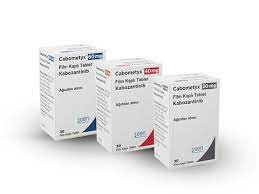
Product name:Cabometyx
Other names: Cabozantinib, Carbozantinib, Cabozantinib
2. Indications:
1. Renal cell carcinoma (RCC): Cabozantinib is suitable for the treatment of patients with advanced renal cell carcinoma; combined with nivolumab is suitable for the first-line treatment of patients with advanced renal cell carcinoma.
2. Hepatocellular carcinoma (HCC): Cabozantinib is suitable for the treatment of patients with hepatocellular carcinoma who have previously received sorafenib treatment.
3. Differentiated thyroid cancer (DTC): Cabozantinib is indicated for the treatment of adult and pediatric patients 12 years of age and older with locally advanced or metastatic differentiated thyroid cancer who have progressed after prior VEGFR-targeted therapy and are ineffective or ineligible for radioactive iodine therapy.
3. Usage and dosage:
1. Medication management: Do not take cabozantinib with food. Give cabozantinib at least 1 hour before or 2 hours after eating. Stop cabozantinib treatment at least 3 weeks before planned surgery (including dental surgery). Do not use cabozantinib capsules instead of cabozantinib tablets.
2. Recommended dosage:
(1) Renal cell carcinoma (RCC): The recommended dose of cabozantinib as a single agent is 60 mg once daily until disease progression or unacceptable toxicity occurs, and at the recommended dose. When administered in combination with nivolumab, the recommended dose of cabozantinib is 40 mg once daily and 240 mg of nivolumab every 2 weeks or 480 mg (30-minute intravenous infusion) every 4 weeks until disease progression or unacceptable toxicity occurs, and nivolumab continued for up to 2 years.
(2)Hepatocellular carcinoma (HCC) : The recommended single-agent dose of cabozantinib is 60 mg once daily until disease progression or unacceptable toxicity.
(3)Differentiated thyroid cancer (DTC) : For adult and pediatric patients 12 years and older with BSA ≥1.2m2, the recommended dose of cabozantinib as a single agent is 60 mg once daily. For pediatric patients 12 years and older with BSA <1.2 m2, the recommended dose is 40 mg once daily until disease progression or unacceptable toxicity.
3. Dosage adjustment: Adverse reactions caused by cabozantinib treatment may require adjustment of the drug dose under the guidance of a doctor. For adults and children aged 12 years and above with BSA ≥ 1.2m2, the first dose is reduced to 40 mg once a day, and the second dose is reduced to 20 mg once a day; for In patients combined with nivolumab, or in children 12 years and older with BSA <1.2m2, the first dose is reduced to 20 mg once daily, and the second dose is reduced to 20 mg every other day. If the lowest dose was previously received, resume the same dose. If the lowest dose is not tolerated, discontinue cabozantinib.
(1) Coadministration with strong CYP3A4 inhibitors: Reduce the daily dose of cabozantinib by 20 mg (e.g., for pediatric patients with BSA <1.2 m2, reduce from 60 mg to 40 g daily or from 40 mg to 20 mg daily or from 20 mg daily to 20 mg every other day). Resume the strong CYP3A4 inhibitor at the same dose 2 to 3 days after discontinuing the strong CYP3A4 inhibitor.
(2) Coadministration with strong CYP3A4 inducers: Increase the daily cabozantinib dose by 20 mg as tolerated (e.g., from 60 mg to 80 mg daily or from 40 mg to 60 mg daily). After 2 to 3 days of discontinuing the strong inducer, resume the dose used before initiating the strong CYP3A4 inducer. The daily dose should not exceed 80mg.
(3 Patients with hepatic impairment: For patients with moderate hepatic impairment (Child-Pugh class B), reduce the starting dose of cabozantinib from 60 mg daily to 40 mg daily or from 40 mg daily to 20 mg daily (applicable to pediatric patients with BSA <1.2 m2).
4. Adverse reactions:
In clinical studies of cabozantinib in the treatment of renal cell carcinoma, the adverse reactions (≥25%) that occurred were diarrhea, fatigue, nausea, decreased appetite, palmar-plantar paresthesia (PPE), hypertension, vomiting, weight loss and constipation. In clinical studies for the treatment of hepatocellular carcinoma, the adverse reactions (≥25%) that occurred were diarrhea, decreased appetite, PPE, fatigue, nausea, hypertension and vomiting; in the clinical studies of the treatment of differentiated thyroid cancer, the adverse reactions that occurred (≥25%) were diarrhea, PPE, fatigue, hypertension and stomatitis. Adverse events such as aneurysm, dissection, and rupture of arteries (including aorta) have also occurred after cabozantinib was marketed.
5. Storage:
Store Cabozantinib20°C to 25°C (68°F to 77°F); deviations of 15°C to 30°C (59°F to 86°F) allowed.
6. Special groups:
1. Women: According to the results of animal studies, cabozantinib may damage the fertility of female and male animals with reproductive potential, and cabozantinib taken by pregnant women can cause harm to the fetus. Therefore, it is recommended that women of childbearing potential use effective contraception during treatment and for 4 months after the last dose; women are advised not to breastfeed during treatment and for 4 months after the last dose.
7. Mechanism of action:
In vitro biochemistry and/or cellular assays show that cabozantinib inhibits the tyrosine kinase activity of MET, VEGFR-1, -2 and -3, AXL, RET, ROS1, TYRO3, MER, KIT, TRKB, FLT-3 and TIE-2. These receptor tyrosine kinases are involved in normal cellular functions and pathological processes, such as tumorigenesis, metastasis, tumor angiogenesis, drug resistance, and maintenance of the tumor microenvironment.
[ 免责声明 ] 本页面内容来自公开渠道(如FDA官网、Drugs官网、原研药厂官网等),仅供持有医疗专业资质的人员用于医学药学研究参考,不构成任何治疗建议或药品推荐。所涉药品可能未在中国大陆获批上市,不适用于中国境内销售和使用。如需治疗,请咨询正规医疗机构。本站不提供药品销售或代购服务。


