
.jpeg)
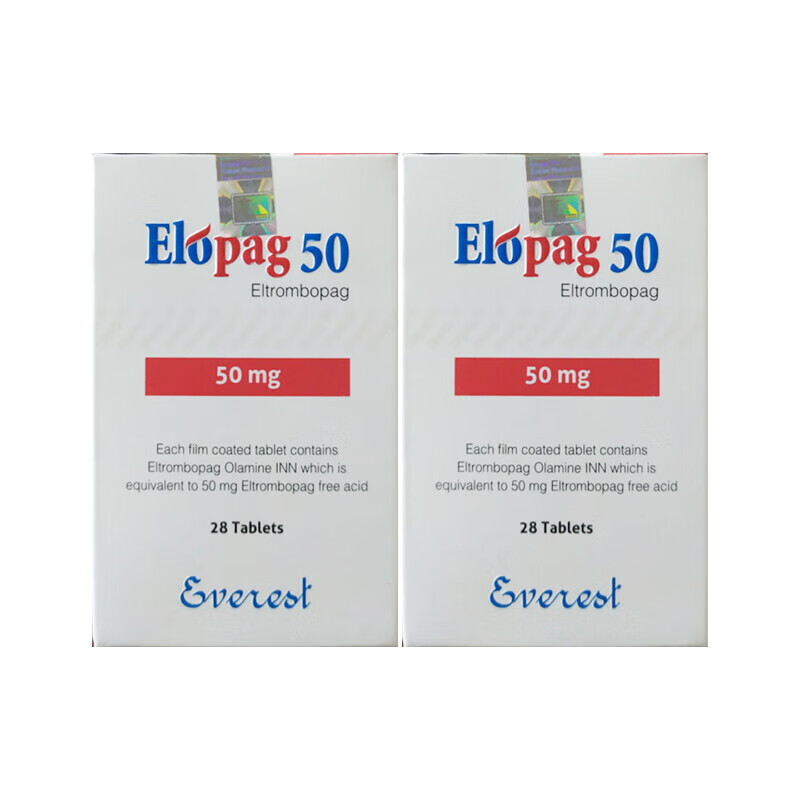
Eltrombopag instructions
一.Common name: Eltrombopag ethanolamine tablets
All names: Eltrombopa,Eltrombopa, Eltrombopa,Eltrombopa
2. Indications
1.For the treatment of adults aged 1 and above with persistent or chronic immune thrombocytopenia (ITP) In human and pediatric patients with thrombocytopenia who have an inadequate response to corticosteroids, immunoglobulins, or splenectomy, eltrombopag should be used only in patients with ITP whose degree of thrombocytopenia and clinical condition increase the risk of bleeding;
2.Eltrombopag is indicated for the treatment of thrombocytopenia in patients with chronic hepatitis C to initiate and maintain interferon-based therapy.Eltrombopag should be used only in patients with chronic hepatitis C whose degree of thrombocytopenia prevents initiation of interferon therapy or limits the ability to maintain interferon therapy;
3.Eltrombopag is used in combination with standard immunosuppressive therapy as first-line treatment for adults and children 2 years and older with severe aplastic anemia;
4.Eltrombopag is indicated for the treatment of patients with severe aplastic anemia who have had an inadequate response to immunosuppressive therapy.
Usage restrictions:
Eltrombopagis not indicated for the treatment of patients with myelodysplastic syndrome(MDS).
The safety and effectiveness of concomitant use with interferon-free direct-acting antivirals for the treatment of chronic hepatitis C infection have not been established.
Three.Dosage and usage
1.Take eltrombopagwithout mealsor take low-calcium drugs(≤ 50 mg) with meals. At least 2 before taking any medicine or product that contains polyvalent cations(such as antacids, calcium-rich foods, and mineral supplements)hours or at least 4hours after taking eltrombopag.
2.Persistent or chronicITP:For most adult and pediatric patients 6 years of age and older, start with eltrombopag at 50 mg once daily. For pediatric patients 1 to 5 years of age, initiate 25 mg of eltrombopag once daily. Patients with hepatic impairment and some patients of East Asian/Southeast Asian ancestry may require reduced dosage. Adjust to maintain platelet count greater than or equal to 50 x 109/L. Do not exceed 75mg per day.
3.Chronic hepatitis C-associated thrombocytopenia:Take 25 mg once daily for all patients. Adjust to achieve target platelet count required to initiate antiviral therapy. Do not exceed 100mg daily.
4.First-line severe aplastic anemia:While receiving standard immunosuppressive therapy, 2.5 mg/kg (2 to 5 years old ), 75 Initiate eltrombopag once daily at a dosage of 150 mg (in pediatric patients 6 to 11 years) or 150 mg (in patients 12 years and older). Reduce initial dose in patients of East Asian/Southeast Asian ancestry. Adjust dose based on toxicity or elevated platelet count.
5.Refractory severe aplastic anemia:Once a day, each time50mg. Reduce initial dose in patients with hepatic impairment or in patients of East Asian/Southeast Asian ancestry. Adjust to keep platelet count greater than 50 x 109/L. Do not exceed 150mg per day.
IV.Dosage form and strength
Tablets:12.5mg, 25mg, 50mg and 75mg
For oral suspension: 12.5mg and 25mg
Five. Contraindications
None
6. Warnings and Precautions
1Hepatic decompensation in patients with chronic hepatitis C
In patients with chronic hepatitis C, imipramine combined with interferon and ribavirin may increase the risk of hepatic decompensation. In two controlled clinical trials in patients with chronic hepatitis C and thrombocytopenia, ascites and encephalopathy occurred more frequently in the group receiving eltrombopag plus antiviral therapy (7%) than in the group receiving placebo plus antiviral therapy (4%). Low albumin level(less than3.5 Patients with g/dL) or Model for End-Stage Liver Disease (MELD) scores greater than or equal to 10 at baseline are at greater risk for hepatic decompensation when receiving eltrombopag plus antiviral therapy. If antiviral therapy is discontinued, discontinueeltrombopag.
2Hepatotoxicity
Eltrombopag may increase the risk of serious and potentially life-threatening hepatotoxicity. Treatment of ITP, chronic hepatitis C-associated thrombocytopenia, and refractory severe aplastic anemia: Before initiating eltrombopag, every time during the dose adjustment phase Measure serum ALT, AST, and bilirubin once every 2 weeks, and once a month after a stable dose is established.
3.The risk of death increases, and myelodysplastic syndrome progresses to acute myeloid leukemia. A randomized, double-blind, placebo-controlled, multicenter trial of patients with International Prognostic Scoring System (IPSS) grade 1, 2, or high-risk MDS with thrombocytopenia was limited by lack of efficacy. and safety reasons(including an increased risk of progression to acute myeloid leukemia(AML))The trial received azacitidine combined witheltrombopag (n = 179)or placebo(n = 177)Treatment. Patients received eltrombopag or placebo at a starting dose of 200 mg once daily and a maximum dose of 300 mg once daily in combination with azacitidine for at least 6 cycles. The incidence of death was 32% (57/179) in the eltrombopag group and 29% (51/177) in the placebo group (HR[95% CI]= 1.42 [0.97, 2.08], indicating a 42% increased relative risk of death in the eltrombopag group in this trial. The incidence of progression to AML was 12% (21/179) in the eltrombopag group and 6% (10/177) in the placebo group (HR[95% CI]= 2.66 [1.31, 5.41], indicating that the relative risk of progression to AML in this trial was increased by 166%) in the eltrombopag group.
4.Thrombus formation/Thromboembolic complications. Thrombus formation/Thromboembolic complications may be caused by an increase in the platelet count caused by eltrombopag. Thromboembolic/Reported thromboembolic complications include venous and arterial events and have been observed with both low and normal platelet counts. For patients with known thromboembolic risk factors(such as coagulation factorV The possibility of an increased risk of thromboembolism should be considered when using eltrombopag in patients with Leiden, ATIII deficiency, antiphospholipid syndrome, and chronic liver disease). To minimize the risk of thrombotic/thromboembolic complications, do not useeltrombopag in an attempt to normalize platelet counts. Follow dosage adjustment guidelines to achieve and maintain target platelet count.
5.Cataract. Cataracts were observed in toxicology studies of eltrombopag in rodents. Perform a baseline eye examination before usingeltrombopagand monitor patients periodically for signs and symptoms of cataracts during treatment witheltrombopag.
7. Adverse reactions
For chronicITPSide effects include upper respiratory tract infection(7-17%), nasopharyngitis(12%), headache(10%), nausea(4-9%)
, cough(9%), diarrhea(9%), fever(9%), abdominal pain span>(8%), oropharyngeal pain(8%), toothache(6%), Vomiting(6%), urinary tract infection(5%), elevated alanine aminotransferase(5-6%)(5-6%) pan>, ASTelevated(4-5%), myalgia(5%), cataract(5%), fatigue(5%), rash(3-5% ), increased blood bilirubin(4%), oropharyngeal pain(4%), pharyngitis< span>(4%), runny nose(4%), hyperbilirubinemia(3%), back pain< /span>(3%), influenza(3%), paresthesia(3%).
Side effects of chronic hepatitis C include anemia(40%), fever(30%), fatigue(28%), headache(21%), nausea(19%), diarrhea(19%), decreased appetite(18%), influenza-like illness(18%)< /span>, insomnia(16%), weakness(16%), cough(15%), itching(15%)< /span>, chills(14%), myalgia(12%), alopecia(10%), peripheral edema(10%).
Side effects of severe aplastic anemia include increased alanine aminotransferase(29%)/increased AST(17%) and increased blood bilirubin (17%), rash(8%), skin discoloration including hyperpigmentation(5%).
Eight.Drug Interactions
1.Polyvalent cations (chelating). Take eltrombopag at least 2 hours before or at least 4 hours after taking any drug or product containing polyvalent cations (such as antacids, dairy products, and mineral supplements) to avoid significant reduction in eltrombopag absorption due to chelation.
2.When taking eltrombopag concurrently with drugs that are OATP1B1 substrates(For example, atorvastatin, bosentan, ezetimibe, fluvastatin, glibenclamide, olmesartan, pitavastatin, pravastatin, rosuvastatin, repaglinide, rifampicin, simvastatin acid,SN- 38[Active metabolite of irinotecan], valsartan)or breast cancer resistance protein< span>(BCRP)(For example, imatinib, irinotecan, lapatinib, methotrexate, mitoxantrone, rosuvastatin, sulfasalazine, topotecan)Use caution when administering. Monitor patients closely for signs and symptoms of overexposure to drugs that are substrates of OATP1B1 or BCRP and consider reducing the dosage of these drugs if appropriate. In clinical trials of eltrombopag, it was recommended that the dose of rosuvastatin be reduced by 50%.
3.Protease inhibitors
HIVProtease inhibitors:No dose adjustment is recommended when eltrombopag is coadministered with lopinavir/ritonavir(LPV/RTV). Drug interactions with otherHIVprotease inhibitors have not been evaluated.
Hepatitis C virus protease inhibitors: WheneltrombopagwithboceprevirortelaprevirDose adjustment is not recommended when used together. Drug interactions with other hepatitis C virus (HCV) protease inhibitors have not been evaluated.
4.Peginterferonα-2a/bTherapy
No dose adjustment is recommended when eltrombopag is coadministered with pegylated interferonα-2a (PEGASYS).
9. Used by specific groups of people
Lactation:It is recommended not to breastfeed.
There are generic drugs overseas, and each box costs about 400 to 1,000 yuan. If you want to get more high-quality information, you can contact YaDE. YaDE will do its best to learn more about high-quality overseas drugs for you.
[ 免责声明 ] 本页面内容来自公开渠道(如FDA官网、Drugs官网、原研药厂官网等),仅供持有医疗专业资质的人员用于医学药学研究参考,不构成任何治疗建议或药品推荐。所涉药品可能未在中国大陆获批上市,不适用于中国境内销售和使用。如需治疗,请咨询正规医疗机构。本站不提供药品销售或代购服务。


