
.jpeg)
Must-read for patients: Overview of basic information on Platinib’s Chinese instructions
1. Generic name: pralsetinib, Pralsetinib
Product name:Gavreto, Phukethua
Other names: Praxitinib, Praxitinib,BLU-667
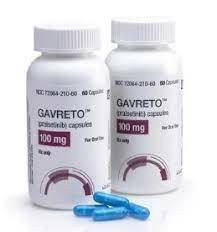
2. Who can take Platinib? Indications?
1. Metastatic RET fusion-positive non-small cell lung cancer (NSCLC) cancer: Pralsetinib is suitable for the treatment of adult patients with metastatic RET fusion-positive non-small cell lung cancer.
2. RET fusion-positive thyroid (TC) cancer: Platinib is indicated for the treatment of adult and pediatric patients 12 years of age and older with advanced or metastatic RET fusion-positive thyroid cancer that requires systemic therapy and is refractory to radioactive iodine (if radioactive iodine is appropriate).
3. What are the side effects of Platinib?
In clinical studies, the most common adverse reactions (≥25%) of platinib were musculoskeletal pain, constipation, hypertension, diarrhea, fatigue, edema, pyrexia, and cough.
4. How should you take Platinib?
For patients who choose to receive Platinib treatment due to the presence of RET gene fusion (NSCLC or thyroid cancer), the recommended dose is 400mg, once daily, taken on an empty stomach, and should not eat for at least 2 hours before taking the drug or at least 1 hour after taking the drug. If the condition worsens, treatment will be continued until unacceptable toxicity is reached.
If you miss a dose of Platinib, take it as soon as possible that day. Resume your normal daily dosing schedule the next day. If you experience vomiting after taking a medicine, do not take another medicine but continue taking the following medicines as planned.
5. How to store Platinib?
Platinib 100 mg is a light blue, opaque, fast-release, hydroxypropyl methylcellulose (HPMC) hard capsule. Store at 20-25°C (68-77°F), away from moisture and children.
6. How does platinib work?
Platinib was developed by screening more than 10,000 design-agnostic kinase inhibitors and then undergoing extensive chemical modifications to improve their properties. It is this specific inhibition of the RET enzyme that is associated with anti-tumor activity and clinical benefit in patients. Despite its increased selectivity for RET compared with other kinases, platinib has been reported to inhibit DDR1, TRKC, FLT3, JAK1-2, TRKA, VEGFR2, PDGFRb, and FGFR1-2 at clinically relevant concentrations. The significance of these findings is uncertain.
7. What will happen if you take too much Platinib?
After platinib was administered to rats at a dose of 20 mg/kg (approximately 2.5-3.6 times the recommended human exposure), 92% of the littermates of pregnant female mice were absorbed (82% complete absorption); reabsorption occurred at doses as low as 5 mg/kg (0.3 times the recommended human exposure). Both male and female rats given pramisitinib at doses of 10 mg/kg or higher experienced observable degeneration of the testes/ovaries. In a 28-day study in rats and monkeys, once-daily platinib caused tissue necrosis at doses 1.1 times or more times the recommended human dose and myocardial hemorrhage at doses 2.6 times or more the recommended human dose. In addition, platinib induces hyperphosphatemia (in rats only, at doses 2.4-3.5 times the recommended human dose) and multi-organ mineralization (at doses 0.11 times or more the recommended human dose).
[ 免责声明 ] 本页面内容来自公开渠道(如FDA官网、Drugs官网、原研药厂官网等),仅供持有医疗专业资质的人员用于医学药学研究参考,不构成任何治疗建议或药品推荐。所涉药品可能未在中国大陆获批上市,不适用于中国境内销售和使用。如需治疗,请咨询正规医疗机构。本站不提供药品销售或代购服务。


